
Scent notes explained: How perfume layers work in 2026

TL;DR:
- Perfumes are structured with top, middle, and base notes that evolve over time.
- Fragrance pyramids show how scents unfold from fresh at first to deep and warm.
- Understanding scent notes enhances perfume shopping and suits personal chemistry.
You spray a perfume and love it instantly. Then, an hour later, it smells completely different on your skin. That’s not a flaw. It’s by design. Every fragrance is a carefully structured composition built from scent notes, individual aromatic ingredients that release at different rates and create a living, evolving scent experience. Understanding how these notes work changes everything about how you shop for, wear, and enjoy fragrance. This guide walks you through the full picture, from the first spritz to the final dry-down, so you can make smarter, more confident choices.
Table of Contents
- What are scent notes? Understanding perfumery’s building blocks
- How do scent notes evolve? The fragrance pyramid explained
- Scent notes in action: Comparing fragrances and their unique blends
- Choosing and exploring fragrances using scent notes
- Why scent notes matter more than ever: A modern perspective
- Explore, sample, and master your scent experience
- Frequently asked questions
Key Takeaways
| Point | Details |
|---|---|
| Layered structure | Perfumes are crafted in top, middle, and base note layers that evolve over time. |
| Sampling matters | Testing scents across different note stages helps you find the right fragrance. |
| Personal chemistry | Scent notes react uniquely with each person’s skin, so results will vary. |
| Informed choices | Understanding scent notes empowers smarter fragrance buying and layering decisions. |
What are scent notes? Understanding perfumery’s building blocks
Scent notes are the individual aromatic components that make up a fragrance. Think of them the way you’d think about chords in music. Each note plays its part, and together they create something richer than any single ingredient could achieve alone. According to fragrance note composition, perfumes are organized into three tiers: top notes, middle notes, and base notes.
Top notes are what you smell the moment you apply a fragrance. They’re bright, fresh, and designed to make a strong first impression. The catch? They evaporate fast, usually within 15 to 30 minutes.
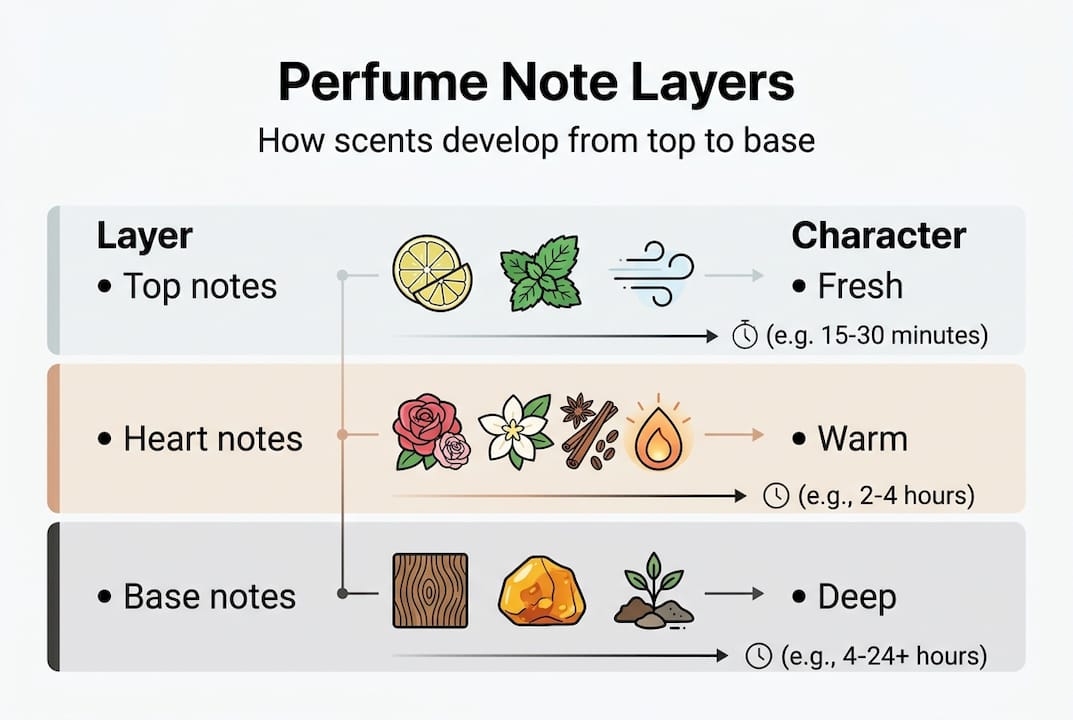
Middle notes (also called heart notes) emerge once the top notes fade. These define the true character of a fragrance and typically last 2 to 4 hours. They’re the emotional core of the scent.
Base notes are the foundation. They’re rich, deep, and slow to develop, but they’re also the most long-lasting, often lingering on skin for 6 hours or more.
Here are common examples for each tier:
- Top notes: Bergamot, lemon, grapefruit, pink pepper, green tea
- Middle notes: Rose, jasmine, lavender, geranium, cinnamon
- Base notes: Sandalwood, musk, vanilla, amber, vetiver, cedarwood
How popular perfumes are structured by notes
| Perfume | Top notes | Middle notes | Base notes |
|---|---|---|---|
| Chanel No. 5 | Aldehydes, neroli, ylang-ylang | Rose, jasmine, iris | Sandalwood, vetiver, musk |
| Dior Sauvage | Bergamot, pepper | Lavender, geranium | Ambroxan, cedarwood |
| YSL Black Opium | Pink pepper, pear | Coffee, jasmine | Vanilla, patchouli, white musk |
“Each tier of scent notes serves a distinct purpose: top notes attract, heart notes define, and base notes anchor. Together, they tell a complete olfactory story.”
Recognizing this structure helps you look past the opening impression and evaluate a fragrance for what it truly is.

How do scent notes evolve? The fragrance pyramid explained
With the basics established, let’s explore how these scent notes interact and change on your skin over time.
The fragrance pyramid is a visual model that shows how a perfume unfolds in stages. It’s not just a diagram. It’s a timeline. Perfumes are built in layers that unfold over time as top, heart, and base notes each take their turn in the spotlight.
Here’s how the timeline typically plays out:
- 0 to 15 minutes: Top notes dominate. You get the immediate burst of citrus, spice, or freshness that drew you in at the store.
- 15 to 30 minutes: Top notes begin fading. The transition phase starts, and you may notice a brief awkward moment as heart notes start to emerge.
- 30 minutes to 2 hours: Heart notes take over. This is the true personality of the fragrance. Floral, woody, spicy, or gourmand profiles become clear.
- 2 to 6+ hours: Base notes settle in. The scent becomes warmer, deeper, and more intimate. This is the dry-down phase.
Fragrance evolution timeline
| Time after application | Dominant note profile | Typical character |
|---|---|---|
| 0 to 15 min | Top notes | Fresh, bright, sharp |
| 15 to 45 min | Top to heart transition | Evolving, sometimes softer |
| 45 min to 3 hrs | Heart notes | Floral, spicy, or aromatic |
| 3 to 8+ hrs | Base notes | Warm, rich, skin-like |
Pro Tip: Never judge a fragrance at the counter based on the first spray. Wear it for at least an hour before deciding. The dry-down is where a perfume reveals its real self.
Personal chemistry matters too. Skin temperature, hydration, and even diet can speed up or slow down how quickly notes evolve. That’s why exploring perfume notes on your own skin is far more reliable than sniffing a test strip.
Scent notes in action: Comparing fragrances and their unique blends
Now that you know how scent notes evolve, let’s put theory into practice by comparing how different perfumes are architected.
Not every fragrance follows the classic three-tier pyramid. Some perfumes are intentionally linear, meaning they smell roughly the same from start to finish. Others are built to surprise, with dramatic shifts between phases. Each fragrance’s uniqueness comes directly from the blend and balance of its scent notes.
Here’s how the two main structures differ:
- Pyramid fragrances: Designed to evolve through all three tiers. Examples include most classic Chanel and Dior releases. The experience changes meaningfully over time.
- Linear fragrances: The scent stays consistent from application to dry-down. Many modern minimalist and skin-scent perfumes work this way. They’re predictable, which some people love.
- Soliflore fragrances: Built around a single dominant note (like pure rose or pure oud), with supporting notes kept very subtle.
- Layered or blended wearing: Using fragrance layering techniques to combine two perfumes creates a custom note profile that neither fragrance has alone.
Note breakdown comparison: Two contrasting styles
| Perfume | Structure type | Top | Heart | Base |
|---|---|---|---|---|
| Tom Ford Black Orchid | Pyramid | Truffle, bergamot | Black orchid, spice | Patchouli, vanilla, sandalwood |
| Byredo Gypsy Water | Near-linear | Bergamot, lemon | Juniper, pine needles | Sandalwood, vanilla, amber |
The fragrance industry has seen an explosion of new scent combinations over the past decade. The number of new fragrance launches globally has grown by over 30% since 2015, with niche houses experimenting with unconventional ingredients like ink, concrete, and smoke.
This means two perfumes can share the same note names on paper but smell completely different in practice. The ratio, quality, and source of each ingredient all shift the outcome. Reading note lists is a starting point, not the full picture.
Choosing and exploring fragrances using scent notes
Understanding scent notes’ role in fragrances helps, but how do you actually use this knowledge when shopping or sampling? Here’s how to put it into practice.
Sampling and comparing scent notes before buying a full bottle is one of the smartest moves you can make as a fragrance buyer. A full bottle is a commitment. Sampling is how you avoid expensive regret.
Here’s a practical step-by-step approach for exploring notes effectively:
- Read the note pyramid first. Before you smell anything, check what the top, heart, and base notes are. This sets your expectations and helps you notice each phase.
- Spray on skin, not paper. Paper strips distort the scent. Your skin’s warmth and chemistry are what actually matter.
- Wait before judging. Give the fragrance at least 30 to 45 minutes. Let the heart notes emerge before forming an opinion.
- Smell different categories. Try a floral, a woody, and an oriental fragrance side by side. Contrast helps you identify what you actually enjoy.
- Use ways to sample scent notes through curated sample sets. Sampling multiple fragrances together gives you direct comparison without the cost of full bottles.
Pro Tip: If you love a fragrance’s base notes but find the opening too sharp, try applying it to clothing instead of skin. Fabric slows down the evaporation of top notes, giving you a gentler transition.
Layering is another tool worth exploring. Wearing a lighter citrus fragrance over a deep musk base can create a note profile that neither perfume achieves alone. It’s a low-cost way to experiment with custom scent combinations before committing to a single bottle.
Why scent notes matter more than ever: A modern perspective
Here’s something most fragrance articles won’t tell you: the average person still judges a perfume in the first 10 seconds. That’s a problem, because those 10 seconds only reveal the top notes, the most fleeting and least representative part of the entire composition.
We’re living through a fragrance renaissance. Niche houses are launching hundreds of new scents every year, and the line between mainstream and artisan has blurred significantly. With so many options, scent literacy, meaning the ability to read, understand, and evaluate fragrance structure, is now a genuine advantage.
Fragrance is no longer just about smelling good. It’s about identity, memory, and personal storytelling. The base notes you wear all day are the ones that linger in a room after you leave. They’re the notes people associate with you. That’s worth understanding deeply.
Exploring personalized fragrance blending is one way to move beyond wearing what’s popular and start building a scent signature that’s genuinely yours. The people who get the most out of fragrance are the ones who slow down, sample widely, and pay attention to how a scent evolves rather than just how it opens.
Explore, sample, and master your scent experience
Ready to apply your new knowledge and discover what’s right for you? The best way to build scent literacy is to actually smell things, lots of things, side by side.
At Befrsh.com, you can browse sample fragrance sets that let you compare note profiles across multiple fragrances before committing to a full bottle. Want to experience a well-crafted pyramid fragrance firsthand? Dior Sauvage Elixir is a great starting point. It moves from sharp pepper and bergamot through a rich lavender heart into a deep, woody amber base. Or simply discover more fragrances across niche and iconic collections to find your next signature scent.
Frequently asked questions
What are fragrance top notes?
Top notes are the first scents you smell after applying a perfume, typically light and fresh, but they evaporate quickly within 15 to 30 minutes.
How long do scent notes last on the skin?
Top notes fade within minutes, heart notes last for hours, and base notes linger the longest, sometimes throughout the entire day depending on skin type and conditions.
Can I mix different perfumes with distinct notes?
Yes, fragrance layering lets you blend different scent notes for a personalized result, but testing combinations on your skin first is key for finding harmony.
Why does the same perfume smell different on me?
Skin chemistry, environment, and even diet impact how scent notes develop, leading to unique results for every wearer, which is exactly why sampling on your own skin matters.