How to choose perfume samples for confident picks in 2026

Buying a full bottle of perfume without proper testing is one of the costliest mistakes fragrance shoppers make. You spray it once in the store, fall in love with the top notes, then discover at home that it smells completely different on your skin or fades within an hour. Perfume samples solve this problem by letting you test scents over several days, experience how they evolve on your unique skin chemistry, and make confident decisions before investing in a full bottle.
Table of Contents
- Prerequisites: What You Need Before Testing Perfume Samples
- Understanding Your Skin Chemistry And Fragrance Interaction
- Step-By-Step Guide To Testing Perfume Samples Effectively
- Matching Perfume Samples To Personality And Lifestyle
- Common Mistakes And How To Avoid Them
- Where And How To Buy Authentic Perfume Samples Conveniently
- Expected Outcomes And Success Metrics For Choosing Perfume Samples
- Explore Authentic Perfume Samples At Be Frsh
Key takeaways
| Point | Details |
|---|---|
| Proper sampling reduces blind buying risk | Testing perfume samples on your skin over multiple wears prevents costly regrets and returns. |
| Skin chemistry alters fragrance significantly | Your skin’s pH and oil levels change how perfume smells and lasts, making skin testing essential. |
| Limit daily testing to avoid fatigue | Test only one or two samples per day to maintain accurate scent perception and avoid olfactory overload. |
| Match samples to your lifestyle | Choose fragrance families and notes aligned with your personality, daily activities, and preferred occasions. |
| Buy from authenticated sources only | Purchase samples from reputable retailers to ensure genuine products and avoid counterfeit scents. |
Prerequisites: What you need before testing perfume samples
Successful perfume sampling starts with the right tools and mindset. You can’t evaluate fragrances accurately without proper preparation, and skipping these basics leads to misleading impressions.
First, identify reliable sample sources. Counterfeit perfumes flood online marketplaces, and fake samples smell nothing like authentic versions. Stick with specialty retailers that guarantee authenticity and offer transparent sourcing information.
Prepare your skin properly before any testing session. Clean skin free of lotions, oils, or other fragrances provides a neutral canvas. Moisturize with an unscented lotion about 15 minutes before applying samples, as hydrated skin holds scent molecules better and reveals truer fragrance development.
Gather these essential tools:
- Unscented blotter strips for preliminary sniff tests
- A fragrance journal or smartphone app to record impressions
- Coffee beans to reset your nose between samples
- Clean cotton swabs for precise application
- A water bottle to stay hydrated during testing
Patience ranks as your most valuable asset. Perfumes reveal their full character over hours, not minutes. Rushing through samples guarantees you’ll miss heart and base notes that define the fragrance experience. Plan to wear each sample for at least six hours, ideally across multiple days, before making any purchase decisions.
| Tool | Purpose | Why it matters |
|---|---|---|
| Blotter strips | Initial scent preview | Lets you screen fragrances before committing skin space |
| Fragrance journal | Track detailed impressions | Enables comparison across multiple wears and samples |
| Coffee beans | Palate cleanse for nose | Resets olfactory receptors between different scents |
| Unscented moisturizer | Skin preparation | Enhances scent projection and longevity |
Understanding your skin chemistry and fragrance interaction
Your skin transforms perfume in ways paper strips never can. Two people wearing identical fragrances smell completely different because of individual skin chemistry variations.

Skin pH levels range from 4.5 to 6.5, creating acidic or alkaline environments that interact with fragrance molecules. Acidic skin tends to amplify citrus and floral notes while softening woody bases. Alkaline skin does the opposite, muting bright top notes while enhancing deeper accords.
Natural skin oils play an equally crucial role. Oily skin grabs and holds fragrance molecules longer, extending wear time but sometimes intensifying projection. Dry skin releases scent faster, requiring more frequent reapplication but offering subtler sillage. Testing samples on moisturized skin improves scent longevity and true note development.
Temperature affects how perfume evolves on your body. Pulse points like wrists, neck, and inner elbows radiate heat that volatilizes fragrance molecules faster, creating stronger initial projection. Cooler application sites like forearms release scent more gradually.
“Skin chemistry acts as an invisible modifier, turning the same perfume into distinctly personal signatures on different wearers.”
Paper strips show you only the fragrance in isolation. They can’t replicate the complex chemical dance between perfume and your unique biology. A scent that smells divine on paper might turn sour on your skin, or vice versa. This explains why testing on actual fragrance skin chemistry provides the only reliable evaluation method.
Hydration status matters too. Well moisturized skin creates a stable base that lets middle and base notes bloom properly. Dehydrated skin absorbs fragrance erratically, distorting the intended scent profile and cutting longevity by up to 30%.
Step-by-step guide to testing perfume samples effectively
Methodical sampling transforms guesswork into confident fragrance selection. Follow this proven process to evaluate perfumes accurately.
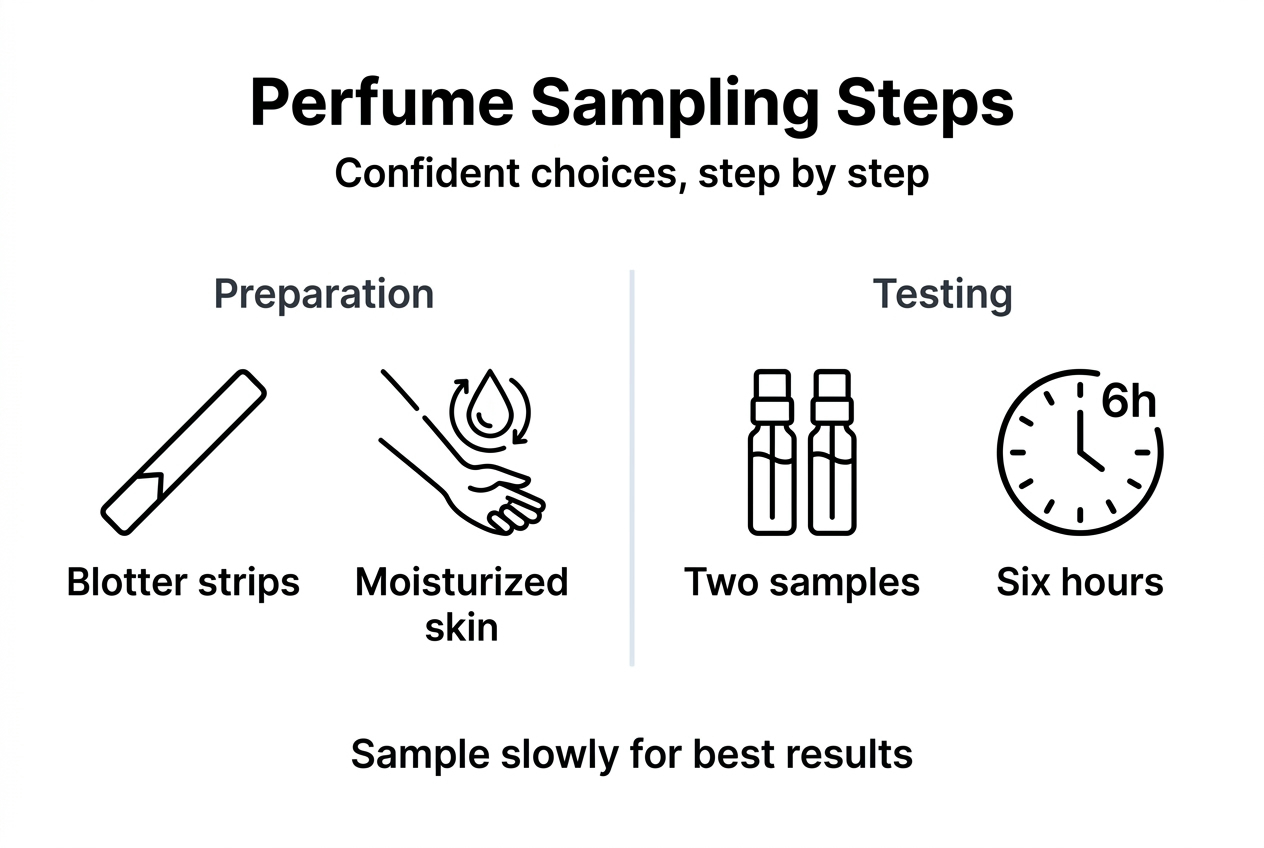
Start with clean, moisturized pulse points. Apply unscented lotion to your wrists and inner elbows 15 minutes before testing. This preparation enhances both projection and longevity without interfering with the fragrance itself. Moisturizing skin before spraying perfume samples can alter the scent profile by enhancing certain notes and improving longevity.
Here’s your complete sampling protocol:
- Spray one sample on your left wrist, another on your right if testing two scents
- Wait 15 minutes before smelling to let alcohol evaporate and top notes settle
- Sniff each wrist separately every 30 minutes for the first two hours
- Record immediate impressions in your journal with timestamps
- Go about your normal activities while wearing the samples
- Check the scent again at the four hour mark to evaluate heart notes
- Final assessment comes at six to eight hours when base notes dominate
- Repeat this process on different days to confirm consistency
Limit yourself to two samples maximum per day. Your nose fatigues quickly when processing multiple competing scents, leading to confused impressions and poor decisions. Testing more samples seems efficient but guarantees inaccurate results.
Document everything. Note how the opening smells, which notes emerge during the heart phase, how long projection lasts, and your emotional response throughout. These details prove invaluable when comparing testing perfume samples effectively across multiple candidates.
Pro Tip: Smell the sample on your wrist, then smell your other unscented wrist immediately after. This contrast helps your brain isolate the fragrance notes more clearly than smelling the perfume alone.
Never judge a perfume testing method based solely on the first 20 minutes. Top notes vanish quickly, revealing completely different middle and base accords that define your actual wearing experience. The scent you smell at hour five matters far more than the initial spray.
Matching perfume samples to personality and lifestyle
Your perfect fragrance reflects who you are and how you live. Strategic sample selection narrows thousands of options to genuinely compatible matches.
Fragrance families provide your starting framework. Fresh citrus scents suit energetic, outdoorsy personalities. Floral bouquets appeal to romantic, expressive types. Oriental spicy fragrances match bold, confident individuals. Woody aromatics complement grounded, sophisticated tastes. Understanding these broad categories focuses your sampling efforts on relevant territory.
Consider your daily environment when choosing samples:
- Office workers need subtle, professional scents that won’t overwhelm colleagues
- Creative professionals can explore bolder, more distinctive fragrances
- Active lifestyles demand lighter compositions that perform well during movement
- Evening social settings accommodate richer, more complex perfumes
Personality traits map surprisingly well to fragrance notes. Introverts often prefer quiet, skin close scents with soft sillage. Extroverts gravitate toward louder perfumes with strong projection. Detail oriented people appreciate complex compositions with multiple evolving layers. Spontaneous personalities enjoy straightforward, immediately gratifying fragrances.
Versatility matters for practical fragrance wardrobes. A sample that smells perfect for Saturday night might prove too heavy for Tuesday morning meetings. Test candidates in contexts matching your intended use. Wear office appropriate samples during actual work days. Save evening scent testing for weekends when you’re relaxed and social.
Seasonal appropriateness influences satisfaction too. Light citrus and aquatic notes shine in summer heat but disappear in winter cold. Rich amber and vanilla bases that feel suffocating in July provide comforting warmth in January. Sample testing across different weather conditions reveals these seasonal performance differences.
Your existing wardrobe offers clues about compatible fragrances. People who favor minimalist black clothing often prefer clean, understated scents. Those who love bold colors and patterns typically enjoy equally expressive perfumes. Fashion and fragrance choices stem from the same aesthetic sensibilities.
Common mistakes and how to avoid them
Even experienced fragrance enthusiasts make sampling errors that compromise their evaluations. Recognizing these pitfalls protects your decision making process.
Premature judgment tops the mistake list. Falling in love with top notes before experiencing the full dry down leads to buyer’s remorse when those fleeting opening accords vanish within an hour. The perfume you actually wear lives in the heart and base notes that emerge after 30 minutes. Always complete the full six to eight hour testing cycle before forming opinions.
Olfactory fatigue from testing too many samples simultaneously ruins your perception. Your nose can accurately distinguish only one or two fragrances per session. Beyond that limit, everything starts smelling similar or you lose the ability to detect subtle differences. Quality beats quantity in perfume sampling. Space testing sessions at least 24 hours apart for optimal accuracy.
Counterfeit samples represent a serious risk when buying from unverified sellers. Fake perfumes contain different ingredients that smell completely wrong, leading you to reject authentic versions of fragrances you might actually love. Purchase only from established retailers with authentication guarantees and transparent sourcing. The small savings from sketchy deals cost you far more in wasted time and misleading experiences.
Here’s what to avoid:
- Deciding before the dry down completes
- Testing more than two samples in one day
- Buying from unauthorized or questionable sources
- Ignoring potential skin sensitivity or allergies
- Relying exclusively on paper strips for final decisions
Skin sensitivity deserves serious attention. Being aware of skin allergies and sensitivity to fragrance ingredients is necessary to avoid adverse reactions when sampling perfumes. Always perform a patch test on your inner forearm before applying any new sample to pulse points. Wait 24 hours to confirm no irritation develops.
Pro Tip: If you experience headaches, nausea, or skin irritation from a sample, wash it off immediately with soap and water. These reactions indicate ingredient sensitivities that won’t improve with continued exposure.
Paper strip dependence creates another common trap. Blotters serve perfectly for initial screening but tell you nothing about how a fragrance performs on your actual skin. The complex interaction between perfume and your body chemistry only happens during skin testing. Use paper strips to eliminate obvious mismatches, then commit to skin evaluation for serious candidates.
Where and how to buy authentic perfume samples conveniently
Finding legitimate sample sources protects you from counterfeits while providing convenient access to genuine fragrances. The right retailers make sampling affordable and reliable.
Specialty online stores focusing exclusively on fragrance samples offer the best combination of authenticity, selection, and service. These dedicated retailers curate their inventory carefully, verify supplier credentials, and guarantee product legitimacy. They understand perfume enthusiasts’ needs and provide detailed scent descriptions, usage guidance, and responsive customer support.
Look for these authentication markers:
- Physical business addresses and transparent contact information
- Detailed product sourcing explanations
- Customer reviews specifically mentioning authenticity
- Clear return and satisfaction policies
- Professional packaging and labeling
- Established online presence with history and reputation
Official brand discovery sets provide another reliable option. Many perfume houses now sell curated sample collections directly, guaranteeing authenticity while introducing you to their full range. These sets cost more per milliliter than third party samples but eliminate any authentication concerns.
Avoid marketplace sellers lacking verifiable credentials. Individual sellers on general e-commerce platforms may offer tempting prices, but you have no way to confirm their samples contain genuine products. Counterfeits flood these channels, and the modest savings disappear when you realize you tested fake perfumes.
| Source type | Authenticity confidence | Selection breadth | Convenience | Cost effectiveness |
|---|---|---|---|---|
| Specialty sample retailers | Very high | Excellent | Very high | High |
| Official brand discovery sets | Absolute | Limited to brand | High | Medium |
| Department store samples | Very high | Good | Medium | Low |
| Marketplace individual sellers | Low to medium | Variable | High | Appears high but risky |
Shipping reliability and customer service quality matter as much as authenticity. Reputable sample retailers pack products carefully to prevent leakage, ship promptly with tracking, and respond quickly to any issues. Poor service creates frustrating delays when you’re eager to test new fragrances.
Consider the total cost equation beyond per sample pricing. Sampling costs far less than blind buying full bottles that end up unused. A $30 investment in five samples that helps you identify one perfect fragrance saves you from three $100 bottles sitting untouched in your drawer. Sample purchasing represents insurance against expensive mistakes.
Expected outcomes and success metrics for choosing perfume samples
Proper sampling produces measurable improvements in your fragrance selection confidence and satisfaction. These concrete outcomes validate your investment in the testing process.
You’ll identify fragrances that genuinely resonate with your personality and preferences rather than buying based on advertising or fleeting first impressions. This emotional connection means you actually wear your purchases regularly instead of letting them gather dust. A fragrance that still delights you after three full day wears passes the authenticity test.
Returns and regrets decrease dramatically when you commit to thorough sampling. Most perfume returns happen because buyers purchased based on brief store testing or online descriptions without skin evaluation. Comprehensive sample testing before buying eliminates this guesswork, cutting your return rate to nearly zero.
Your fragrance collection becomes more focused and intentional:
- Each bottle serves a distinct purpose or occasion
- You regularly wear everything you own
- No impulse purchases languish unused
- Every fragrance genuinely suits your skin chemistry
- Your collection reflects your authentic taste, not marketing influence
Knowledge accumulation represents another valuable outcome. Through systematic sampling, you learn which notes you love, which accords turn unpleasant on your skin, and how different fragrance families perform throughout the day. This education makes future fragrance exploration more efficient and enjoyable.
Confidence in your choices grows with each successful sample to purchase progression. You stop second guessing decisions or feeling anxious about expensive fragrance investments. The data from proper testing provides solid justification for each purchase.
Emotional satisfaction increases when fragrances truly fit your life. Wearing a scent discovered through patient sampling feels personal and intentional. You develop meaningful connections with perfumes that enhance your self expression rather than just occupying shelf space.
Time efficiency improves paradoxically. While sampling takes more time upfront than blind buying, you eliminate the wasted effort of living with regrettable purchases or managing returns. The hours invested in proper testing save weeks of disappointment and hassle.
Explore authentic perfume samples at Be Frsh
Now that you understand effective perfume sampling, you need a trusted source for authentic samples. Be Frsh specializes in curated, genuine perfume samples across all major fragrance families, from fresh citrus to rich oriental compositions. Their collection includes both popular designer scents and niche discoveries, giving you comprehensive options to find your perfect match.
Shopping at Be Frsh perfume samples means convenient online ordering with reliable delivery straight to your door. Their authentication guarantee ensures you’re testing real fragrances, not counterfeits that waste your time. Whether you’re a fragrance enthusiast building your collection or searching for the perfect gift, their sample sets provide risk free exploration. The sampling methods covered in this guide work perfectly with Be Frsh’s offerings, letting you make confident decisions before committing to full bottles.
FAQ
How many perfume samples should I test at once?
Limit testing to one or two samples per day for accurate scent evaluation. Your nose fatigues quickly when processing multiple competing fragrances, leading to confused impressions. Testing more samples seems efficient but guarantees poor decision making. Space sessions at least 24 hours apart for optimal olfactory clarity.
Can I rely on paper strips to choose a perfume sample?
Paper strips only reveal initial top notes, not how fragrance develops on your actual skin. Skin chemistry significantly alters scent through pH levels, natural oils, and body heat. Use blotters for preliminary screening to eliminate obvious mismatches, then always test serious candidates on your skin for accurate evaluation.
How long should I wear a perfume sample before deciding?
Wear samples for at least six to eight hours to experience all scent phases from top notes through base. Many fragrances smell completely different after the dry down compared to initial spray. Ideally, test the same sample across multiple days to confirm consistency before purchasing a full bottle.
Where can I find authentic perfume samples online?
Choose reputable specialty retailers with verified sourcing, transparent business information, and positive customer reviews specifically mentioning authenticity. Trusted perfume sample retailer Be Frsh offers curated, genuine samples with authentication guarantees. Avoid marketplace sellers lacking credentials, as counterfeit samples flood those channels and provide misleading testing experiences.