How to Test Perfume Samples for the Best Match

Trying a new niche fragrance can be thrilling, but muddled scents or leftover lotions often make it tough to judge a perfume’s true character. Young adults and collectors crave authentic, undistorted experiences when sampling the next addition to their fragrance collection. Fragrance-free preparation reduces sensory interference and a neutral environment lets each perfume reveal its real self on your skin, helping you make choices that match your style and personality.
Table of Contents
- Step 1: Prepare Your Skin and Environment
- Step 2: Apply Perfume Samples Properly
- Step 3: Evaluate Initial Scent Reactions
- Step 4: Monitor Scent Development Over Time
- Step 5: Assess Compatibility and Make Your Choice
Quick Summary
| Key Point | Explanation |
|---|---|
| 1. Clean Skin is Essential | Thoroughly wash skin to eliminate competing scents and ensure an accurate fragrance evaluation. |
| 2. Neutral Environment Matters | Test fragrances in a calm, odor-free space to prevent contamination from external aromas. |
| 3. Apply to Pulse Points | Use pulse points like wrists or neck for optimal scent projection and natural fragrance development. |
| 4. Monitor Development | Track scent changes over time through top, heart, and base notes to assess true fragrance character. |
| 5. Evaluate Compatibility | Consider personal preferences, lifestyle, and the fragrance’s performance before making a final decision. |
Step 1: Prepare Your Skin and Environment
Your skin is a canvas for fragrance, and the space around you matters just as much. Getting both ready ensures you’ll experience each perfume sample authentically, without interference from competing scents or skin conditions that might distort how a fragrance develops.
Start by cleansing your skin thoroughly with fragrance-free soap and water. This removes any residual scents from previous products, deodorants, or lotions that might clash with or mask the perfume you’re about to test.
Why skip fragranced products? Fragrance-free preparation reduces sensory interference when evaluating new scents. Your nose needs a clean slate to detect the true character of each sample.
Here’s what to do before testing:
- Wash your wrists, neck, and inner elbows with unscented soap
- Pat your skin dry completely
- Wait 5-10 minutes for your skin to return to normal temperature
- Avoid applying moisturizer or body lotion right before testing
Now shift your focus to your environment. The space where you test samples should be neutral and odor-free. Close windows to prevent outside air currents from carrying competing smells. If your home has cooking odors, strong candles, or lingering scents from other activities, move to a different room.
Preparing a clean environment prevents sample contamination and lets you focus purely on what each fragrance offers. Think of it like tasting wine in a room that reeks of garlic—the experience gets compromised.
Quick environmental checklist:
- Move away from kitchens or areas with strong cooking smells
- Avoid rooms recently sprayed with air freshener
- Turn off scented diffusers or candles
- Open a window briefly to refresh the space if needed
- Sit in a quiet area where you won’t be rushed or distracted
Clean skin and a neutral environment are non-negotiable for accurate fragrance evaluation. They’re your foundation for discovering your next favorite scent.
Pro tip: Test perfume samples in the morning or early afternoon when your sense of smell is sharpest and your skin temperature is stable, avoiding testing right after exercise or showering when skin heat might intensify fragrance projection.
Step 2: Apply Perfume Samples Properly
How you apply a fragrance sample matters as much as what you’re testing. The right technique ensures you experience the scent as intended, from opening notes through the dry-down, without wasting product or skewing your perception.
Start by spraying or dabbing your sample once on a pulse point. Your wrists, inner elbows, neck, and behind your ears are ideal because body heat accelerates fragrance diffusion. Applying perfume to pulse points enhances scent projection and allows you to experience the fragrance as it develops naturally on your skin.
Here’s the proper application method:
- Hold the sample bottle 3-6 inches from your skin
- Spray once or dab lightly onto one pulse point (typically the inner wrist)
- Resist the urge to rub your wrists together immediately
- Wait 15-30 seconds for the alcohol to evaporate
- Gently bring your wrists to your nose to smell the opening notes
Why avoid rubbing? Friction breaks fragrance molecules, accelerating oxidation and distorting how the scent unfolds. You want to experience the fragrance in its natural progression, not a rushed, altered version.
One spray is usually enough for accurate evaluation. Consistent application in small quantities produces faithful fragrance performance/07%3A_Obtaining_and_Preparing_Samples_for_Analysis) and prevents overwhelming your olfactory system. More product doesn’t equal better testing.
For multiple samples, space them out on different pulse points or areas. You can test one on your wrist and another on your neck. This prevents scent mixing and keeps your evaluation clean.
One strategic spray on a pulse point gives you the truest fragrance experience without waste or confusion.
Pro tip: Apply your sample early in your testing session and let it develop for 10-15 minutes before making final judgments, as the heart and base notes reveal the true character of the fragrance and often differ significantly from the initial fresh burst.
Step 3: Evaluate Initial Scent Reactions
Your first impression matters, but it’s only the beginning. The initial scent reaction tells you whether a fragrance’s opening appeals to you, while also revealing how it interacts with your unique body chemistry.
Wait about 30 seconds after application before you evaluate. This gives the alcohol time to evaporate and lets you experience the true fragrance rather than the solvent. Bring your wrist to your nose and take a gentle sniff—not a deep breath, just a natural inhalation.
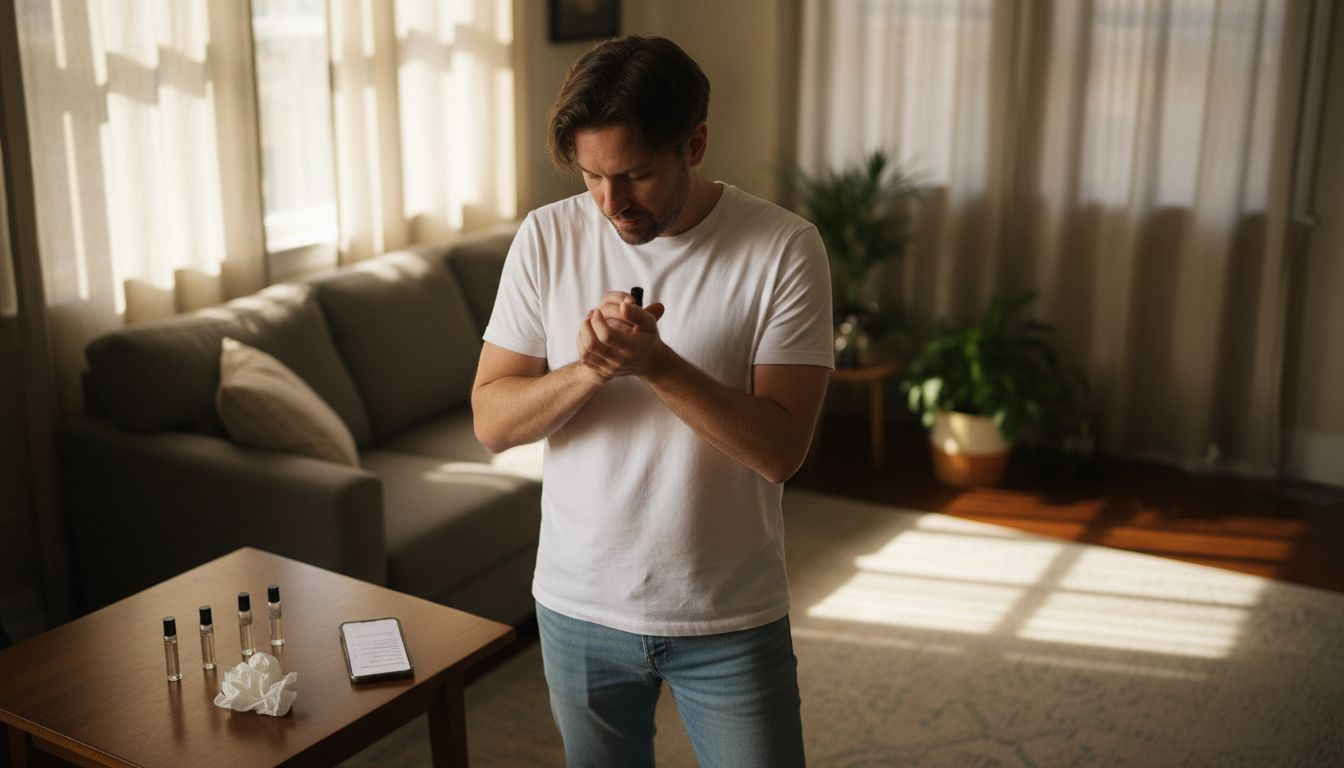
What are you looking for in those first moments? How the nose decodes complex odors dynamically involves your olfactory receptors responding to volatile molecules in the top notes. These opening notes typically consist of the brightest, most fresh elements—citrus, herbs, florals, or spice that grab your attention immediately.
Ask yourself these questions:
- Does the initial scent appeal to you, or does it feel off-putting?
- Are the top notes what you expected based on the fragrance description?
- Does the scent smell fresh, clean, fruity, sweet, spicy, or herbal?
- Is the intensity appropriate, or does it feel too strong or too subtle?
Remember that your initial reaction is shaped by your personal preferences and your individual biology. Initial perfume reactions are influenced by how the scent interacts with your body odor, creating a unique experience that differs from how someone else perceives the same fragrance. What smells amazing on your skin might smell completely different on a friend.
Don’t make a final decision yet. Many people dismiss fragrances based on their opening alone, missing out on beautiful heart and base notes that emerge later. The initial reaction is valuable, but it’s incomplete.
Your first sniff tells you if the opening notes appeal to you—not whether the entire fragrance is right for you.
Pro tip: Rate your initial reaction on a simple scale (love it, like it, neutral, dislike it, hate it) and jot down specific descriptors you notice, so you can compare multiple samples objectively without relying on memory alone.
Step 4: Monitor Scent Development Over Time
A fragrance is not static. What you smell at minute one differs dramatically from what you experience at the three-hour mark. Monitoring how a scent evolves reveals its true character and helps you determine if it’s worth purchasing.
Track the fragrance through its three distinct phases. The top notes appear immediately and fade within 5-15 minutes. The heart notes emerge next and typically last 30 minutes to a few hours. Finally, the base notes settle in for the long haul, often lasting 4-8 hours or more.
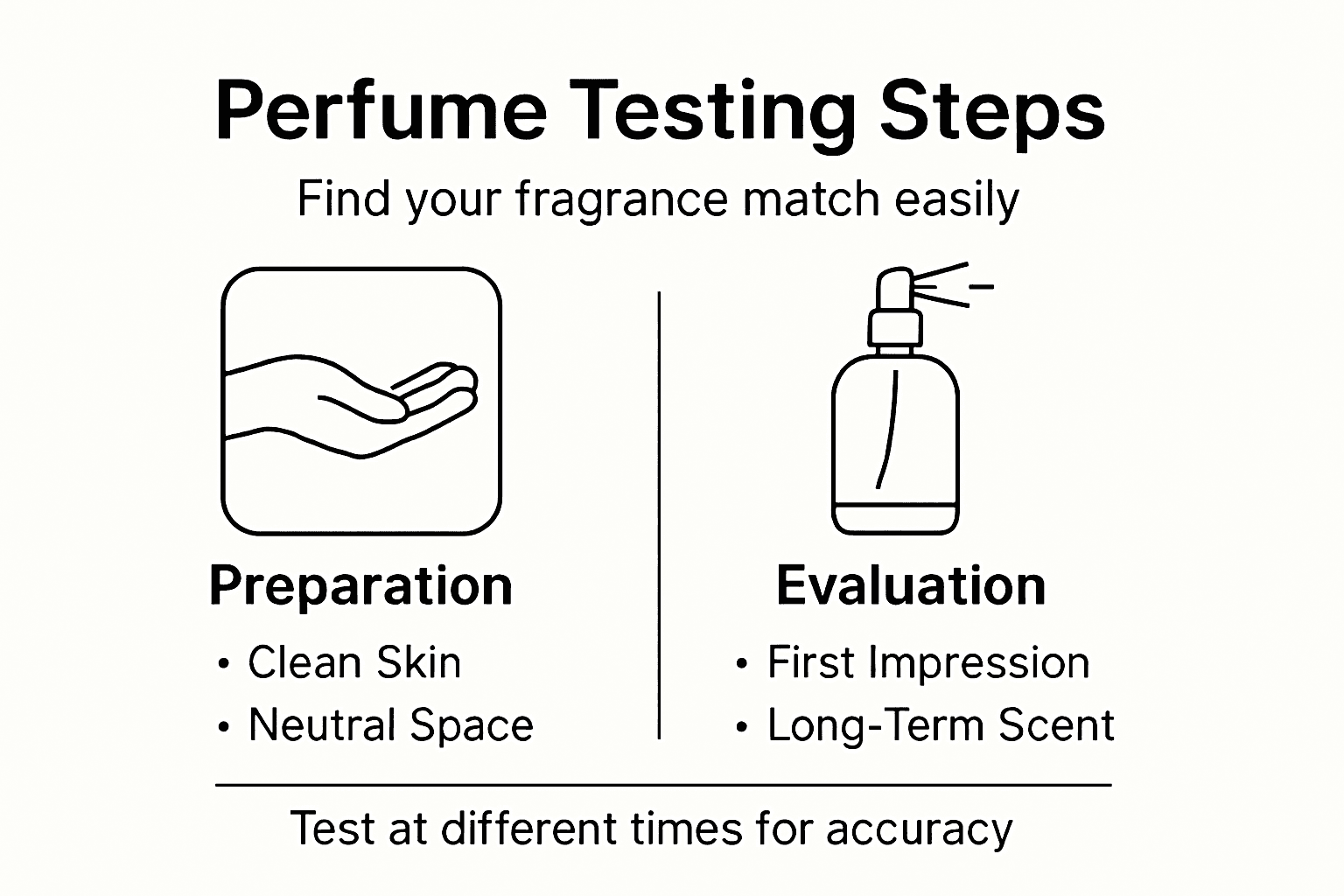
Here’s what to do at each phase:
Here is a summary of fragrance testing phases and what to observe:
| Phase | When to Evaluate | Key Changes to Notice | Typical Duration |
|---|---|---|---|
| Top Notes | 5 minutes after use | Initial freshness, first impression | 5-15 minutes |
| Heart Notes | 30 minutes after use | Scent’s core character and main composition | 30 minutes-2 hours |
| Base Notes | 2-4 hours after use | Longevity, subtle shifts, dry-down quality | 2-8 hours or longer |
- At 5 minutes: Note how the opening has softened—does the fragrance feel more balanced now?
- At 30 minutes: Smell the heart notes—these are the core of the fragrance and reveal its true personality
- At 2 hours: Check if the fragrance is still noticeable or if it’s fading into your skin
- At 4+ hours: Assess the base notes and overall longevity on your skin
Why does this matter? Scent composition and intensity change over time due to chemical volatility as fragrance compounds interact on your skin. A fragrance that feels cloying at first might become beautifully balanced after an hour, or it might completely disappear before dinner time.
Write down your observations at each checkpoint. Does the fragrance smell fresh after four hours, or does it turn into something unpleasant? Monitoring how fragrance character changes and key notes persist helps evaluate lasting power and personal compatibility with the scent.
Many fragrances feel disappointing in their opening minutes but transform into something stunning once the heart notes arrive. Conversely, some smell incredible on first spray but fade to nothing by lunchtime. Real-world performance matters more than initial excitement.
The heart and base notes reveal whether a fragrance is truly right for you—not the opening spray.
Pro tip: Set phone reminders at the 30-minute, 2-hour, and 4-hour marks so you remember to evaluate the fragrance without disrupting your day, and you’ll develop an accurate sense of each sample’s performance on your individual skin.
Step 5: Assess Compatibility and Make Your Choice
You’ve tested the fragrance, monitored its development, and gathered observations. Now comes the final decision: Is this scent right for you? Assessing compatibility goes beyond whether you like how it smells right now.
Think about your lifestyle and occasion fit. Will you wear this to the office, out on weekends, or for special events? Some fragrances work beautifully in professional settings while others feel too bold or casual. Consider whether the scent aligns with how you present yourself in different contexts.
Review your notes from the testing sessions. Ask yourself these key questions:
- Did the fragrance maintain your interest through the heart and base notes?
- Did it perform well on your skin, or did it fade too quickly?
- Can you see yourself wearing this regularly, or does it feel like a one-time novelty?
- Does the scent complement your natural body chemistry, or does it clash?
- Would you repurchase this at full size, or does the sample feel sufficient?
Assessing compatibility with individual preferences and needs helps you find your best match, much like evaluating any significant personal choice. Self-awareness about what you genuinely enjoy matters more than following trends or what others recommend.
Self-awareness and contextual factors determine which scent suits your personality and lifestyle. Some people prioritize longevity and projection, while others prefer subtle, skin-close fragrances. Neither preference is wrong—it’s about knowing yourself.
Don’t feel pressured to buy a full bottle immediately. Many fragrance enthusiasts keep multiple samples in rotation before committing to a purchase. Testing over several weeks reveals whether your attraction is genuine or just novelty appeal.
Compare how fragrance compatibility factors influence your final choice:
| Factor | Impact on Decision | Why It Matters |
|---|---|---|
| Body Chemistry | Alters scent on your skin | Ensures scent suits you |
| Lifestyle/Occasion | Guides scent selection | Fits daily and special needs |
| Scent Longevity | Determines lasting presence | Avoids frequent reapplication |
| Heart/Base Note Appeal | Reveals lasting enjoyment | Confirms true fragrance match |
| Purchase Motivation | Checks novelty vs. preference | Prevents impulsive buying |
Your perfect fragrance match reflects your taste, lifestyle, and how a scent genuinely makes you feel—not what marketing promises.
Pro tip: Test your top contenders on separate days over a two-week period to see which one you consistently reach for first, as your repeated choices reveal authentic preferences far better than any single testing session ever can.
Discover Your Perfect Scent Match with Confidence
Testing perfume samples carefully helps you avoid the common pitfalls of impulse buying and fragrance disappointment. The article highlights challenges like skin chemistry, proper application, and scent development phases that often make choosing a perfume overwhelming. You want to smell your best and feel confident wearing a fragrance that truly fits your lifestyle and personal taste. That is why sampling matters so much.
Explore a wide range of high-quality perfume samples tailored for women, men, and unisex preferences. Our collection lets you try various top, heart, and base notes in realistic quantities so you can evaluate real scent evolution on your skin. Take the guesswork out of fragrance shopping with convenient options like travel-sized bottles, curated scent sets, and gift cards. Start your journey today at Befrsh.com and experience effortless fragrance discovery with fast shipping and customer-focused service. Don’t wait to find your signature scent that feels perfect every time.
Frequently Asked Questions
How do I prepare my skin before testing perfume samples?
To prepare your skin, wash your wrists, neck, and inner elbows with fragrance-free soap and water. This ensures that you have a clean slate, free from competing scents or skin products, for the best evaluation of each perfume.
What is the best way to apply fragrance samples?
Apply a fragrance sample by spraying or dabbing it once on a pulse point, such as your inner wrist. Avoid rubbing your wrists together afterward to preserve the integrity of the fragrance, allowing it to develop naturally on your skin.
How long should I wait before evaluating a perfume sample?
Wait about 30 seconds after applying a perfume sample to evaluate the initial scent. This allows the alcohol to evaporate, revealing the true fragrance notes without the interference of the solvent.
What should I look for in the heart and base notes of a fragrance?
Monitor the heart notes around 30 minutes after application and the base notes a few hours later. Pay attention to how the fragrance evolves, noting its balance, longevity, and whether it still appeals to you as it changes.
How do I determine if a fragrance fits my lifestyle?
Consider how often you’ll wear the fragrance and its appropriateness for various occasions, such as work or special events. Assess whether it complements your personal style, ensuring it aligns with how you wish to present yourself in different contexts.
Should I make a purchase immediately after testing a fragrance sample?
No, it’s best to take your time before making a purchase. Give yourself a few weeks to test your favorite samples over multiple days to see which fragrances you consistently enjoy before committing to a full size.