Master fragrance layering for a personalized scent

Many of the signature scents you admire on other people are not coming from a single bottle. They are the result of strategic, intentional fragrance layering, which is the practice of combining two or more fragrances applied sequentially on the skin to build something entirely your own. Most people assume that wearing one perfume is the correct approach, and that mixing is risky or messy. That assumption is worth challenging. Fragrance layering is one of the most powerful tools you have to stand out, tailor your scent to any occasion, and stop smelling like everyone else who bought the same bottle.
Table of Contents
- What is fragrance layering?
- How to layer fragrances: Core techniques
- Expert tips: How to combine and test fragrances
- Fragrance layering mistakes everyone makes (and how to avoid them)
- Does fragrance layering really make a difference?
- Our take: The real secret to memorable fragrance layering
- Explore and experiment with scent layering
- Frequently asked questions
Key Takeaways
| Point | Details |
|---|---|
| Layer for personalization | Combining fragrances allows you to build a unique scent signature and experiment beyond standard perfumes. |
| Follow proven techniques | Apply heavy scents first, use moisturizer, layer 2-3 fragrances max, and spray sparingly for best results. |
| Test and learn | Try combinations on your own skin and be open to adjusting based on chemistry and occasion. |
| Avoid common mistakes | Don’t rub wrists together, avoid layering too many or heavy scents, and always prep skin first. |
| Enjoy the creativity | Layering is about playful experimentation and discovering scents that reflect your personality. |
What is fragrance layering?
Fragrance layering means applying more than one scent in a deliberate order so they interact and evolve together on your skin. The goal is personalization. Instead of being locked into what a perfumer decided your scent should be, you get to build something that reflects your taste, mood, or the moment. Our fragrance layering guide breaks this down further if you want a deeper look.
Fragrance layering is rooted in Middle Eastern traditions and has exploded in popularity through social media, where creators share unexpected combinations that go viral. What was once a niche practice among collectors is now a mainstream approach to wearing fragrance.
Here is a quick look at how layering compares to wearing a single scent:
| Factor | Single fragrance | Layered fragrance |
|---|---|---|
| Uniqueness | Standard | Highly personal |
| Flexibility | Fixed | Adjustable by mood |
| Complexity | Designed by perfumer | Co-created by you |
| Risk level | Low | Moderate (but manageable) |
People layer for many reasons:
- To create a scent no one else wears
- To boost a fragrance that feels too light on their skin
- To adapt a scent for different seasons or settings
- To extend the life of a favorite that fades quickly
“Layering is not about masking a fragrance. It is about adding dimension to it.”
The biggest misconception is that layering weakens or ruins a fragrance. Done correctly, it does the opposite. It adds depth and longevity that a single spray rarely achieves.
How to layer fragrances: Core techniques
Knowing why layering works is one thing. Knowing how to do it well is what separates a memorable result from a confusing mess. The process is straightforward once you understand the logic.
Apply the heaviest scent first, let it dry for one to five minutes, then layer lighter scents on top. Moisturizing beforehand helps the fragrance cling to your skin longer and project more evenly. These are the core steps for solid perfume layering techniques.
Here is a step-by-step process to follow:
- Moisturize your skin with an unscented lotion or one that matches your fragrance family. Dry skin kills scent projection fast.
- Apply your base fragrance first. This is typically the heaviest, most complex scent, such as an oriental, woody, or musky perfume.
- Wait one to five minutes to let the base settle and dry down on your skin.
- Layer your lighter scent on top. Florals, citruses, and fresh aquatics work well as top layers.
- Target pulse points: wrists, neck, inner elbows, and behind the knees. These warm spots help the scent radiate.
- Limit yourself to one or two sprays per layer to avoid overwhelming the blend.
Pro Tip: Do not spray both fragrances in the exact same spot at the same time. Apply the base to your wrists, let it dry, then add the lighter scent to your neck. This separation lets each scent breathe while still interacting.
“Think of layering like building an outfit. The base is your foundation piece, and the top layer adds personality.”
The key rule is patience. Rushing the process by spraying everything at once collapses the layers into a single indistinct cloud.

Expert tips: How to combine and test fragrances
Once you have the basics down, the real creativity begins. Knowing which scent families pair well together is the difference between a blend that turns heads and one that clears a room.
Complementary scent families like floral with citrus or woody with gourmand tend to blend naturally. Limit yourself to two or three fragrances for clarity. Testing combinations on paper and skin, and experimenting with zoning on different body areas, gives you the most useful feedback.
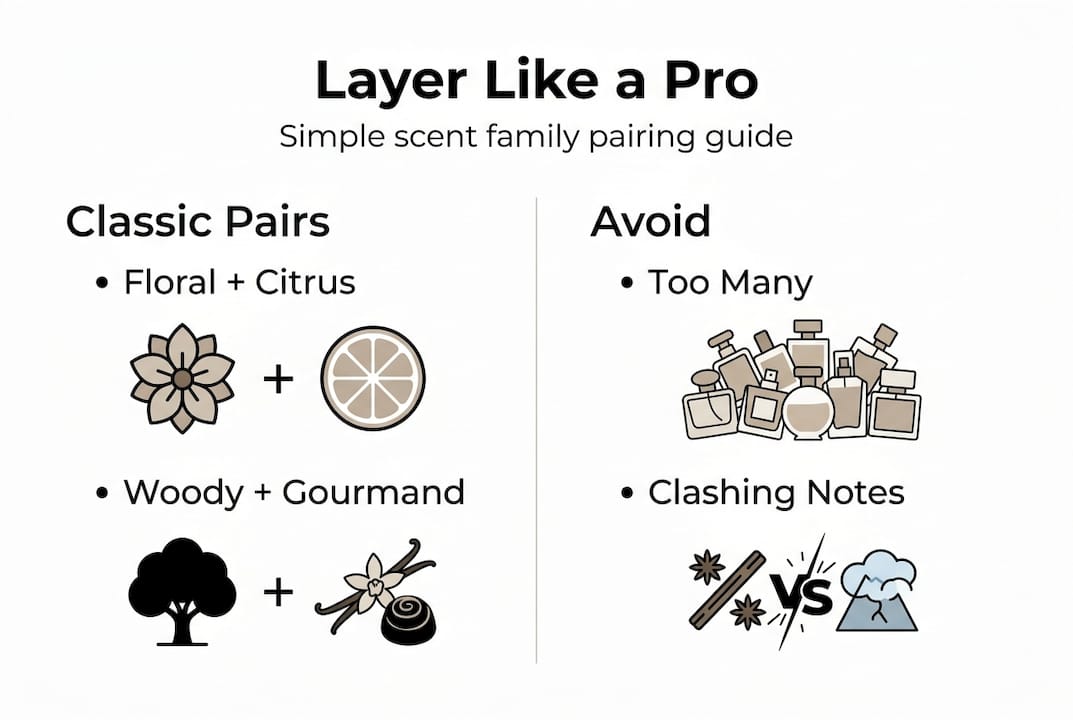
Here is a quick comparison of pairing approaches:
| Pairing style | Example combo | Result |
|---|---|---|
| Floral + Citrus | Rose + bergamot | Bright, feminine, fresh |
| Woody + Gourmand | Sandalwood + vanilla | Warm, sensual, cozy |
| Aquatic + Musk | Sea spray + white musk | Clean, modern, subtle |
| Oriental + Floral | Oud + jasmine | Rich, complex, bold |
Before committing a combination to your skin, test it on a paper strip first. This tells you whether the notes clash at a basic level. Then test on a small skin area and wait 20 minutes. Skin chemistry transforms fragrance in ways paper cannot predict, so always do both.
Jo Malone built an entire brand identity around the idea of layering their fragrances together, calling it “fragrance combining.” Their minimalist approach proves that two well-chosen scents are almost always better than four competing ones.
Some practical combinations worth trying:
- A light citrus on top of a base woody scent for an office-ready blend
- A soft floral layered over a clean musk for an everyday signature
- A spicy oriental base with a fresh green top note for evening wear
Pro Tip: Try how to test perfumes on different parts of your body at the same time. Apply one scent to your left wrist and another to your right, then see which combination you prefer before committing.
Zoning, which means applying different scents to different body areas, is an advanced technique that lets each fragrance perform independently while still contributing to your overall scent profile.
Fragrance layering mistakes everyone makes (and how to avoid them)
Even experienced fragrance fans make these errors. Avoiding them will immediately improve your results.
Rubbing your wrists together after applying fragrance is one of the most common habits, and one of the most damaging. It disrupts the scent molecules and accelerates the top notes, which collapses the structure of your blend. Let fragrance dry naturally.
Key mistakes to stop making right now:
- Layering two heavy fragrances together: Two orientals or two dense gourmands compete rather than complement. One heavy, one light is the rule.
- Overspraying: More product does not mean more scent. It means more noise. One to two sprays per layer is enough.
- Skipping moisturizer: Dry skin cannot hold fragrance molecules. Testing perfume samples on moisturized skin gives you a far more accurate read.
- Ignoring skin chemistry: The same combination smells different on every person. What works for someone online may not work for you.
- Layering too many scents: Three is the absolute maximum. Two is usually better.
Stat to know: In blind scent tests, the order of layering proved more important than the specific scents used. Getting the sequence right matters more than finding the “perfect” combination.
Pro Tip: If a combination smells off, do not add a third fragrance to fix it. Strip back and start with a different base. Adding more almost never solves a clash.
Skin chemistry is the wildcard that no guide can fully account for. Your diet, hydration level, and even stress hormones affect how a fragrance develops on you. This is why testing on your own skin is non-negotiable.
Does fragrance layering really make a difference?
This is a fair question, and the answer is genuinely nuanced. Layering is not universally better than wearing a single well-made fragrance. It depends on your goal and your skill level.
Some experts argue that well-composed perfumes are already complete and that layering is unnecessary, while others celebrate its creativity and personalization potential. Both sides have a point.
Arguments in favor of layering:
- You can create a scent that is genuinely unique to you
- You can adapt a fragrance to a season, mood, or occasion without buying something new
- It adds creative engagement to something you already do every day
- A well-layered combination can feel more complex and interesting than either scent alone
Arguments against layering:
- Skilled perfumers spend years balancing a formula for maximum impact
- Your skin chemistry is already unique, so the same bottle smells different on you anyway
- Clashing notes can muddle the overall impression and reduce longevity
- It requires experimentation and patience, which not everyone wants to invest
“Fragrance layering is more art than science. The best results come from curiosity, not from following a formula.”
The honest answer is that layering makes a real difference when done thoughtfully. It adds fragrance personalization that a single bottle simply cannot deliver. But it can also backfire when rushed or overcomplicated. The practice rewards those who approach it with intention.
Our take: The real secret to memorable fragrance layering
After seeing how people approach layering, the pattern is clear. Beginners almost always sabotage their results before they even start. They skip the moisturizer, grab three or four bottles, spray everything at once, and then wonder why the result smells chaotic. The problem is not the fragrances. It is the process.
The real secret is restraint. Start with two fragrances, not four. Prep your skin. Wait between layers. Using a lotion base is especially critical for those still exploring before committing to full bottles, because it gives you the most accurate preview of how a scent will actually perform.
Building a signature scent is not about owning more fragrances. It is about mastering scent combinations with what you already have. Two fragrances layered with care and intention will always outperform five fragrances applied without thought. The most memorable scents are not complicated. They are considered.
Explore and experiment with scent layering
Fragrance layering rewards curiosity, and the best way to build confidence is to experiment without the pressure of committing to a full bottle. That is exactly where fragrance discovery at Be Frsh comes in. We offer a wide selection of samples and travel-sized options so you can test combinations on your own skin before investing in anything.
Whether you are just starting out or looking to refine your layering approach, our in-depth scent layering tips give you the practical guidance to move forward with confidence. Explore, test, and find the combination that is unmistakably yours.
Frequently asked questions
Do you apply heavier or lighter fragrances first when layering?
Always apply the heaviest fragrance first, let it dry for a few minutes, then layer lighter scents on top to achieve the best blend.
How many fragrances can you safely layer at once?
Limit layering to two or three fragrances at most. Using more risks creating a muddled scent rather than a clean, intentional blend.
Does layering fragrances make your scent last longer?
Layering can extend wear when you prep skin well and choose compatible families, but clashing notes can shorten longevity rather than extend it.
What is the biggest mistake beginners make with fragrance layering?
Most beginners over-apply, skip moisturization, or combine two heavy scents, all of which lead to a muddled or weak projection instead of a defined blend.
Can you layer different types of scent products (oil, EDT, body spray)?
Yes. You can layer oils, EDTs, and body sprays together as long as you follow the correct order, applying oils and heavier scents before lighter sprays.