
Expert tips for choosing perfumes that match your style

Standing in front of a fragrance counter with dozens of bottles competing for your attention is genuinely overwhelming. You spray one on your wrist, another on a paper strip, and suddenly nothing smells right anymore. Worse, many first-time buyers commit to a full bottle based on a 30-second impression, only to find the scent feels completely different after a few wears. Your skin chemistry, your lifestyle, and even the season all shape how a perfume performs on you. This guide cuts through the noise with practical, evidence-backed advice so you can choose with confidence and avoid expensive regrets.
Table of Contents
- Understand the fragrance pyramid
- Consider the concentration and longevity
- Test on your skin, not paper
- Match perfume to your lifestyle and the season
- Start with samples, not full bottles
- Discover your next signature scent with Be Frsh
- Frequently asked questions
Key Takeaways
| Point | Details |
|---|---|
| Patience reveals true scent | Test perfume on your skin and wait several hours to experience its real character. |
| Choose by concentration | Match perfume strength to your needs for occasions and lasting power. |
| Lifestyle and season matter | Adjust your fragrance choices for different events, moods, and weather. |
| Sample before you buy | Use discovery sets or vials to avoid expensive mistakes and find what works. |
Understand the fragrance pyramid
Every perfume is built in layers, and understanding those layers changes everything about how you evaluate a scent. The fragrance pyramid basics describe three distinct stages: top notes, heart notes, and base notes, each with a different role and a different lifespan on your skin.
Top notes are what you smell the moment you spray. They are bright, fresh, and designed to grab attention, but they fade fast. Heart notes emerge next and form the true personality of the fragrance. Base notes are the slowest to appear and the longest to linger, often defining how you remember a scent hours later.
Here is a quick reference for how each layer behaves:
| Note type | When it appears | How long it lasts |
|---|---|---|
| Top notes | Immediately | 5 to 15 minutes |
| Heart notes | 15 to 30 min | 1 to 4 hours |
| Base notes | 30 to 60 min | 4 to 12+ hours |
This timeline matters because most people judge a perfume in the first 60 seconds. That first impression is almost entirely top notes, which are often not representative of the full scent. A fragrance that smells sharp or too sweet at first can become warm and complex once the base notes settle.
“Never buy a perfume based on the first spray. Give it at least two hours on your skin before making any decision.”
Key things to remember about the fragrance pyramid:
- Top notes are the opening act, not the main event
- Heart notes reveal the true character of the perfume
- Base notes determine lasting impression and skin compatibility
- Judging too early leads to buyer’s remorse
Consider the concentration and longevity
Understanding the inner structure of scent is key, but next, it is crucial to match the intensity and durability of a fragrance to your lifestyle. Perfume concentration refers to how much fragrance oil is dissolved in the formula, and it directly affects how long the scent lasts and how strongly it projects.
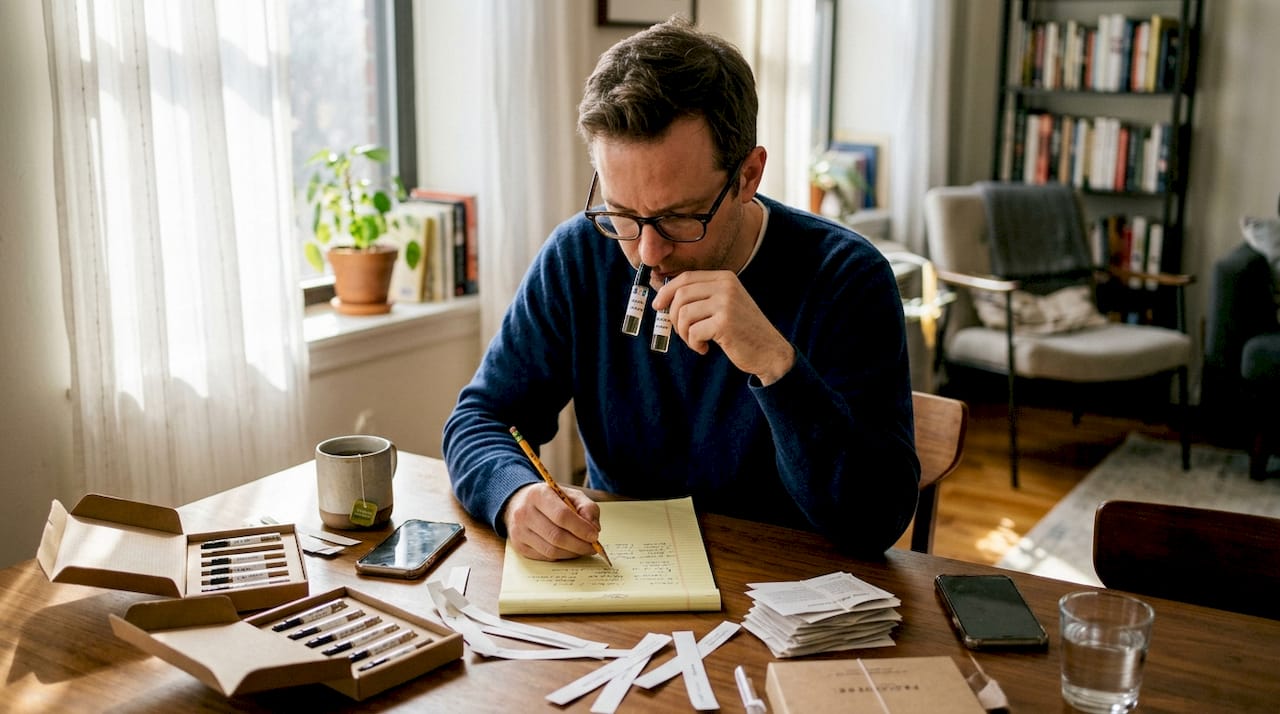
Here is how the main types compare, based on perfume concentrations compared:
| Type | Concentration | Longevity | Best for |
|---|---|---|---|
| Parfum/Extrait | 20 to 30% | 8 to 12+ hours | Evenings, special occasions |
| Eau de Parfum (EDP) | 15 to 20% | 6 to 8 hours | Daily wear |
| Eau de Toilette (EDT) | 5 to 15% | 3 to 5 hours | Office, summer |
| Eau de Cologne (EDC) | 2 to 5% | 2 to 3 hours | Refresh, casual |
Choosing the right concentration is not just about preference. It is about practicality. A heavy Parfum in a small office can be overwhelming for colleagues. A light EDC on a winter evening out may disappear before dinner is over. Longevity benchmarks from multiple fragrance guides confirm that higher concentration formulas consistently outperform lighter ones in wear time.
How to match concentration to your life:
- For the office or daytime errands, choose EDT for a clean, non-intrusive presence
- For daily wear that lasts through a full workday, EDP is the reliable middle ground
- For evenings, dates, or formal events, Parfum delivers depth and staying power
- For travel or gym bags, EDC works as a quick refresh without commitment
Pro Tip: A higher-priced Parfum can actually save you money over time. Because it lasts twice as long as an EDT, you use far less product per wear, making the cost per use surprisingly competitive.
Test on your skin, not paper
Once you have narrowed down a concentration, the next step is trying it properly in a way that reveals how it really smells on you. Paper strips are useful for a quick first filter, but they tell you almost nothing about how a fragrance will behave on your body.
Body chemistry plays a major role in how a scent develops. Your skin’s pH level, natural oils, diet, and even hydration all interact with fragrance molecules. People with oily skin tend to amplify base notes and hold scent longer. Those with dry skin may find that the same perfume fades within a couple of hours.
For testing perfume samples effectively, follow these guidelines:
- Apply to pulse points: wrists, inner elbows, or the base of the throat
- Do not rub the wrists together. Rubbing breaks down fragrance molecules and distorts the scent
- Wait at least 30 minutes before evaluating. This is the dry-down phase where the real character emerges
- Limit yourself to three scents per session to avoid nose fatigue
- Smell coffee beans or your own skin between tests to reset your senses
Pro Tip: Test the same perfume at different times of day. Skin temperature, humidity, and even what you have eaten can shift how a scent reads. A fragrance that feels heavy in the morning may feel perfectly balanced in the evening.
Match perfume to your lifestyle and the season
With your skin test done, consider your daily rhythm and what environments your signature scent will need to suit. A perfume that works beautifully on a summer beach vacation may feel suffocating in a heated office in January.
Matching scent to lifestyle is one of the most practical skills in building a fragrance wardrobe:
- Office and daytime: Fresh, clean, or green scents. Think light florals, citrus, or soft musks
- Dates and evenings: Warm, spicy, or sensual. Amber, vanilla, sandalwood, and oud work well here
- Summer: Citrus, aquatic, and fruity notes feel natural in heat and humidity
- Winter: Richer, heavier scents like amber, leather, and woody orientals carry better in cold air
The idea of a single signature scent is romantic but limiting. Fragrance wardrobe ideas from style experts suggest that building a small collection of two to four scents gives you the flexibility to match your mood, the weather, and the occasion without compromise.
“Layering and wardrobe choices let you express any mood. A single signature is a starting point, not a ceiling.”
Check out the seasonal perfume guide for specific recommendations organized by time of year. Rotating your scents seasonally also extends the life of each bottle and keeps your fragrance feeling fresh and intentional.
Start with samples, not full bottles
Once you have mapped your ideal scent for your lifestyle, the smartest next step is to experiment at low risk before spending more. Full bottles of quality perfume can cost anywhere from $80 to several hundred dollars. Committing that amount without proper testing is a gamble most people lose at least once.
Fragrance discovery sets and decants let you test a perfume at home over multiple days, in different conditions, and across different moods. This is far more reliable than a single in-store test. Here is how to make the most of samples:
- Order a discovery set or individual samples of your shortlisted scents
- Wear each sample for at least two full days before forming an opinion
- Note how the scent performs in different settings: work, outdoors, evenings
- Pay attention to compliments. Other people’s reactions are useful data
- Only buy the full bottle once you have worn the sample enough to miss it
Blind buying, meaning purchasing without testing, only makes sense for fresh or woody mainstream fragrances with broad appeal. Niche, oud-heavy, or experimental scents are risky without prior testing.
Pro Tip: Keep a simple scent journal. After each sample, write down the name, your first impression, how it developed, and how you felt wearing it. Patterns emerge quickly and help you identify your true preferences faster than memory alone.
For inspiration on combining scents, the perfume layering tips guide walks you through how to build more complex, personal scent profiles using multiple products together.
Discover your next signature scent with Be Frsh
Now that you have the framework for making smart perfume choices, the final step is to bring these insights to life with a trustworthy source for samples. Knowing what to look for is only half the equation. Having access to quality samples that let you test properly at home is the other half.
At Be Frsh, we have built our entire store around exactly this idea. Our fragrance sample sets are curated to cover a wide range of styles, concentrations, and seasons, so you can work through your shortlist without committing to a full bottle too soon. Whether you are just starting your fragrance journey or refining a collection you have built over years, our discovery kits give you the room to explore, compare, and decide with confidence. Fast delivery and expert curation mean the process stays enjoyable from start to finish.
Frequently asked questions
How do I know if a perfume suits me?
Apply it to your skin, wait at least 30 minutes for the dry-down phase, and evaluate how the scent develops and feels over several hours. A perfume that still appeals to you after two hours is a strong match.
What is the safest type of scent to buy without testing?
Fresh or woody scents from mainstream brands are the safest blind buys because they tend to have broad appeal and predictable performance across different skin types.
Why does my perfume fade so quickly?
Dry skin fades scent faster than oily skin because it lacks the natural oils that help anchor fragrance molecules. Try moisturizing before applying and switching to a higher-concentration formula like an EDP or Parfum.
How many scents can I test at once?
Limit yourself to three scents per session to avoid nose fatigue, which makes it harder to accurately distinguish between fragrances and leads to poor decisions.
What is the fragrance pyramid?
The fragrance pyramid refers to the three layers of a perfume: top, heart, and base notes. Each layer unfolds over time to form the complete scent profile you experience throughout the day.