

Seasonal Fragrance Trends 2026: Expert Scent Guide

TL;DR:
- Temperature, humidity, and skin chemistry significantly influence how fragrances perform across seasons.
- Trend notes in 2026 include soft fruits in spring, clean musks in summer, darker woods in fall, and gourmands in winter.
- Personalization and layering allow for flexible fragrance use beyond traditional seasonal rules.
Your favorite perfume smells nothing like itself in July compared to December. That’s not your imagination. Temperature, humidity, and even your skin chemistry shift dramatically across seasons, and your fragrance reacts to every single change. Most people pick a scent they love and wear it year-round, then wonder why it feels flat in summer or overwhelming in winter. This guide breaks down the real science behind seasonal scent performance, maps out what’s actually trending in 2026, and gives you practical tools to experiment, rotate, and gift fragrances with genuine confidence.
Table of Contents
- How seasons affect fragrance performance
- What’s trending in fragrance notes for 2026
- Personalization vs. tradition: Breaking seasonal rules
- How to experiment with seasonal fragrances
- Why seasonal fragrance trends matter less than you think
- Explore your next signature scent with Be Frsh
- Frequently asked questions
Key Takeaways
| Point | Details |
|---|---|
| Seasons change scent | Heat and cold dramatically affect how a fragrance smells and lasts. |
| 2026’s leading notes | Soft fruits, airy florals, and richer woods are in demand this year. |
| Layer for flexibility | Combining scents and rotating by season customizes performance and feel. |
| Personal style matters most | Trends are guides, but experimenting with layering creates a unique signature. |
How seasons affect fragrance performance
Fragrance is chemistry. Every perfume is built from layers of molecules, called top notes, heart notes, and base notes, that evaporate at different speeds. Temperature is the single biggest variable controlling how fast those molecules leave your skin and reach someone else’s nose.
In warm weather, heat speeds up evaporation dramatically. Your top notes, the bright citrus, light florals, and green herbs, burn off within minutes. What lingers is whatever sits in the heart and base. This is why a heavy oud or dense amber can feel suffocating in August. The base arrives too fast, too loud, before the lighter notes have had time to create balance. Conversely, cold air slows evaporation significantly. A fragrance that smells sheer and elegant in spring can turn into a rich, almost edible experience on a January morning because those base notes finally have time to develop and project slowly.
As physics of scent volatility explains: “Heat accelerates top-note evaporation, favoring light scents for warmer months; cold slows evaporation, enhancing heavy notes in cooler seasons.”
The season doesn’t change the fragrance formula. It changes the order in which you experience it. Winter gives you the full symphony. Summer gives you the opening act.
Skin chemistry adds another layer. In summer, your skin produces more oil and sweat, which can amplify certain musks and florals while making synthetic notes smell sharper. In winter, dry skin absorbs fragrance faster, which means projection drops and longevity suffers unless you moisturize first.
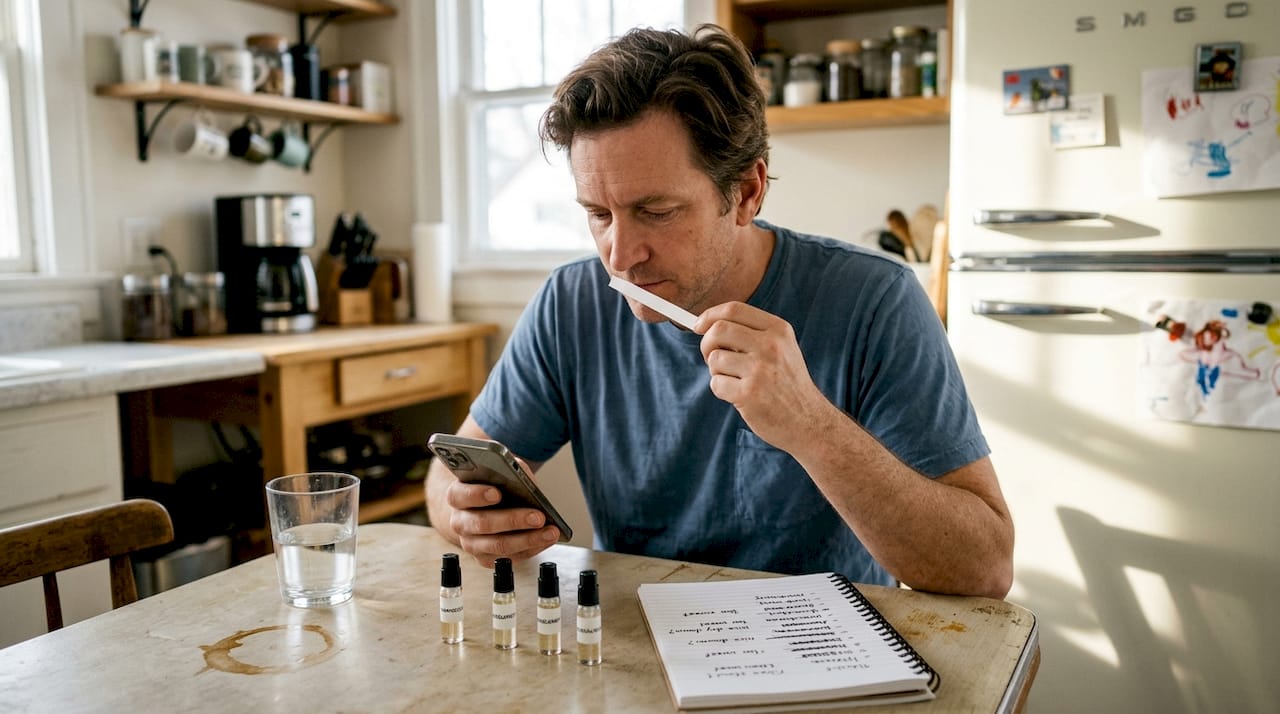
Here’s a quick breakdown of which note families perform best by season:
| Season | Best performing notes | Avoid |
|---|---|---|
| Spring | Airy florals, light musks, green notes | Dense resins, heavy woods |
| Summer | Citrus, aquatics, sheer florals | Gourmands, heavy ambers |
| Fall | Spiced woods, leather, warm musks | Very sharp citrus |
| Winter | Ambers, gourmands, deep orientals | Light aquatics, thin florals |
Pro Tip: Test any fragrance outdoors in its target season for at least six hours. Indoor testing under climate control tells you almost nothing about real-world performance. You need sun, wind, and temperature to understand what a scent actually does on your skin.
Understanding this science also helps you appreciate the mood effects of seasonal scents and why a winter fragrance worn in July can feel emotionally mismatched, not just chemically off.
What’s trending in fragrance notes for 2026
Armed with an understanding of scent science, discover what’s actually making waves in 2026’s seasonal fragrance trends.
2026 is a fascinating year for fragrance. The industry is seeing a collision between nostalgia-driven softness and bold, unapologetic richness. Spring is leaning into comfort and softness. Summer is going cleaner and more skin-forward. Fall and winter are getting darker and more complex than ever.
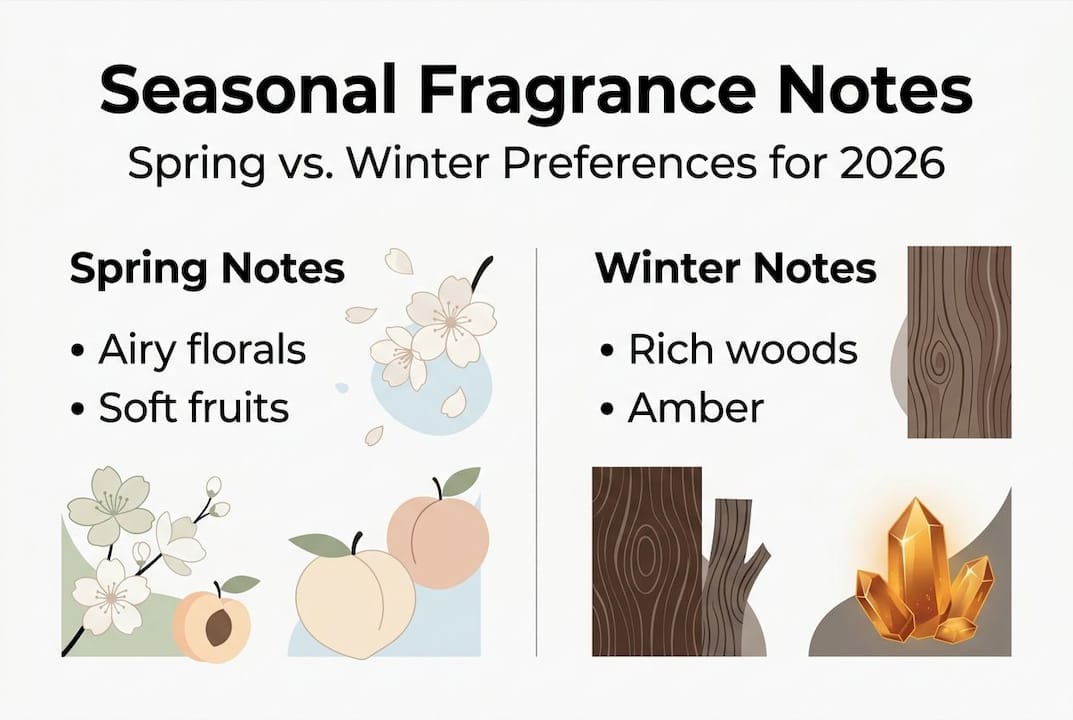
According to 2026 fragrance benchmarks, spring 2026 features soft fruits like peach and pear alongside airy florals and gourmands, while winter trends toward richer woods and ambers. Notably, 75% of consumers are now choosing extraits (highly concentrated parfum formulations) over lighter eau de toilette versions, prioritizing longevity and value over volume.
Here’s a season-by-season snapshot of what’s resonating right now:
| Season | Trending notes | Key mood |
|---|---|---|
| Spring | Peach, pear, lily of the valley, soft musk | Fresh, optimistic |
| Summer | Neroli, solar musks, sea salt, white tea | Clean, effortless |
| Fall | Cardamom, vetiver, tobacco, leather | Cozy, sophisticated |
| Winter | Oud, vanilla, benzoin, dark amber | Indulgent, bold |
Seasonal favorites worth watching this year:
- Spring: Soft peach-floral combinations that feel like a second skin
- Summer: Transparent musks layered over citrus for a barely-there effect
- Fall: Spiced cardamom and leather hybrids that feel both classic and modern
- Winter: Dark gourmands with vanilla and resinous woods that project for hours
For collectors, this trend toward extraits is significant. A single 10ml sample of an extrait now gives you a genuinely accurate picture of how a full bottle will perform, making sampling smarter than ever. Gift-givers should note that the psychology of seasonal scent plays a real role in how a gift lands. A rich winter amber given in February feels intentional. The same bottle gifted in June might confuse the recipient.
The extrait shift also means that the traditional “spray more in cold weather” advice is becoming outdated. Concentration does the work now. One or two sprays of a quality extrait in winter is enough.
Personalization vs. tradition: Breaking seasonal rules
While trends tell us what’s popular, the real magic comes when you make rules your own.
The fragrance world has spent decades telling us that citrus belongs in summer and woods belong in winter. That framework is useful for beginners, but it’s increasingly out of step with how serious enthusiasts and collectors actually wear fragrance. The rules are loosening fast.
Traditional seasonal rules are loosening, and layering and personalization now enable many people to wear gourmands or skin scents year-round. Remarkably, 45% of consumers now choose scent based on mood rather than season. That’s a seismic shift in how fragrance is being used.
Mental wellbeing is driving a lot of this. People are reaching for comforting vanilla gourmands in summer because those scents reduce anxiety, not because the weather calls for it. Others are wearing airy white musks in January because they want to feel light and calm during the heaviest month of the year. Fragrance is becoming a mood tool as much as a style statement.
Layering is the technique that makes rule-breaking actually work. Here’s how to approach it:
- Start with your heaviest base note fragrance. Apply it to pulse points and let it settle for two to three minutes.
- Add a lighter, fresher fragrance on top. Wrists and neck work well here.
- Adjust the ratio by season. In summer, use more of the lighter scent. In winter, let the base dominate.
- Test the combination on skin, not paper strips, and wait at least thirty minutes before evaluating.
- Keep notes on what works. Memory fades fast.
Pro Tip: A single drop of a rich oud or amber layered under a fresh citrus in summer creates a scent that reads as “interesting” rather than heavy. It adds depth without the suffocation. This is where personalized fragrance routines become genuinely exciting.
If you want to explore layering for year-round use more deeply, there are specific combinations that consistently work across seasons regardless of the weather outside.
How to experiment with seasonal fragrances
Ready to take control? Here’s how to make seasonal trends work for your wardrobe, collection, or gifts.
Experimenting with seasonal fragrances doesn’t require owning dozens of full bottles. In fact, that’s one of the most common and expensive mistakes enthusiasts make. Sampling first is always smarter.
Here’s a practical approach to building and rotating a seasonal fragrance wardrobe:
- Identify your seasonal anchors. Choose one or two core fragrances per season that feel genuinely right for your skin and lifestyle.
- Test on skin in real conditions. Wear each candidate for at least six hours in actual weather, not indoors. A fragrance that sings in an air-conditioned room may disappoint outside.
- Evaluate longevity and projection separately. A scent might last eight hours but project only for two. Know which matters more to you.
- Rotate intentionally. When the season shifts, retire those scents to a cool, dark place and bring out the next rotation. Treat your collection like a seasonal wardrobe.
- Review and refine. At the end of each season, decide which fragrances earned a permanent spot and which ones get replaced.
For collectors, proper storage matters as much as selection. Heat and light degrade fragrance molecules over time. Store bottles away from windows, ideally in their original boxes, and keep them at a stable temperature. A well-stored extrait can remain vibrant for years.
For gift-givers, the seasonal fragrance testing methodology offers a useful framework: think about when the recipient will actually wear the gift, not just when you’re giving it. A holiday gift of a rich winter amber is perfect. A birthday gift in March calls for something lighter.
Common mistakes to avoid:
- Buying full bottles before testing on your own skin
- Storing fragrances in the bathroom where heat and steam accelerate degradation
- Ignoring the recipient’s lifestyle when gifting (an office worker may need something quieter than a bold collector’s pick)
- Assuming a fragrance that works on someone else will work on you
Pro Tip: Keep a fragrance diary. After each wear, jot down the date, weather, and how the scent performed. Over one season, patterns emerge that tell you exactly which fragrances belong in your rotation. Pair this with exploring layering fragrance combinations to expand your options without expanding your collection.
Why seasonal fragrance trends matter less than you think
Here’s the counterintuitive truth: the more you learn about seasonal fragrance rules, the less you should feel bound by them. Trends are a starting point, not a destination. They tell you what’s resonating with the market right now, but your nose, your skin, and your memories are far more reliable guides than any trend report.
Some of the most memorable fragrance experiences come from wearing the “wrong” scent at the “wrong” time. A heavy amber on a hot summer evening. A crisp green tea in the depths of winter. These unexpected choices create contrast, and contrast is what makes a scent memorable rather than predictable.
Personal connection matters more than seasonal correctness. If a fragrance reminds you of someone you love or a place that shaped you, that emotional resonance will always outperform a technically perfect seasonal choice. The goal isn’t to follow a formula. It’s to build a relationship with scent that feels genuinely yours.
Use trends to discover new notes and expand your vocabulary. Then use customizing your scent techniques to make those discoveries your own. The best fragrance wardrobe is one that’s both timely and deeply personal.
Explore your next signature scent with Be Frsh
If you’re ready to make the most of seasonal scent possibilities, Be Frsh has you covered. Discovering your seasonal signature doesn’t have to mean committing to expensive full bottles before you know how a fragrance truly performs on your skin.
At Be Frsh, you’ll find a curated selection of high-quality fragrance samples and travel-size bottles spanning every season and mood. Whether you’re building a personal rotation, hunting for the perfect gift, or exploring 2026’s biggest trends before investing, sampling first is always the smarter move. Dive into the perfume layering guide to discover how to get more from every bottle you already own, and let the seasonal journey begin.
Frequently asked questions
What makes a fragrance more suitable for a specific season?
Heat accelerates light, volatile notes making them ideal for summer, while cold weather slows evaporation and lets heavier base notes develop fully, which is why rich woods and ambers feel natural in winter.
What are the top fragrance notes for spring 2026?
Soft fruits like peach and pear, airy florals, and subtle gourmands are leading spring 2026 trends, offering a balance of freshness and warmth that works across different skin types.
How do I layer fragrances for year-round appeal?
Start with a richer, heavier scent as your base and add fresher notes on top, then rotate seasonally by adjusting how much of each layer you apply depending on the weather.
Can I wear the same scent all year?
Yes, but its performance and emotional impact will shift with the seasons. Personalization blurs strict seasonal rules, and layering is the most effective way to adapt a favorite fragrance across very different weather conditions.
Jätä viesti