Why unisex perfumes matter: scent beyond gender

TL;DR:
- Nearly 40% of premium fragrance sales now come from unisex perfumes, reflecting a cultural shift.
- Science shows scent preferences are individual and not strictly tied to gender.
- Truly unisex perfumes balance notes like citrus, musk, and balanced woods for versatile, gender-neutral appeal.
Nearly 40% of premium fragrance sales now come from unisex perfumes, a number that would have seemed impossible two decades ago when department store counters were split cleanly into “for him” and “for her.” The old idea that certain scents belong to certain genders is losing ground fast, and not just because of marketing trends. Science, culture, and a new generation of fragrance lovers are all pushing in the same direction. Whether you’re building a personal scent wardrobe or searching for a gift that actually lands, understanding unisex perfumes gives you a real advantage. This guide breaks down why they matter, what makes them work, and how to choose confidently.
Table of Contents
- The rise of unisex perfumes: A cultural shift
- Debunking the myth: The science of scent and gender
- What makes a perfume truly unisex?
- Real-world advantages: Why unisex perfumes are practical
- A fresh perspective: Scent as self-expression, not category
- Discover your next signature with Be Frsh
- Frequently asked questions
Key Takeaways
| Point | Details |
|---|---|
| Market growth | Unisex perfumes now make up a major segment of the global fragrance market and are rapidly growing in popularity. |
| Science over stereotypes | Research shows there is no biological requirement for gendered scents—fragrance choice is personal. |
| Versatility and gifting | Unisex perfumes offer unmatched adaptability for wear and are perfect for gifts without assumptions. |
| Self-expression focus | Choosing a unisex perfume lets you express yourself and your style, unbound by traditional categories. |
The rise of unisex perfumes: A cultural shift
The fragrance world is changing at a pace that surprises even industry insiders. The global unisex fragrance market was valued at $19.75 billion in 2023 and is projected to reach $33.42 billion by 2031, growing at a 6.81% CAGR. That’s not a niche movement. That’s a structural shift in how people think about scent.
Millennials and Gen Z are the primary drivers. These generations grew up questioning inherited categories, and fragrance is no exception. For them, a scent is a form of self-expression, not a social signal about gender. They’re less loyal to legacy brands and more willing to explore niche houses, indie perfumers, and scent that breaks gender barriers entirely.
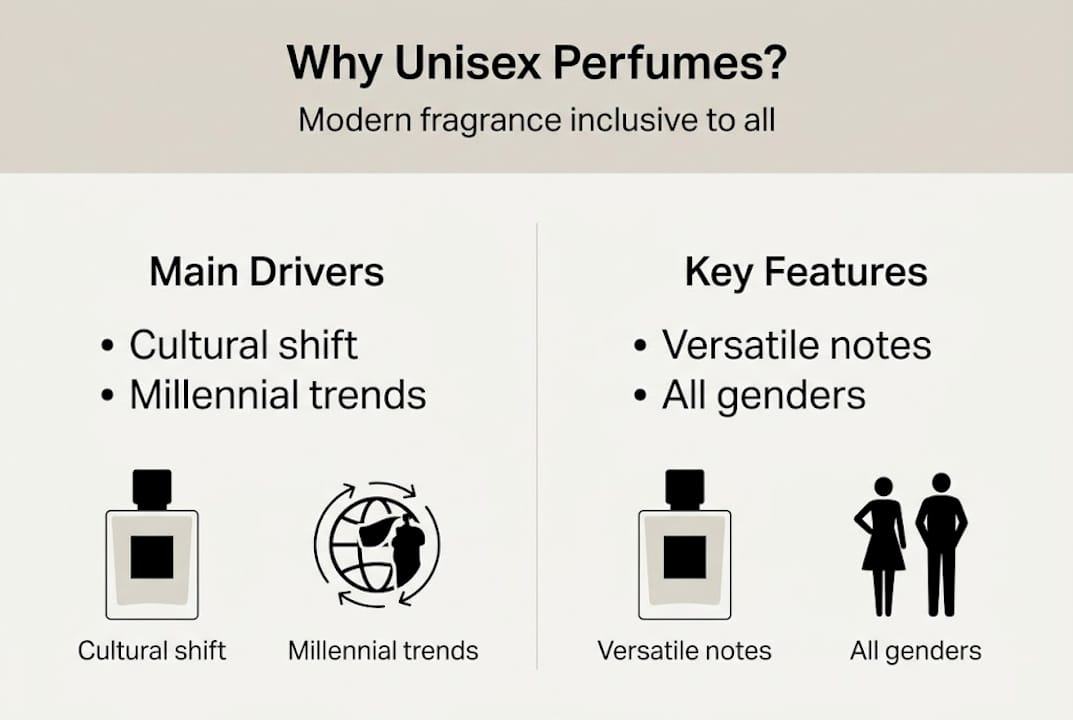
Cultural moments have accelerated this shift too. Gender-fluid fashion on major runways, celebrities openly wearing fragrances marketed to the opposite gender, and the rise of minimalist lifestyle values have all normalized the idea that a great scent is simply a great scent.
Key factors driving demand for unisex fragrances:
- Growing commitment to equality and self-expression across demographics
- Flexibility to wear one fragrance across multiple contexts and moods
- Convenience for gifting without worrying about gender assumptions
- Alignment with minimalist and capsule wardrobe trends
- Broader acceptance of gender-fluid identity and presentation
| Segment | 2023 Market Value | Projected 2031 Value | CAGR |
|---|---|---|---|
| Global unisex fragrances | $19.75B | $33.42B | 6.81% |
| Premium unisex segment | ~40% of premium sales | Growing | Above average |
Statistic to know: Unisex fragrances now account for roughly 40% of premium fragrance sales, driven by Millennials and Gen Z actively rejecting gendered labels.
For anyone serious about fragrance, whether as a personal passion or a gifting strategy, this market context matters. The guide to unisex perfumes is no longer a side conversation. It’s the main event.
Debunking the myth: The science of scent and gender
Market trends are undeniable, but what does science say about gender and scent itself?
The short answer: biology doesn’t dictate your scent preferences as much as you think. Blind tests reveal no strong innate gender perception in fragrances. When people can’t see labels or packaging, their preferences don’t split neatly along gender lines. Individual variation, shaped by memory, culture, and personal experience, matters far more than biology.
This is a genuinely surprising finding. Most of us assume there’s something hardwired about preferring florals or woods, something rooted in biology. But the research points elsewhere. What we call “masculine” or “feminine” scents are largely learned associations, not instincts.
In these studies, participants typically rated scents using a process like this:
- Smell the fragrance without any visual or contextual cues
- Rate it on dimensions like pleasantness, intensity, and familiarity
- Guess whether it was marketed to men, women, or neither
- Explain personal associations or memories triggered by the scent
- Revisit ratings after seeing the actual product label
The pattern researchers found was consistent: ratings shifted significantly after labels were revealed, proving that packaging and marketing shape our perception more than the scent itself.
“Scent preferences are individual, not biologically dictated. Blind testing consistently shows that people cannot reliably assign gender to a fragrance based on smell alone.” Nature, 2025
This has real implications for how you shop. If you’ve been avoiding certain notes because they felt “not for you,” you may be responding to a label rather than the actual scent. Understanding how scent breaks gender barriers is the first step toward finding fragrances you genuinely love.
Pro Tip: Next time you’re testing fragrances, try smelling strips without looking at the bottle or brand name first. Your unfiltered reaction is far more reliable than any label.
What makes a perfume truly unisex?
Now that we’ve challenged gender assumptions, let’s clarify what structurally defines a unisex perfume.
It’s not just about removing pink or blue from the packaging. A truly unisex fragrance achieves balance at the compositional level. Balanced note structures like citrus-woody-musk combinations replace the dominant gender-coded elements that traditionally separated men’s and women’s perfumes. Instead of leaning heavily into powdery florals or aggressive woods, unisex scents find a middle ground that reads as sophisticated and personal rather than categorized.
Common unisex building blocks include:
- Citrus top notes (bergamot, lemon, grapefruit) that open fresh and clean
- Woody base notes (sandalwood, cedarwood, vetiver) that anchor without being heavy
- Musk and amber that add warmth and skin-like softness
- Aquatic or green accords for lightness and versatility
| Fragrance type | Typical notes | Gender coding | Versatility |
|---|---|---|---|
| Traditional men’s | Heavy woods, leather, tobacco | Strong masculine | Lower |
| Traditional women’s | Powdery florals, sweet vanilla | Strong feminine | Lower |
| Unisex | Citrus, musk, balanced woods | None | High |
| Niche/experimental | Unusual accords, raw materials | Varies | Variable |
Unisex perfumes also adapt well across occasions and seasons. A well-chosen unisex scent can move from a morning meeting to an evening dinner without feeling out of place. It can work in summer heat or winter cold with equal confidence. For more on choosing the right fit, what are unisex perfumes offers a solid starting framework.
Occasions where unisex scents shine:
- Professional environments where subtlety matters
- Casual weekend wear that needs flexibility
- Travel, where one bottle needs to cover multiple situations
- Gifting, where you can’t predict the recipient’s preferences
Pro Tip: When selecting a unisex fragrance for daily use or gifting, look for citrus or musk-forward compositions. They tend to be the most universally appreciated and least polarizing across skin types and personal styles.
Real-world advantages: Why unisex perfumes are practical
Understanding the composition helps, but what are the real-life benefits of choosing unisex perfumes?
The most immediate advantage is versatility. A single unisex fragrance can anchor your entire scent wardrobe. It doesn’t demand a specific outfit, season, or occasion. You wear it because it suits you, not because the bottle told you to. That kind of flexibility has real value, especially if you travel frequently or prefer a streamlined approach to personal style.

Gifting is where unisex perfumes truly earn their place. Choosing a fragrance for someone else is notoriously difficult. You’re guessing at their skin chemistry, their taste, and their mood associations. Unisex scents remove the additional layer of gendered assumptions, narrowing the risk considerably. A well-chosen unisex fragrance says “I thought about what you’d enjoy” rather than “I assumed what you should smell like.”
Top practical advantages of unisex fragrances:
- Ideal for travel since one bottle covers all situations
- Easy to share between partners or household members
- More cost-efficient when one quality bottle replaces several specialized ones
- Supports a minimalist approach to personal care
- Inclusive by design, suitable for any identity or presentation
- Removes the guesswork from fragrance gifting
Worth noting: Unisex fragrances now represent roughly 40% of premium fragrance sales globally, reflecting their growing status as a first choice rather than an alternative.
There’s also a quality argument here. Many of the most acclaimed niche and artisan perfumers work primarily in unisex territory. They’re less constrained by marketing briefs about what men or women “should” want, which often leads to more creative, complex, and interesting compositions. Choosing unisex frequently means choosing better.
A fresh perspective: Scent as self-expression, not category
The practical benefits are clear, but what does embracing unisex perfume mean on a deeper level?
We think the most important shift isn’t in the bottle. It’s in the mindset. For too long, fragrance marketing told people what they were supposed to want based on gender. That’s not a scent philosophy. That’s a sales strategy. The best perfumers have always known that scent breaks gender categories when it’s done with real intention.
There’s a genuine tension worth acknowledging though. Some fragrances try to be universally appealing and end up being universally forgettable. A scent that offends no one often moves no one either. The goal isn’t to erase personality. It’s to stop letting gender do the work that personal taste should do.
“Some traditionally masculine notes become genuinely unisex through balance and modern technique, but over-projection can polarize rather than invite.” The Cut, 2025
The best unisex fragrances have a point of view. They’re not trying to please everyone. They’re trying to express something specific, and that specificity happens to transcend gender. That’s the standard worth holding fragrance to, whether you’re buying for yourself or someone you care about.
Discover your next signature with Be Frsh
Ready to experiment with scent beyond binaries? Exploring unisex fragrances is much easier when you can try before you commit to a full bottle.
At Be Frsh, we offer a wide selection of unisex fragrance samples and travel-sized options from popular and niche houses, so you can test what actually works on your skin before investing. Our guides help you confidently choose scents that match your personality, lifestyle, and gifting needs. Whether you’re new to unisex fragrances or deepening an existing collection, sampling is the smartest first step. Browse our collection and find the scent that’s simply, unapologetically yours.
Frequently asked questions
Are unisex perfumes suitable for every skin chemistry?
Yes, unisex perfumes are formulated for versatility and generally perform well across a wide range of skin types, though individual results can vary based on skin pH and moisture levels.
What scents are most common in unisex perfumes?
Citrus, woody, musk, and light floral notes in balanced combinations are the most common building blocks, chosen specifically for their broad and cross-demographic appeal.
How is a unisex perfume different from a gender-neutral one?
Unisex perfumes are designed to suit any gender with full sensory appeal, while gender-neutral scents may deliberately minimize all associations. In practice, both terms are often used interchangeably in the market.
Why are unisex perfumes a strong choice for gifting?
They remove the risk of gendered assumptions entirely, making them ideal for gifting to anyone regardless of identity, taste, or occasion, which is why they’ve become a go-to for thoughtful gift-givers.