

Perfume Discovery Process: A Sampling Guide

Testing perfume on your own skin is the most reliable way to understand how it really feels. This guide shows how to sample and compare fragrances calmly so you can choose with confidence instead of rushing.
Buying a full-size bottle you have only smelled in a store is a common way to end up with a fragrance that disappoints. This guide walks through a step-by-step discovery process built around sampling, so you can find a scent that genuinely suits your taste, season and lifestyle. Instead of chasing trends, you compare each fragrance on your own skin and decide for yourself.
Why sampling works
Buying a full-size perfume without testing is like buying a car without a test drive. A fragrance can smell quite different on your skin than it does in the bottle or on a paper strip, and that difference only becomes clear over a few hours of wear.
Sampling lowers the financial risk by letting you experience how a fragrance develops before you commit. Digital descriptions and quick counter tests rarely capture how a scent unfolds over time on your own skin chemistry. A physical sample gives you the real experience you need to decide.
Curated sample sets help focus your exploration on fragrances that are more likely to match your taste, chosen with an understanding of fragrance families, note profiles and seasons. The key benefits of sampling methodically include:
- Less wasted money on bottles you never reach for
- More confidence in your final choice
- The chance to discover scents you might never have tried in a store
- A real sense of how a fragrance interacts with your own skin
Sampling turns perfume buying from guesswork into a calmer, more deliberate process – and protects your budget along the way.
What you need before you start
A good sampling session starts with a little preparation. Access to high-quality, well-stored curated sample sets gives you an accurate impression. Generic or poorly stored samples can misrepresent how a fragrance really smells.
Your environment matters too. A neutral, scent-free space prevents false impressions caused by competing smells, so avoid testing near cooking aromas, air fresheners or other fragrances.
Time is the other ingredient most people underestimate. Give yourself a couple of weeks to test several perfumes properly, so you can experience each one from its top notes through to its base. Rushing means you never see how a fragrance changes through the day.
A simple patch test protects your skin. Apply a small amount to your inner forearm and wait 24 hours. If you notice redness or itching, you have spared yourself a larger problem.
A little organisation keeps scents from overlapping:
- Test one perfume per day for accurate comparisons
- Use a notebook or app to track impressions
- Photograph sample bottles for easy reference
- Note the weather and your activities while testing
- Record how long each fragrance lasts on your skin
| Tool | Purpose | Why it matters |
|---|---|---|
| Quality samples | Authentic scent testing | Poor samples misrepresent fragrances |
| Clean environment | Accurate scent perception | Competing odours confuse your nose |
| Testing journal | Track impressions | Memory fades; notes help comparisons |
| Fragrance blotters | Initial evaluation | Test without skin contact first |
| Calendar | Schedule tests | Prevents overlap and fatigue |
Pro tip: Test perfumes in the morning, when your sense of smell tends to be sharpest. Your nose grows tired through the day as it takes in other scents.
A step-by-step sampling method
Follow this approach to get a clear read on each scent. Testing on blotters first, giving the fragrance time to develop, and using travel-size sprays all improve accuracy.
- Smell the perfume on a blotter to catch the top and middle notes without committing it to skin.
- Wait about ten minutes after spraying the blotter so the alcohol evaporates and the true scent emerges.
- Apply one spray to your inner wrist or forearm – a single spray is enough to avoid overwhelming your senses.
- Wait at least 30 minutes before evaluating, letting the fragrance interact with your skin.
- Smell your wrist now and then over the next few hours to follow how the perfume moves through its note stages.
- Wear it in your daily environment, not just at home, to see how it performs in real conditions.
- Ask a trusted friend for their impression, since a fragrance can smell different to others than to you.
- Space your testing across days to avoid scent fatigue and keep comparisons clean.
Test one perfume at a time in a neutral space. Your nose can only judge one fragrance well at a time, and testing several at once tends to blur them together.
Travel-size spray samples are handy here. They apply a consistent amount and let you test the same fragrance in different settings across your week.
Pro tip: Smell coffee beans between fragrances to help reset your sense of smell – a simple trick to clear scent fatigue and sharpen your perception.
Write down your impressions straight after each phase. Note how the fragrance opens, develops and settles, and whether it suits day or evening, casual or formal, and which season feels right.
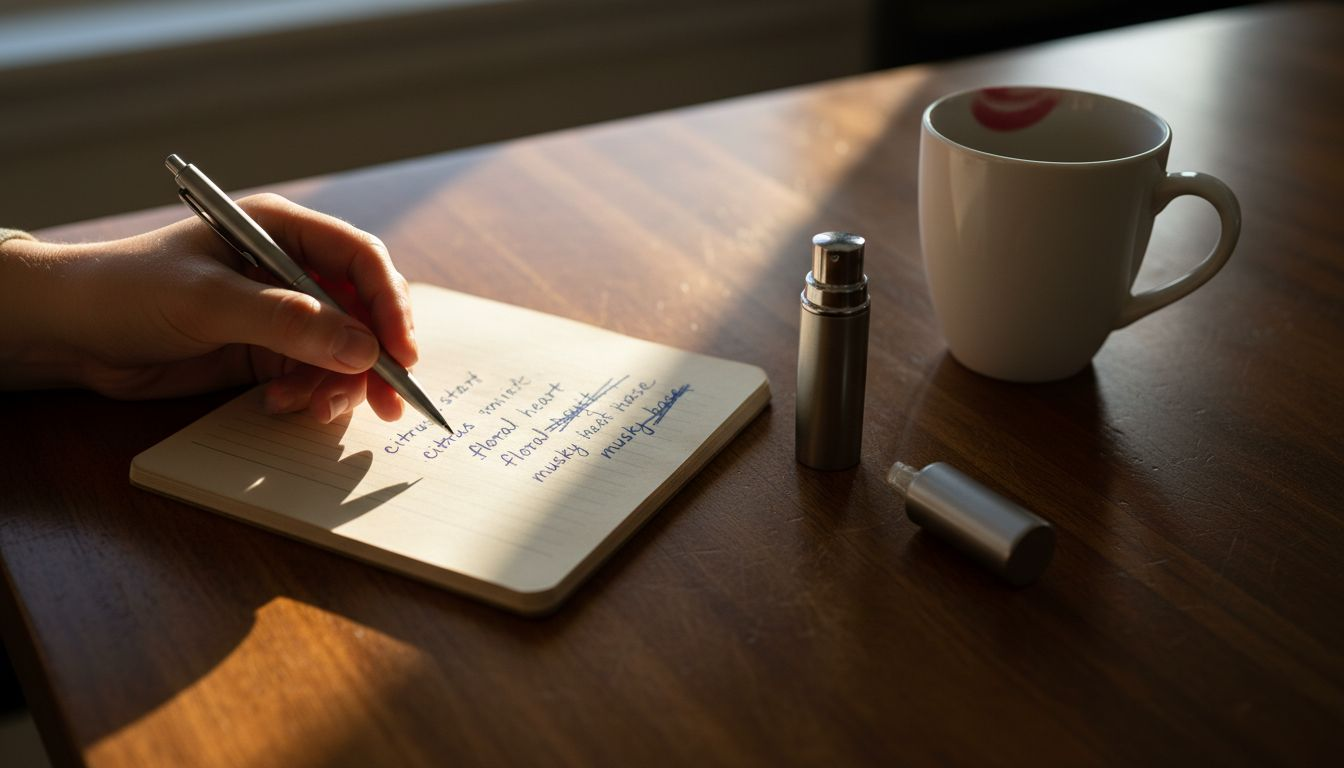
These testing steps take a little patience, but they leave you knowing exactly what you are buying before you spend on a full bottle.
Common mistakes to avoid
Even experienced enthusiasts make avoidable errors while sampling. Knowing them helps you sidestep them.
Skipping the patch test raises the risk of an allergic reaction. Some people only discover a sensitivity after applying a perfume generously. A simple 24-hour patch test on your inner arm helps prevent uncomfortable reactions and wasted money.
Testing several scents at once causes confusion, because your nose struggles to tell fragrances apart when they compete. The result is a muddled impression and a harder decision.
Pitfalls to watch for:
- Testing when you are congested or unwell, which dulls accuracy
- Applying samples to clothes instead of skin, missing the skin interaction
- Deciding based only on the first few minutes
- Testing in stores full of competing fragrances
- Ignoring how a perfume performs over several hours
Give each fragrance the attention it deserves, with breaks between samples. If you feel rushed, it is better to postpone testing until you can focus.
A common mistake is judging a perfume on its first 15 minutes. Fragrances evolve considerably over hours, and the dry-down often decides whether you love or tire of a scent over the long term.
Avoid testing on broken or irritated skin. Cuts, rashes or sunburn can react poorly to fragrance ingredients, so wait until your skin has healed. And remember that bright lights, competing scents and sales pressure in a department store make honest evaluation hard – take samples home and test in your own environment.
Timeline and cost
Knowing the time and cost involved helps set realistic expectations. Most people need a couple of weeks to settle confidently on a fragrance that truly suits them.
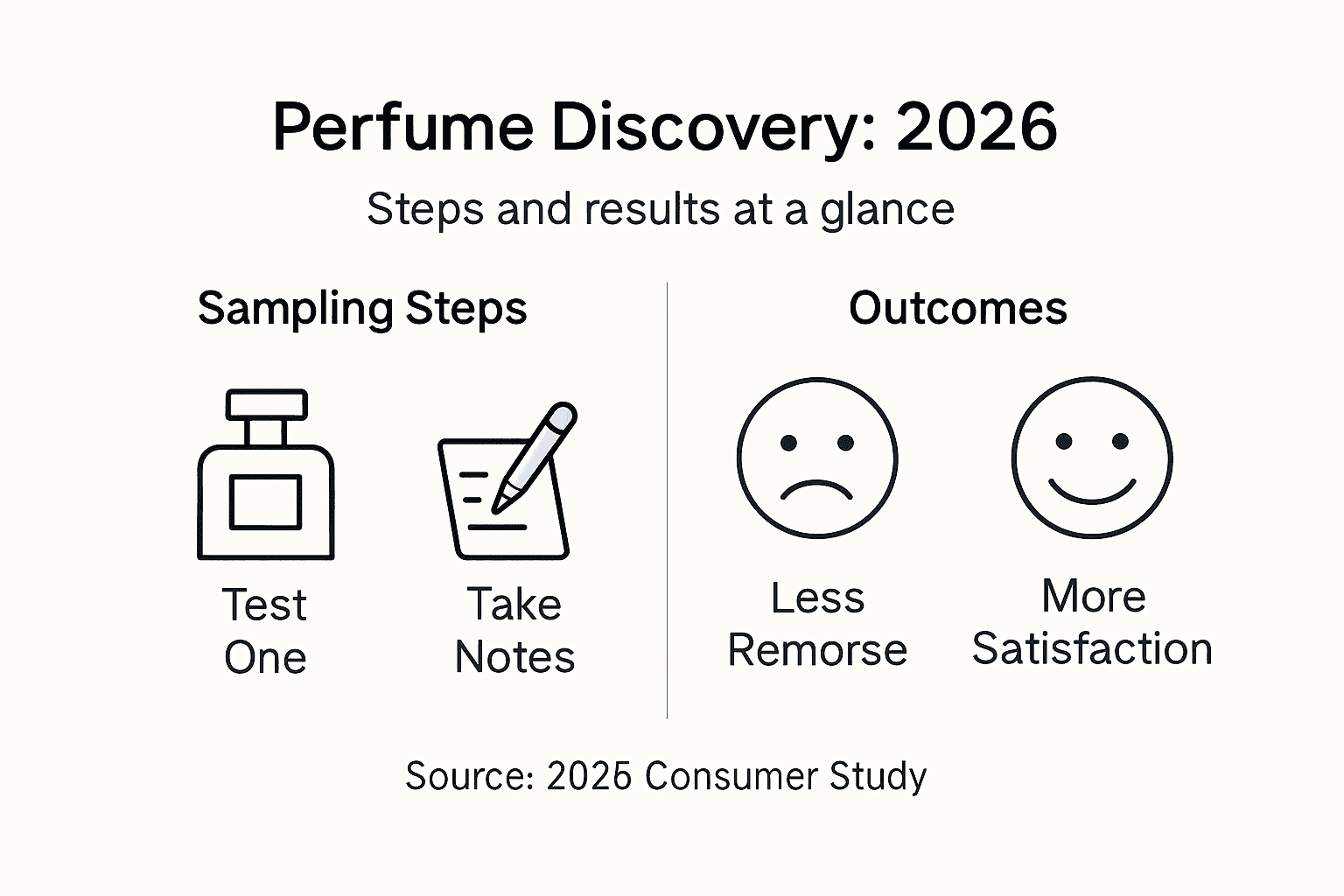
A small sample costs only a fraction of a full bottle, which makes it a sensible insurance against an expensive mistake. Returns, by contrast, cost time, shipping and stress – and many retailers will not accept an opened perfume at all, leaving you stuck with a bottle you never wear.
| Phase | Duration | Activities | Outcome |
|---|---|---|---|
| Initial selection | 1–2 days | Research and choose 3–5 samples | A focused sample set |
| Sample arrival | A few days | Wait for delivery | Samples ready to test |
| Testing period | 2–3 weeks | Test each perfume several times | Clear preferences emerge |
| Final decision | 1–2 days | Compare notes and choose | A confident purchase |
When you choose well the first time, you wear and enjoy that fragrance far more, and your cost per wear drops. Spending a modest amount on samples is a simple way to avoid wasting much more on a bottle that ends up forgotten on a shelf.
Other discovery approaches
Physical samples are not the only option. Apps, websites and virtual consultations all have a place, each with its own strengths and limits.
Physical samples give you the full experience, including how a fragrance behaves on your own skin throughout the day. That is something no virtual method can fully replicate.
Recommendation apps and quizzes use your preferences to narrow the field, which is genuinely useful for shortlisting – but they cannot reproduce an actual scent. Spray samples, meanwhile, deliver a consistent amount and let you test the same fragrance repeatedly over weeks.
The main limitation of virtual tools is that they cannot show how a perfume evolves from its fresh opening to its deep base notes over several hours. That evolution often decides whether a scent becomes a long-term favourite.
| Method | Strength | Limit | Best for |
|---|---|---|---|
| Physical samples | True skin experience | Takes time | Serious buyers |
| Store testing | Immediate and free | Competing scents, sales pressure | Initial exploration |
| Recommendation apps | Quick shortlisting | No real scent experience | Preliminary research |
| Virtual consultations | Guidance and education | No skin testing | Learning the basics |
| Subscription boxes | Ongoing variety | Recurring cost | Continuous discovery |
Combining methods often works best. Use a quiz or app to identify fragrance families that appeal to you, then order physical samples of specific perfumes to test properly. This hybrid approach balances efficiency with accuracy.
Safety and sensitivity
Fragrance sensitivity varies from person to person. Some people react to specific ingredients while others tolerate most perfumes well, so it is worth taking a few simple precautions.
Patch test before regular use of any new perfume. Apply a small amount to your inner forearm and wait 24 hours, checking for redness, itching or swelling. If anything appears, avoid that fragrance. The inner forearm has sensitive skin similar to where you would normally wear perfume, so it gives a reliable signal.
Avoid testing on broken or irritated skin – cuts, rashes, eczema or sunburn all increase the risk of a reaction. Wait until your skin has healed.
Key safety practices:
- Patch test new fragrances 24 hours before regular use
- Apply samples to intact, healthy skin only
- Start with one spray to gauge your reaction
- Keep samples away from eyes and mucous membranes
- Store samples in cool, dark places away from children
- Stop use immediately if irritation occurs
A careful patch-testing routine takes little time but helps prevent reactions, and it matters most for anyone with known sensitivities.
Fragrance allergies can develop at any age, even to scents you have used before. Patch testing new perfumes helps protect against unexpected reactions and can flag problematic ingredients.
If you have a history of reactions to cosmetics or fragrances, consider speaking with a dermatologist before extensive sampling. Professional allergy testing can identify specific problem ingredients to avoid. Anyone pregnant or nursing should also take extra care and consult a healthcare provider before testing new fragrances.
Bringing it together
Successful perfume discovery comes from combining the habits above. Start with curated samples to focus your search, and give yourself two to three weeks to test and compare properly so you experience each fragrance's full evolution.
Use a neutral, scent-free space, since environmental odours distort your perception. Always patch test before committing to regular use, even for fragrances that seem mild. And test methodically – blotters first, then skin – documenting your impressions as you go.
A simple checklist:
- Choose 3–5 samples from curated sets to start
- Test one perfume per day to avoid confusion
- Apply in the morning when your sense of smell is sharpest
- Track impressions in a notebook or app
- Wait at least 30 minutes after applying before evaluating
- Follow the full evolution over several hours
- Ask others how the perfume smells on you
- Decide only after testing all samples more than once
Approached this way, choosing a fragrance becomes a calm, confident process – and you end up wearing a scent that genuinely fits you.
Explore curated samples with Be Frsh
Ready to start your discovery with confidence? Be Frsh offers curated perfume sample sets made for exactly the kind of systematic testing described here, focused on quality fragrances across women's, men's and unisex categories.
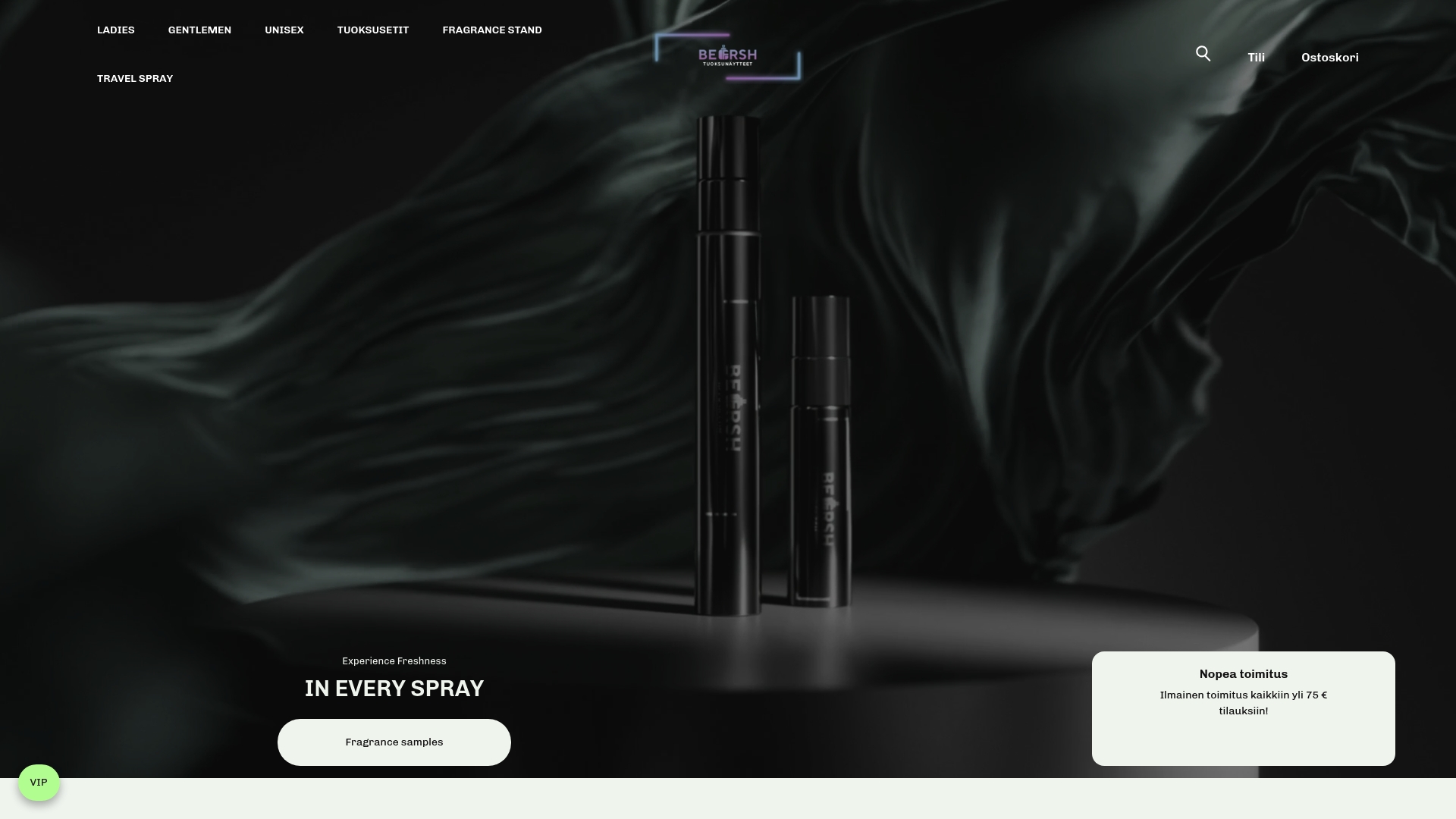
Travel-size spray samples make testing convenient wherever you are, with consistent application across several sessions, so you can experience each fragrance properly before committing to a full bottle. Visit the Be Frsh collections to explore curated sets and start your perfume journey with the confidence that comes from informed choices.
Frequently asked questions
How many perfume samples should I test before buying a full bottle?
Testing 3–5 samples lets you compare different scent families and find a good match. Fewer than three limits your perspective, while too many can cause decision fatigue. Focus on quality over quantity.
Can I test multiple perfumes on the same day?
Yes, but apply only one to your skin per day for accurate results. You can smell several on blotters in the same session to narrow your choices, then save skin testing for your top candidates to avoid scent confusion.
How long should I wait between applying different perfume samples?
Wait at least 24 hours between skin applications so the previous fragrance fully dissipates. Your skin holds scent molecules longer than you might notice, and overlapping fragrances create muddled comparisons.
Do perfume samples expire or lose their scent over time?
Properly stored samples last a good while before noticeable degradation. Keep them in cool, dark places away from sunlight and heat. Spray bottles preserve better than open vials because less air exposure means less oxidation.
What is the best time of day to test perfume samples?
Morning testing tends to give the most accurate results, when your sense of smell is sharpest. Avoid testing after meals, during illness or while wearing other scented products.
Should I test perfumes on my wrist or another body area?
Test on your inner wrist or forearm, where the skin is accessible and the temperature is consistent. These pulse points warm the fragrance and make it easy to smell throughout the day.
Recommended reading
Avoimuus: tämä artikkeli on laadittu tekoälyavusteisesti, ja sisältö on tarkistettu ennen julkaisua. Kuvituskuvat voivat olla tekoälyllä luotuja.