

Why sample fragrances: 52% less buyer's remorse in 2026

Many fragrance shoppers experience disappointment after purchasing full bottles without testing them first. The scent that smelled perfect in the store often transforms completely on your skin, leading to expensive regrets. Sampling fragrances before committing to a full bottle solves this problem by revealing how a perfume truly interacts with your unique body chemistry. This approach has proven remarkably effective, reducing buyer’s remorse by more than half compared to blind purchases. As we explore why sampling is important, let’s first highlight the key takeaways to keep in mind.
Table of Contents
- Key takeaways
- How your skin changes the way fragrances smell
- Financial benefits and reducing buyer’s remorse with samples
- Unlocking the full fragrance pyramid through skin testing
- Future trends and innovations improving fragrance sampling
- Practical tips for sampling fragrances effectively
- Discover curated perfume samples at Be Frsh
- FAQ
Key Takeaways
| Point | Details |
|---|---|
| Skin chemistry matters | Your skin’s pH, oils, hydration, and microbiome shape how a fragrance unfolds, so testing on your skin reveals the true scent. |
| Remorse reduction via sampling | Sampling reduces buyer’s remorse by about 52 percent compared with buying blind. |
| Sample cost efficiency | A fragrance sample typically costs five to fifteen dollars, a small upfront cost compared with a full bottle. |
| Fragrance evolution through day | Testing across the day shows how a scent evolves from morning to evening on your skin. |
How your skin changes the way fragrances smell
Your skin acts as a living canvas that transforms every fragrance you apply. Individual body chemistry affects scent perception through factors like pH levels, natural oils, temperature, and even your unique skin microbiome. What smells floral and fresh on a paper blotter might turn musky or powdery on your wrist within minutes.
The same perfume can smell completely different on two people standing side by side. Your skin’s pH balance determines whether certain fragrance molecules amplify or fade. Oily skin tends to hold scents longer and project them more strongly, while dry skin may cause fragrances to dissipate quickly or smell sharper.
Several key factors influence how fragrances develop on your skin:
- pH levels: Acidic skin (below 5.5) can make sweet notes turn sour, while alkaline skin enhances floral and citrus notes
- Natural oils: Higher sebum production extends fragrance longevity but may alter lighter top notes
- Hydration: Well-moisturized skin holds fragrance molecules better than dehydrated skin
- Microbiome: Your unique bacterial ecosystem interacts with perfume compounds, creating personalized scent signatures
Testing a fragrance on paper strips or smelling it directly from the bottle gives you zero insight into how it will actually smell on you. The warmth of your skin activates volatile compounds differently than room temperature air. Your body’s natural scent mingles with the perfume, creating a completely unique result that no one else will experience exactly the same way.
Pro Tip: Apply a perfume sample in the morning and check it at lunch, late afternoon, and evening to observe how it evolves throughout the day on your specific skin chemistry.
Understanding these personal scent variations leads us to explore how sampling can also protect your investment and satisfaction.
Financial benefits and reducing buyer’s remorse with samples
Buying a full bottle of perfume without testing it first is like purchasing a car without a test drive. The financial risk becomes painfully clear when you realize that luxury fragrances often cost $150 to $300 for a standard 50ml bottle. A sample of the same fragrance typically costs $5 to $15, representing just 5-10% of the full bottle price.
The math becomes even more compelling when you consider failure rates. Sampling reduces buyer’s remorse by 52% compared to purchasing full bottles without prior testing. This means more than half of blind purchases end up sitting unused on bathroom shelves, representing hundreds of dollars in wasted spending.
| Purchase Method | Average Cost | Buyer’s Remorse Rate | Effective Cost per Satisfactory Purchase |
|---|---|---|---|
| Full bottle (no sample) | $200 | 48% | $385 (accounting for failures) |
| Sample first, then bottle | $210 ($10 sample + $200 bottle) | 23% | $273 (accounting for fewer failures) |
| Multiple samples before deciding | $240 (4 samples + $200 bottle) | 12% | $273 (minimal failures) |
The data reveals a counterintuitive truth. Spending slightly more upfront on samples actually reduces your total cost per fragrance you genuinely love. When you skip sampling, nearly half your purchases become expensive mistakes. Those failed purchases dramatically inflate your real cost per wearable perfume.
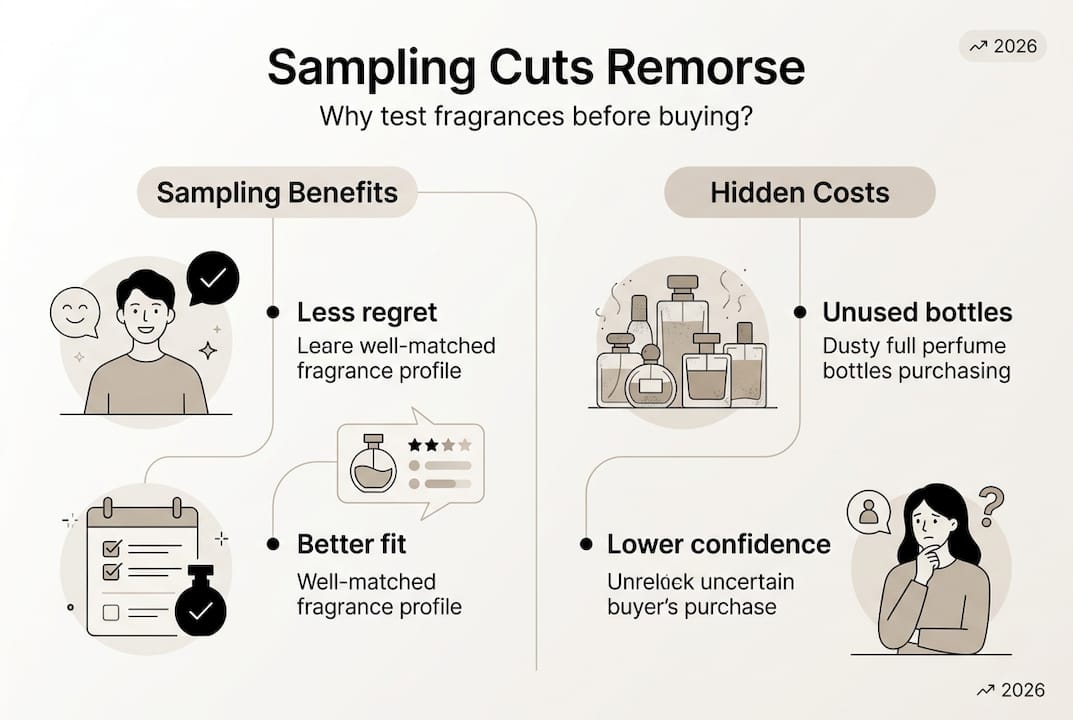
Sampling also prevents the sunk cost fallacy trap. Without testing first, you might force yourself to wear a fragrance you dislike simply because you spent $200 on it. This leads to months of dissatisfaction and compliments you’ll never receive. Testing with carefully chosen samples eliminates this psychological burden entirely.
Consider the hidden costs beyond the bottle itself. A fragrance you don’t love affects your confidence, your mood, and how others perceive you. The $10 you spend on a sample protects not just your wallet but your daily experience and social interactions.
Pro Tip: Start by sampling three variations of fragrances you already enjoy to refine your preferences before exploring completely new scent families.
Beyond the financial benefits, it’s important to consider how sampling reveals the full complexity of a fragrance over time.
Unlocking the full fragrance pyramid through skin testing
Every quality perfume is built like a pyramid with three distinct layers that reveal themselves over time. The fragrance pyramid structure includes top notes that you smell immediately, heart notes that emerge after 15-30 minutes, and base notes that linger for hours. You cannot experience this complete evolution by smelling a bottle or testing on paper.
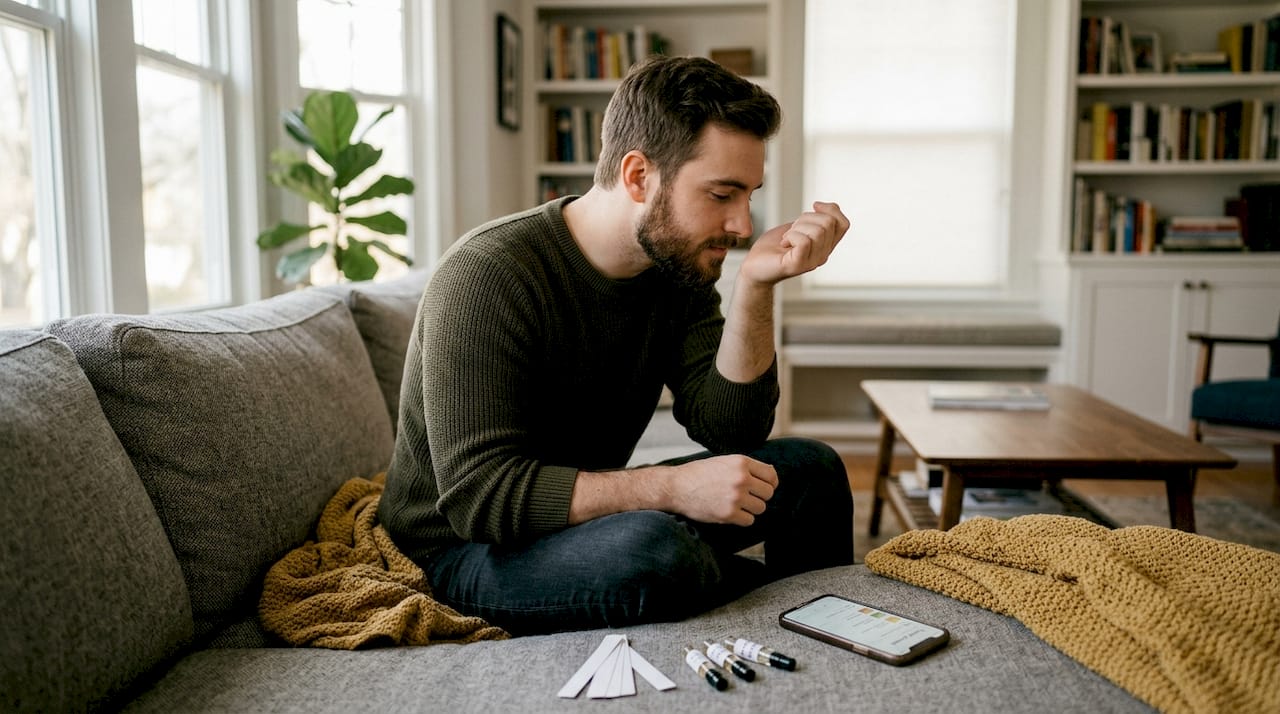
Top notes are the lightest, most volatile molecules that evaporate within 5-15 minutes. These create your first impression with bright citrus, fresh herbs, or light florals. Heart notes form the perfume’s true character, developing after the top notes fade and lasting 2-4 hours. Base notes are the heaviest molecules that provide depth and longevity, often featuring woods, musks, or vanilla that can last 6-8 hours or more.
To properly evaluate a fragrance sample and experience all three pyramid levels:
- Apply the sample to clean, unscented skin on your wrist or inner elbow
- Wait 2 minutes, then note the immediate top note impressions without rubbing
- Set a timer for 30 minutes and observe how the scent transforms as heart notes emerge
- Check again after 2 hours to evaluate the heart notes at their peak
- Assess the base notes after 4-6 hours to determine longevity and final impression
- Record your observations to compare against other samples objectively
This systematic approach matters because a perfume might smell amazing for the first 20 minutes but turn unpleasant as it dries down. Conversely, some fragrances start sharp or overwhelming but settle into beautiful complexity. You’ll never discover these transformations by spraying a tester strip at a store counter.
Testing in a controlled environment prevents interference from other scents, strong foods, or environmental factors that distort your perception. Avoid testing fragrances while cooking, immediately after eating spicy food, or in heavily scented spaces. Your nose needs a neutral baseline to accurately assess each sample.
“Skin chemistry testing remains irreplaceable for authentic scent discovery. No technology can replicate the complex interaction between your unique biology and fragrance molecules over time. The full pyramid only reveals itself through patient, methodical skin application.”
Recognizing the complex evolution of scents naturally guides you to smarter sampling practices for confident fragrance choices.
Future trends and innovations improving fragrance sampling
The fragrance industry is embracing technology to enhance how consumers discover and test perfumes. Micro-encapsulation technology allows perfume molecules to be trapped in tiny protective shells that release gradually. This innovation extends longevity testing by simulating how a fragrance performs over 8-12 hours from a single small sample application.
Digital scent profiling uses AI algorithms to analyze your preferences and predict which fragrances might suit you based on past choices. Some services now offer virtual consultations where experts guide you through sample selections via video chat. Subscription boxes curate monthly sample collections tailored to your evolving taste profile and seasonal preferences.
Sustainable sampling methods are gaining traction as brands recognize environmental concerns. Refillable sample vials, biodegradable packaging, and concentrated sample formats reduce waste while maintaining testing effectiveness. Some companies now offer sample swapping programs where you can exchange unused samples with other fragrance enthusiasts.
Key advantages and limitations of modern sampling innovations:
- Micro-encapsulation: Extends testing duration but cannot replicate natural skin chemistry interactions perfectly
- AI recommendations: Saves time exploring options but may miss unexpected fragrances you’d love outside your usual profile
- Virtual consultations: Provides expert guidance remotely but lacks the immediacy of in-person scent evaluation
- Subscription services: Introduces variety regularly but may include fragrances you wouldn’t have chosen independently
- Sustainable formats: Reduces environmental impact but sometimes offers smaller quantities per sample
Despite these technological advances, nothing replaces the fundamental practice of applying perfume to your actual skin and observing how it develops over hours. Innovations enhance convenience and discovery but the core principle remains unchanged. Your unique body chemistry is the ultimate testing ground that no algorithm or encapsulation method can fully simulate.
The smartest approach combines new tools with traditional methods. Use AI recommendations to narrow your choices, leverage micro-encapsulation for extended wear testing, but always validate with thorough skin trials before committing to a full bottle. Technology serves as a helpful filter, not a replacement for authentic personal testing.
With this understanding, let’s see how you can apply this knowledge to sample fragrances smartly and confidently.
Practical tips for sampling fragrances effectively
Selecting the right samples requires strategy beyond randomly choosing bottles with attractive packaging. Consider your lifestyle, the occasions you need fragrances for, and the seasons when you’ll wear them most. A heavy oriental perfume perfect for winter evenings will feel suffocating during summer days at the office.
Start your sampling journey with these selection guidelines:
- Match samples to specific occasions: Choose lighter citrus or aquatic scents for work, richer orientals for evening events, fresh florals for casual daytime wear
- Consider seasonal appropriateness: Test warm spicy scents in fall/winter, bright florals in spring, fresh aquatics in summer
- Explore within your preference zone first: Sample variations of scent families you already enjoy before venturing into completely unfamiliar territory
- Include one wildcard: Add one unexpected sample outside your comfort zone to potentially discover a surprising new favorite
- Limit simultaneous testing: Never test more than 2-3 fragrances in a single day to avoid olfactory fatigue and confusion
Application technique dramatically affects your testing results. Spray or dab the sample on pulse points where blood flow brings warmth to the surface: inner wrists, inner elbows, or behind ears. Never rub your wrists together after application, as this crushes fragrance molecules and distortions the scent development.
Wait at least 4 hours between testing different fragrances on the same skin area. Your nose adapts to scents quickly, making it difficult to evaluate a new fragrance accurately when another is still present. If you must test multiple samples in one day, use different pulse points for each and take breaks outdoors in fresh air to reset your olfactory system.
| Common Sampling Mistake | Recommended Practice | Why It Matters |
|---|---|---|
| Testing 5+ fragrances in one store visit | Limit to 2-3 samples per day maximum | Prevents olfactory fatigue and confusion |
| Rubbing wrists together after applying | Let samples dry naturally without rubbing | Preserves molecular structure and true scent development |
| Deciding immediately after application | Wait 6-8 hours to evaluate full pyramid | Top notes fade quickly; base notes reveal true character |
| Testing on paper only | Always test on skin for final decisions | Paper cannot replicate skin chemistry interactions |
| Ignoring environmental factors | Test in neutral, unscented environments | Food, smoke, and other scents distort perception |
Documentation transforms casual sampling into a systematic discovery process. Create a simple journal noting the fragrance name, application time, and your impressions at 30 minutes, 2 hours, and 6 hours. Record whether you received compliments, if the scent gave you a headache, and how it made you feel emotionally.
This written record becomes invaluable when comparing multiple samples over weeks. Your memory of how a fragrance smelled three days ago will be unreliable, but notes provide objective comparison points. You’ll spot patterns in which note families work best on your skin and which occasions demand specific scent profiles.
Pro Tip: Keep a fragrance journal on your phone with photos of each sample vial and timestamped notes throughout the day to track exactly how each scent evolves on your unique skin chemistry.
Apply these systematic testing methods consistently and you’ll develop expertise in identifying which fragrances truly suit you. This knowledge prevents impulse purchases and builds confidence in your sample selections going forward.
Having these practical tools ensures you make the most of fragrance sampling, maximizing satisfaction before purchase.
Discover curated perfume samples at Be Frsh
Finding your signature scent shouldn’t involve guesswork or expensive mistakes. Be Frsh specializes in curating high-quality perfume samples that let you explore fragrances confidently before committing to full bottles. The collection spans popular designer scents and niche discoveries across women’s, men’s, and unisex categories.
Every sample in the Be Frsh catalog is carefully selected to represent diverse scent families and occasions. Whether you’re searching for a fresh daily wear fragrance or a sophisticated evening scent, the curated selection removes the overwhelm of endless options. Expert guidance helps you navigate choices based on your preferences and lifestyle needs.
The platform prioritizes accessibility to ensure everyone can enjoy the fragrance discovery process regardless of ability. Fast shipping and customer-focused service make testing new scents convenient and enjoyable. Visit Be Frsh to start your personalized sampling journey and discover fragrances that truly match your unique chemistry.
FAQ
What are perfume samples and why are they important?
Perfume samples are small quantities of fragrance, typically 1-5ml, designed for testing before purchasing full bottles. They allow you to experience how a scent develops on your specific skin chemistry over several hours. Samples prevent expensive buyer’s remorse by revealing whether a fragrance truly suits you before investing $150-300 in a full bottle.
How should I test a perfume sample to get accurate results?
Apply the sample to clean pulse points like your inner wrist or elbow and observe how it evolves over 6-8 hours. Avoid rubbing the application area, testing multiple fragrances simultaneously, or evaluating in scented environments. Check the scent at 30 minutes, 2 hours, and 6 hours to experience the complete fragrance pyramid from top notes through base notes. For detailed guidance, explore effective testing techniques.
Are fragrance samples worth the extra cost and effort?
Samples cost 5-15% of full bottle prices but reduce buyer’s remorse significantly. The upfront investment of $10-15 in samples prevents wasting $200 on a full bottle you’ll never wear. Most fragrance enthusiasts confirm that sampling is essential despite the initial time and cost, as it leads to much higher satisfaction with final purchases.
How many samples should I test before buying a full bottle?
Test at least 2-3 samples within your preferred scent family before deciding on a full bottle purchase. This comparison reveals which specific fragrance performs best on your skin chemistry and matches your lifestyle needs. If exploring a completely new scent category, consider testing 4-5 samples to understand the range before committing.
Can I trust online fragrance sample descriptions without smelling them first?
Online descriptions provide helpful guidance about note compositions and scent families, but they cannot predict how a fragrance will smell on your specific skin. Use descriptions to narrow your selection, then order samples for actual testing. Your unique body chemistry will transform any fragrance in ways that written descriptions cannot capture or predict accurately.
Leave a comment