

How to choose a perfume: Find your perfect scent easily

Finding the right perfume can feel challenging, with endless options and each scent behaving differently on different people. Perfume reacts uniquely to your body odor and personality, so a mere recommendation may not be enough. Identifying your scent preferences and testing fragrances calmly with samples are key steps on the path to finding a perfume that truly feels like your own – before making a large purchase decision.
Table of Contents
- Step 1: Define Your Scent Preferences and Needs
- Step 2: Use Scent Samples to Compare Options
- Step 3: Test Scents on Your Skin and Observe Their Development
- Step 4: Choose the Best Perfume Based on Your Experiences
Quick Summary
| Key Point | Explanation |
|---|---|
| 1. Define your scent preferences | Consider what scents you like and in what situations you use perfume most. |
| 2. Use scent samples in practice | Test different scents on your skin to see how they develop over time. |
| 3. Document your experiences | Monitor the development of all samples and record your initial impressions at different stages. |
| 4. Choose the best-performing scent | Make your final choice based on what feels right on your skin and pleases you the most. |
Step 1: Define Your Scent Preferences and Needs
Before you start trying hundreds of different scents, it’s worth pausing to consider your own preferences. This will save you time and help you find fragrances that truly resonate with you.
Perfumes are a personal choice. People choose perfumes that work well with their own body aroma, creating unique scent blends. This means that the same perfume can smell different on you than on your best friend.
Start by asking yourself these questions:
- What scents do you like in the world around you? Roses, coffee, the sea, wood?
- How strong a perfume suits you? Do you want something delicate or bold?
- In what situations do you use perfume most? Daily wear, parties, work?
- Whom have I followed before? Friends' recommendations or my own intuition?
Scent preferences are influenced by cultural background, personality, and even unconscious memories. Therefore, finding your own scent begins with knowing yourself.
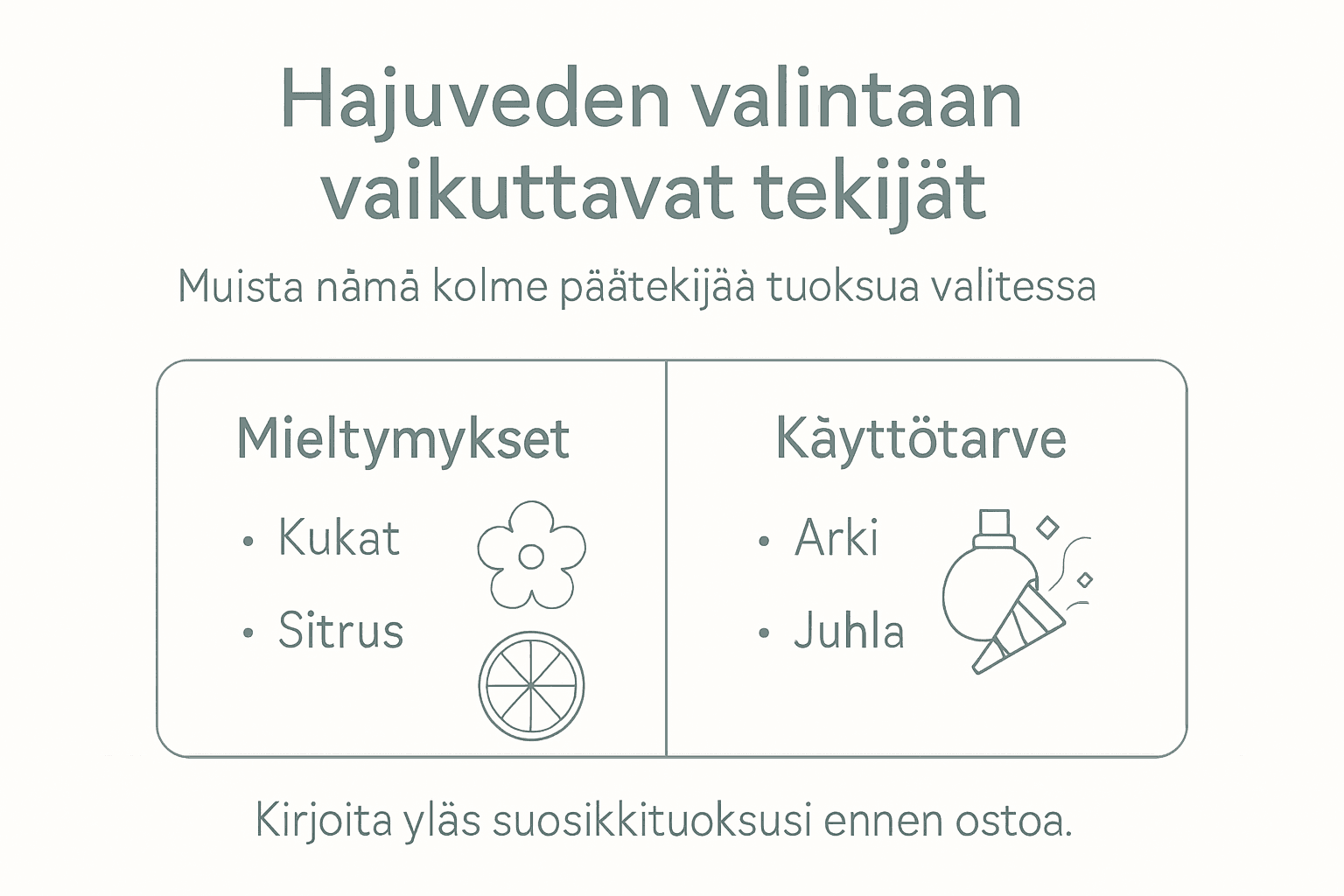
Also consider practical needs. Do you need a light scent for daily use, or perhaps something more special for an evening out? Some people have sensitive skin, so the choice of fragrance also affects how it sits on them.
Next, it’s good to get acquainted with different fragrance families. Basic fragrance terms will help you understand what each scent type means.
Here's a concise comparison of the characteristics and uses of different fragrance families:
| Fragrance Family | Typical Scents | Use | Suitability |
|---|---|---|---|
| Floral | Rose, jasmine | Daily, work | Suitable for most |
| Citrus | Orange, bergamot | Fresh everyday, spring | For fresh skin |
| Oriental | Vanilla, spices | Evenings out, parties | For those seeking warmth |
| Woody | Sandalwood, vetiver | Autumn, winter | For those who value longevity |
| Aquatic | Sea breeze, water lily | Sports, summer | For those who want lightness |
Understanding your own preference is the most important step towards the perfect perfume – other things will follow.
- Scent interests: Compile a list of scents you like in products you currently use or in your environment.
- Lifestyle: Consider your daily situations and what kind of scent would feel appropriate.
- Your own body: Remember that all perfumes react differently to each person's skin.
Pro tip: Write down a few scents you like and try to name their common features – you'll quickly see which fragrance families attract you.
Step 2: Use Scent Samples to Compare Options
Now that you know what you're looking for, it's time to put samples to use. Scent samples are the best way to compare different options without having to buy full bottles.
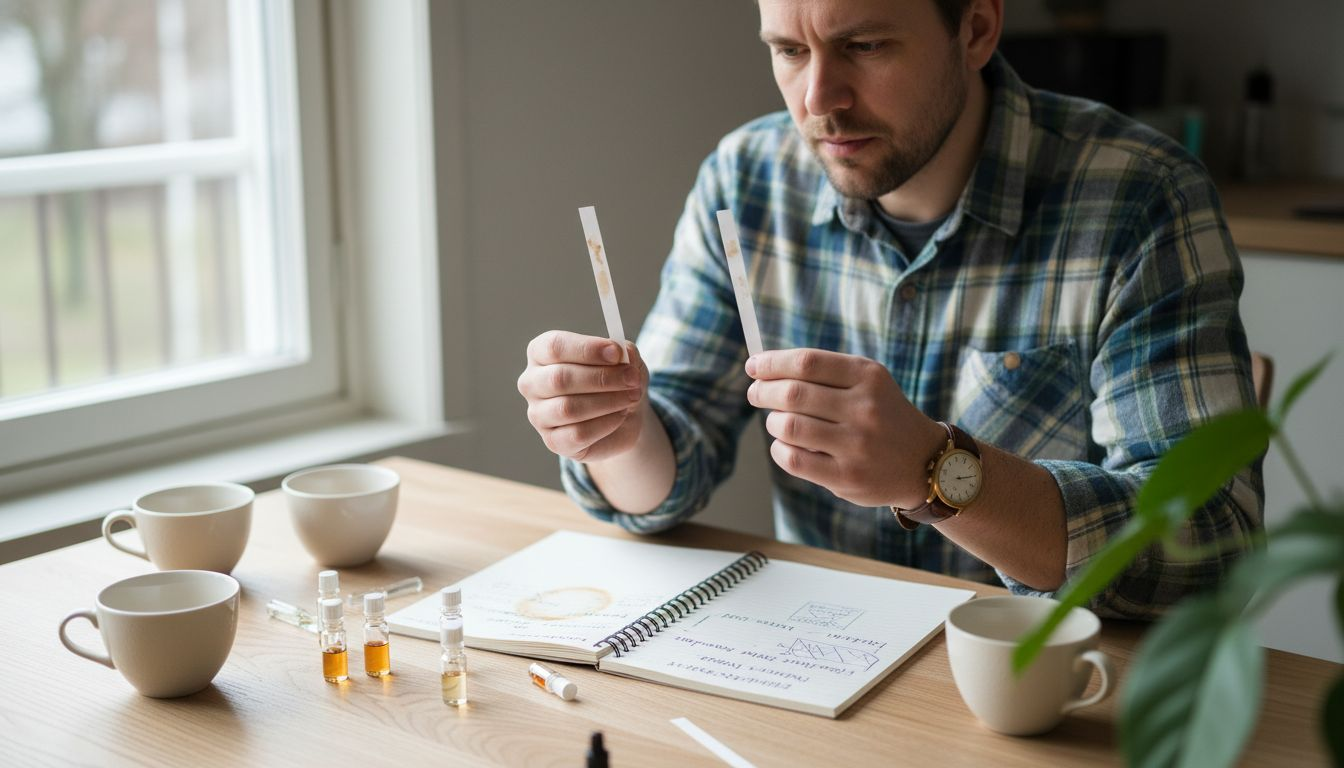
Systematic evaluation of fragrances helps you learn to distinguish between different fragrance families and understand how scents change over time. With samples, you can compare materials with different evaporation rates and see which scents suit you best.
Start comparing samples in this way:
- Test one sample at a time – don't try several simultaneously.
- Wait a few minutes for the first scent to dissipate before moving on to the next.
- Write down your initial impressions and how the scent develops.
- Try samples on different days – some scents are better suited for certain situations.
The most important thing is to give the scents time to develop. A perfume won't smell the same after the first second as it does an hour later. Scent samples give you the opportunity to see the full journey of a fragrance without a large investment.
Samples allow you to try dozens of different scents without having bottles everywhere.
Compare samples in three stages:
- Opening: What scents did you feel immediately after applying them? What were the dominant notes?
- Middle: How does the scent change after 15 minutes? Do new layers of scent emerge?
- Drydown: What is the base of the fragrance? Does it stay on the skin or fade quickly?
Experimenting with scent samples is effortless and affordable. You can keep several samples on hand to try at once and compare them at your own pace.
Here's how the different stages of a scent differ and what to note during comparison:
| Stage | Scent Character | Aromas Emerge | Comparison Tip |
|---|---|---|---|
| Opening | Fresh, strong | Citrus, green, aldehyde | Pay attention to the initial impression |
| Middle | Soft, balanced | Floral, spicy | Compare the scent's transformation |
| Drydown | Deep, lasting | Woody, amber | Test the lingering base notes on skin |
Pro tip: Test samples on your forearms, not your wrists – this way, the scent dissipates more naturally, and you'll see how it behaves in everyday life.
Step 3: Test Scents on Your Skin and Observe Their Development
Testing samples on paper is a good start, but the real test happens on your own skin. Each person's body reacts differently to perfume, so it's important to see how the scent develops specifically on you.
Apply the sample to your skin and begin documenting. The development of a fragrance over different time intervals reveals how the scent changes during the first few minutes and how long it lasts on the skin. Note that each fragrance evaporates at its own rate.
Observe the scent at these stages:
- First 5 minutes: What intense scents do you immediately perceive? These are the so-called top notes.
- 15-30 minutes: The scent begins to change. What new scents emerge?
- 1 hour: The scent is now in its stable form. This is the heart or middle note.
- 4-6 hours: The base note is now dominant. Does the scent still remain pleasant?
Write down every observation. Don't rely solely on memory – comparing scent samples from memory leads to errors.
The development of a scent on the skin is like a piece of music, where each stage reveals new layers.
Test each sample at least twice:
- The first test provides a general idea.
- The second test confirms that the impression was correct and not accidental.
Allow the scents to fully evaporate before testing the next sample. Wait at least 2-3 hours or test on different days. This way, you won't mix the scents together.
Pro tip: Always test samples on the same skin area and at the same time of day – body temperature and time of day affect how the scent develops.
Step 4: Choose the Best Perfume Based on Your Experiences
You have now tested several samples and observed their development. The next step is to make a final choice based on what you learned about yourself and the fragrances.
The best perfume is one that works well with your body chemistry. A perfume that suits your body chemistry, creating a harmonious blend with your own body odor, is always a better choice than a scent chosen solely based on marketing claims. Personal testing is the most important step.
Look at your notes and consider the following factors:
- Which sample made you smile when you smelled it?
- Which scent stayed in your mind at the end of the day?
- Which one do you want to use again next time?
- Which scent felt natural on your skin and not foreign?
Be honest with yourself. A good perfume is not one that everyone else recommends, but one that feels right for you.
The emotional connection to a scent and personal feeling are crucial factors in the long run. A scent you use regularly will be associated with memories and mood, so choose one that truly speaks to you.
The best perfume is one you want to wear every day without obligation or guilt.
Make your final decision as follows:
- Test your two favorites once more side-by-side.
- Consider which one you want to use more in the coming months.
- Listen to your inner intuition – don't think about price or brand.
- Remember that you can always try more scents later.
Your decision is now based on real experiences, not guesses. This means you are more likely to be satisfied with your choice in the long run.
Pro tip: Don't rush the final purchase decision – if you are unsure between two scents, test them for a couple more days before making your choice.
Find Your Perfect Perfume Easily with Befrsh.com
The article “How to Choose a Perfume: Find Your Perfect Scent Easily” highlights the importance of knowing your own scent preferences and using scent samples before making a significant purchase. The problem often lies in the wide selection and multi-layered fragrances, which confuse the choice and create uncertainty about what scent truly suits you. Your perfume should highlight your personality and suit your body chemistry while feeling natural and bringing you joy every day.
Explore Befrsh.com's extensive selection of high-quality perfume samples, which allow you to compare and test scents from different fragrance families easily at home. With samples, you avoid unnecessary purchases and make your choice calmly, based on your own experiences. Click here to take advantage of our inspiring selection of perfume samples that are suitable for both everyday use and special occasions. Give yourself permission to find the very scent that makes you happy right now.
Frequently Asked Questions
How can I define my own perfume preferences?
Start by considering what scents you like in the world around you, such as flowers or the smell of seawater. Write down the scents you enjoy and think about their intensity and suitability for different situations.
Why are scent samples useful in choosing a perfume?
Scent samples allow you to compare different fragrances without a large financial commitment. Take your time to distinguish each sample, for example, by testing a few different samples over three days.
How long should I wait when testing perfumes on my skin?
Test scents for at least 2-3 hours before applying the next sample, to see how the scent develops on your skin. Follow the scent's stages, such as the first 5 minutes and within 1 hour, to get a comprehensive overview.
What factors influence my perfume choice?
Perfume choice is influenced by body chemistry, personal preferences, and practical needs. Write down which scents made you smile or stayed in your mind, so you can make an informed choice.
How can I ensure that the perfume I choose is the right one?
Test your favorite scents side-by-side as a final choice and listen to your intuition. Make sure the scent feels natural on your skin and evokes positive associations.
What is the best way to assess a perfume's development during my test?
Keep a detailed diary of each scent's observations at all stages, such as top note, middle, and base. This helps you see which scents last well and suit you best.
Leave a comment