

Essential Perfume Terms: An Important Vocabulary for Scent Enthusiasts

Choosing a new perfume can feel daunting, as each fragrance sample opens up a different fascinating world. Understanding the basic structure and terms of fragrances helps young adults and adults find options that suit their preferences and expand their collection thoughtfully. This highlights the role of the fragrance pyramid, which reveals the different dimensions of a scent, and the diversity of fragrance families, through which everyone can find a unique and suitable fragrance experience.
Table of Contents
- What Do Basic Perfume Terms Mean
- Fragrance Pyramids and the Roles of Scent Notes
- Different Perfume Types and Concentration Levels
- Fragrance Families: Main Categories and Examples
- Niche, Unisex, and Other Modern Trends
- Typical Mistakes and Misunderstandings in Fragrance Terminology
Key Observations
| Point | Details |
|---|---|
| Basic Perfume Terms | Perfumes contain many key terms, such as the fragrance pyramid, fragrance concentrations, and fragrance raw materials. |
| Fragrance Pyramid Structure | The fragrance pyramid is divided into three parts: top notes, heart notes, and base notes, each with their own roles in the development of the fragrance. |
| Different Perfume Types | Perfume types vary by concentration levels, affecting the strength and longevity of the fragrance. |
| Modern Fragrance Trends | Niche and unisex fragrances are gaining popularity, offering individual and personalized options for consumers. |
What Do Basic Perfume Terms Mean
The world of perfumes is complex, full of various terms and concepts that can even be a bit confusing for fragrance enthusiasts. Understanding the origin of fragrance raw materials is paramount when delving into the secrets of perfumes.
The basic structure of perfumes consists of several key elements, the most important of which are:
- Fragrance pyramid: Describes the different layers and evolution of a scent
- Fragrance concentrations: Define the strength of a perfume
- Fragrance raw materials: Natural and synthetic components
The perfume manufacturing process is precise and multi-stage. Various methods are used in extracting fragrance compounds, where essential oils are isolated from flowers, spices, animal fats, and wood. The goal is to create a balanced whole where each scent note complements the others.
Identifying fragrance families helps understand the characteristics of perfumes. These include, for example:
- Floral fragrances
- Woody fragrances
- Oriental fragrances
- Fresh fragrances
- Fruity fragrances
Each fragrance family has its own character and mood, which makes the world of perfumes so multi-dimensional and interesting.
Professional tip: Familiarize yourself with different fragrance families and their characteristics before making your final perfume choice – this way you will find the perfect scent for you.
Fragrance Pyramids and the Roles of Scent Notes
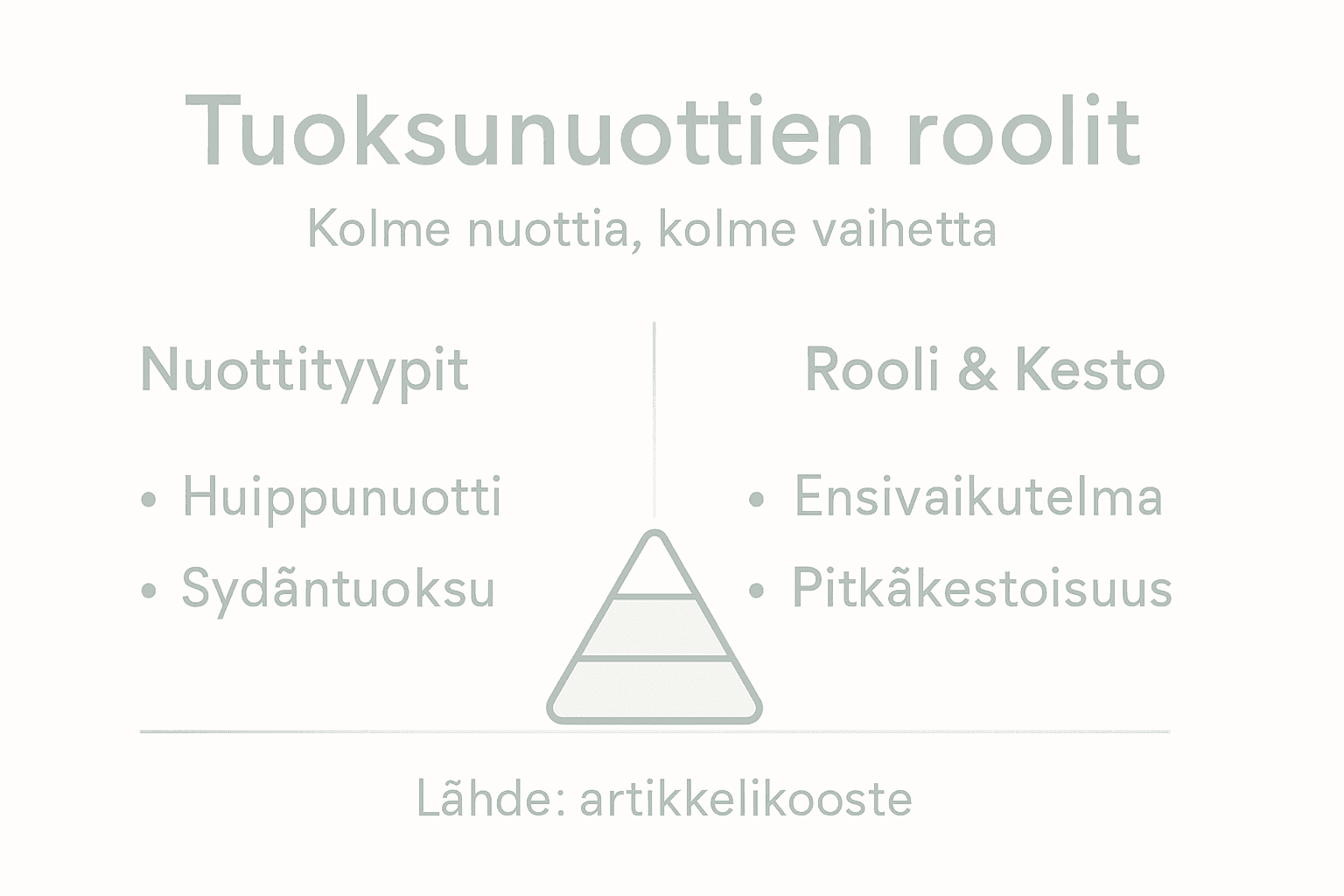
The fragrance pyramid is a multi-layered structure of perfumes that describes the layering of a scent and its evolution over time. Analyzing fragrance notes helps understand how a perfume behaves on the skin and what layers it consists of.
The fragrance pyramid is divided into three main notes:
- Top notes: The first, rapidly evaporating scents
- Heart notes: The actual character and core of the scent
- Base notes: The longest-lasting and deepest fragrance elements
Each note plays its own important role in perfumes. Top notes are like a first impression - light and fresh, immediately arousing interest. They typically last 15-30 minutes and often contain citrus, herbal, or light floral aromas.
The heart note forms the heart and personality of the perfume. It emerges about 30 minutes after application and lasts for several hours. At this stage, the deeper notes of the fragrance begin to reveal themselves, exposing more complex aromas such as flowers, spicy, or woody tones.

The base note is the last and longest-lasting phase of the fragrance. It can last for several hours or even days, and contains the heaviest and deepest aromas such as woody, musk, or vanilla bases. This note remains on the skin for a long time and forms the memory imprint of the scent.
Professional tip: Test the perfume on your skin for at least 30 minutes before final evaluation to experience the full development of the fragrance pyramid.
The following table summarizes the effects and example ingredients of the different parts of the fragrance pyramid:
| Scent Note | Role in Scent | Duration on Skin | Common Examples |
|---|---|---|---|
| Top Note | Creates the first impression | 15-30 minutes | Bergamot, lemon |
| Heart Note | Defines the character of the scent | 2-4 hours | Rose, lavender |
| Base Note | Adds depth and longevity | 4-24 hours | Sandalwood, vanilla |
Different Perfume Types and Concentration Levels
The world of perfumes is filled with various concentration levels that determine the intensity and longevity of a fragrance. Understanding different perfume types helps in choosing the most suitable scent for oneself.
The main types of perfumes can be categorized as follows:
- Parfum: The most concentrated form
- Eau de Parfum: Medium-strength fragrance type
- Eau de Toilette: Lighter alternative
- Eau de Cologne: Lightest perfume type
The fragrance oil content of each perfume type varies significantly. Parfum contains 20-40% fragrance oil, making it the most intense and longest-lasting option. This type of fragrance is often the most expensive and is used especially for special occasions.
Eau de Parfum is a slightly milder version, containing about 15-20% fragrance oil. It is excellent for daily use, typically lasting 4-5 hours. Eau de Toilette, on the other hand, contains about 5-15% fragrance oil and is a lighter alternative, suitable for summer days or office environments.
Finally, there is Eau de Cologne, which contains only about 2-4% fragrance oil. It is the lightest and freshest version, evaporating quickly and best suited for short-term refreshment.
When choosing a fragrance, consider both your personal style and the nature of the occasion.
Professional tip: Try different concentration levels on your wrist and let the scent develop on your skin for at least 30 minutes before making a final assessment.
Below is a comparison of the most popular uses for different types of fragrances:
| Perfume Type | Recommended Use | Longevity in daily life |
|---|---|---|
| Parfum | Evening events, parties | Very long-lasting |
| Eau de Parfum | Daily use | Long-lasting |
| Eau de Toilette | Light workdays, summer weather | Medium-lasting |
| Eau de Cologne | Quick refreshment | Short-lasting |
Fragrance Families: Main Categories and Examples
Analyzing fragrance families helps to understand the diverse world of perfumes. Fragrance families are like music genres – each brings its own mood and story.
The main fragrance families can be categorized as follows:
- Floral fragrances: Delicate and feminine
- Woody fragrances: Deep and masculine
- Oriental fragrances: Mysterious and exotic
- Fresh fragrances: Light and energetic
- Fruity fragrances: Playful and lively
In floral fragrances, various flower scents such as rose, jasmine, gardenia, and ylang-ylang are emphasized. They are classic and feminine, often softly delicate and romantic. In these fragrances, the aromas of flowers blend to create a complex and harmonious whole.
Woody fragrances are the opposite of floral fragrances – they are stronger, deeper, and often more masculine. These include sandalwood, cedar, patchouli, and vetiver, for example. These fragrances evoke the forest, the salon, and the deepest essence of nature.
Choosing a fragrance family is a personal journey – don't be afraid to try different options!
Professional tip: Collect a few samples from different fragrance families and test how they behave on your skin at different times of the day.
Niche, Unisex, and Other Modern Trends
Exploring modern fragrance trends reveals interesting shifts in the world of scents. Traditional boundaries are breaking down, and consumers are increasingly seeking more personal and individualized fragrance experiences.
Modern fragrance trends can be divided into the following categories:
- Niche fragrances: Small, handcrafted specialty scents
- Unisex fragrances: Gender-neutral perfumes
- Eco-friendly fragrances: Natural and sustainable production methods
- Minimalist fragrances: Simple and clear compositions
Niche perfumes have gained significant popularity in recent years. They differ from mass-market products in both quality and manufacturing method. These fragrances emphasize craftsmanship, rare raw materials, and a completely unique scent concept. They are often designed for small, passionate fragrance enthusiasts.
Unisex fragrances break traditional gender roles by offering scents suitable for anyone, regardless of gender. They emphasize individuality and the freedom to choose a scent based on one's own personality. These fragrances often blend feminine and masculine elements to create something entirely new.
Choosing a fragrance is a personal experience that says more about you than just the scent itself.
Professional tip: Don't be afraid to try completely different fragrances than what you're used to – you'll surely be pleasantly surprised.
Typical Mistakes and Misunderstandings in Fragrance Terminology
Mistakes in perfume application are more common than one might think. The world of fragrance is full of subtle details that can easily go unnoticed.
The most common misunderstandings in fragrance terminology and usage are:
- Incorrect dosage: Too much or too little perfume
- Wrong skin area: Spraying in incorrect spots
- Confusing concentrations: Misunderstanding the purpose of different fragrance types
- Misunderstanding layering: Difficulty in grasping fragrance compatibility
Perfume dosage is an art. Layering fragrances requires precision and understanding. Excessive spraying can make a scent intrusive, while too little application can easily go unnoticed. The right amount is usually 2-3 sprays, focusing on the wrists, neck, and behind the ears.
One of the most common mistakes is confusing concentration levels. Parfum is the strongest, while eau de cologne is the lightest. Incorrect use of these can lead to unpleasant fragrance experiences. For example, wearing a strong parfum on a summer day can be too heavy and intrusive.
Choosing and using a fragrance is a personal art – don't be afraid to experiment, but also learn to moderate.
Professional tip: Always test a perfume with a small amount first and let it develop on your skin for a few minutes before making a final assessment.
Find Your Perfect Scent Easily and Safely
The article highlights the importance of exploring the complex world of perfumes and addresses common challenges such as choosing the right fragrance family, understanding the fragrance pyramid, and distinguishing between different concentration levels. Have you ever felt uncertain about how to select a scent that perfectly suits your style and occasion? Or wondered how to test the various scent notes of a new perfume without buying the entire bottle? This is where Befrsh.com comes to your aid.
Befrsh.com offers a wide selection of high-quality fragrance and perfume samples for women, men, and unisex fragrance lovers. With these premium samples, you can calmly test various fragrance families and different concentration levels on your skin, just as the professional tips recommend. This way, you avoid mistakes like over-application or choosing the wrong scent, and you can make your purchasing decision with confidence. Explore Befrsh's inspiring selection today and take a step towards the best fragrance experiences for you.
Frequently Asked Questions
What does the fragrance pyramid of a perfume mean?
The fragrance pyramid describes the different layers of a perfume, which include top notes, heart notes, and base notes. Each layer unfolds at different times, giving the fragrance depth and complexity.
What is the significance of perfume concentration levels?
Concentration levels determine the intensity and longevity of a perfume. For example, parfum is the strongest, while eau de cologne is the lightest option. This directly affects the scent's duration and usability.
How do perfumes differ according to fragrance families?
Fragrance families, such as floral, woody, oriental, fresh, and fruity, define the overall character and mood of a perfume. Each family has its unique characteristics and aromas.
Why is it important to test perfume on the skin before purchasing?
Perfume behaves differently on each person's skin, and testing helps to understand the development of the fragrance at different stages. It is recommended to try perfumes for at least 30 minutes before making a final assessment.
Leave a comment