

A guide to fragrance notes: identify the 3 layers

A fragrance doesn't smell the same all day, and this is one of perfumery's most fascinating secrets. Fragrance notes explain why your perfume's initial impression differs completely from how it smells a few hours later. Fragrance notes are the building blocks of a perfume, evolving on your skin in stages to create a unique sensory experience. When you understand the notes your favorite fragrance is built from, you can also choose perfumes with much more confidence. And that's precisely why trying before buying isn't just a matter of convenience, but the only way to make the right decision.
Table of Contents
- What is a Fragrance Note? The Three-Layer Pyramid at the Heart of Perfumery
- The Chemistry of Fragrance Notes: Why Does the Scent Change on the Skin?
- Fragrance Longevity: How Long Does a Scent Truly Last?
- The Fragrance Pyramid is Not the Whole Truth: A Modern Perfumery Perspective
- How to Identify Notes in Practice and Find Your Own Scent Profile
- Find the Perfect Perfume Samples – Try Before You Buy
- Frequently Asked Questions About Fragrance Notes
Key Takeaways
| Aspect | Details |
|---|---|
| Fragrance pyramid guides the experience | Different layers of perfume bring out varying scent notes over time. |
| Skin type and conditions affect it | Your skin and environment shape how a scent ultimately feels and how long it lasts. |
| Modern perfumery can break the mold | Not all fragrances follow the classic structure – experimentation is always recommended. |
| Importance of samples in selection | Perfume samples help you find the scent notes you love before making a purchase. |
What is a Fragrance Note? The Three-Layer Pyramid at the Heart of Perfumery
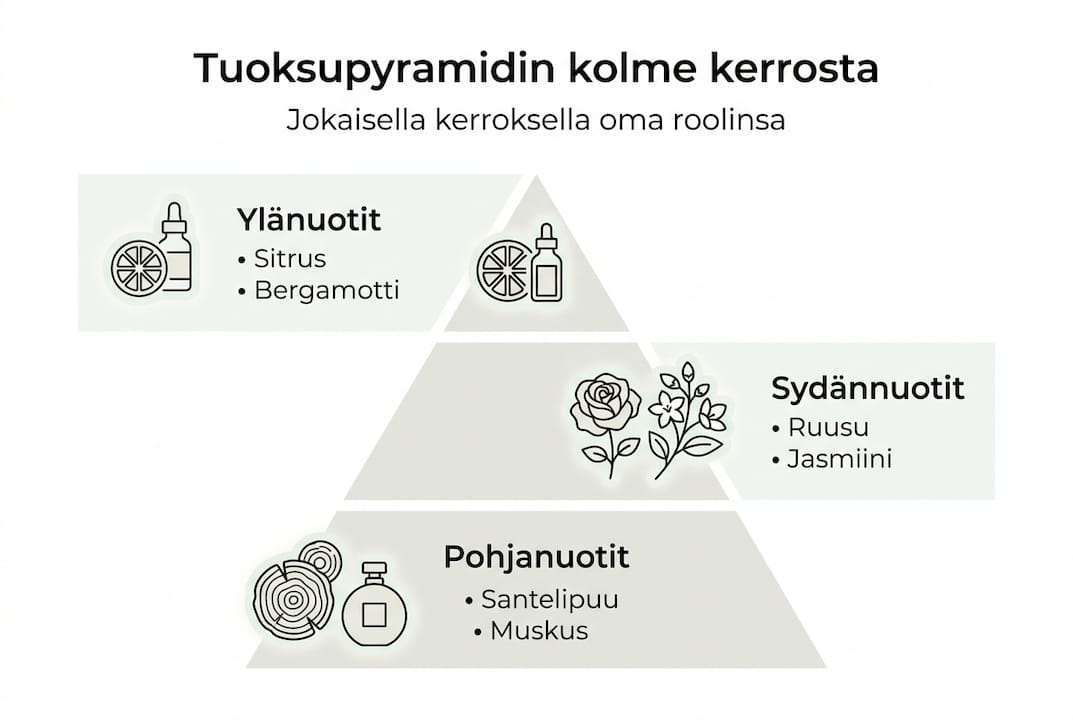
A fragrance note refers to an individual ingredient or group of ingredients that forms part of the overall structure of a perfume. The fragrance pyramid consists of three layers: top notes, heart notes, and base notes. Each layer evaporates at a different rate, and together they form the lifespan of the perfume.
Top notes are the first thing your nose detects. They are light, fresh, and evaporate quickly, usually within 5–15 minutes. Typical top notes include citrus fruits like bergamot and lemon, as well as light herbal aromas like mint. They create the initial impression but don't tell the whole story.
Heart notes emerge once the top notes have evaporated. They form the core of the fragrance and last on the skin for 2–4 hours. Rose, jasmine, lavender, and spicy aromatics like cinnamon are classic heart notes. This layer is often what makes you fall in love with a perfume.
Base notes are the deepest and longest-lasting. They can linger on the skin for up to 8 hours or more. Sandalwood, amber resins, vanilla, and musk are typical base notes. The structure of the notes directly affects how long the scent lives and how it evolves.
“The pyramid model helps to understand why a perfume feels different in the store than at home after a few hours of wear.”
Here is a quick comparison of the three layers:
| Layer | Evaporation Time | Typical Ingredients |
|---|---|---|
| Top notes | 5–15 minutes | Citrus, mint, bergamot |
| Heart notes | 2–4 hours | Rose, jasmine, lavender |
| Base notes | 6–8+ hours | Sandalwood, musk, vanilla |
If you want to learn more about the basic concepts of perfumery, explore perfume basic terms that clarify the industry's vocabulary in a practical way.
The Chemistry of Fragrance Notes: Why Does the Scent Change on the Skin?
Chemistry is behind everything. The volatility of a note is determined by its molecular weight: light molecules evaporate quickly, heavy ones slowly. Top note molecules are small and light, so they fly to your nose immediately. Base note molecules are large and heavy, so they stay on the skin for a long time.
Skin type significantly affects how a fragrance develops. Oily skin retains fragrance better than dry skin because fat molecules effectively bind perfumes. Temperature accelerates evaporation, so a scent can feel stronger and evaporate faster in summer. Humidity, in turn, can enhance certain notes, especially floral and woody aromas.
See in more detail how different factors influence the development of a scent:
| Factor | Effect on Scent |
|---|---|
| Oily skin | Longer duration, richer scent |
| Dry skin | Faster evaporation |
| High temperature | Stronger projection, shorter duration |
| High humidity | Enhances floral and woody notes |
This means in practice that the same perfume can smell completely different on two different people. That's why your friend's favorite might not work for you. A more detailed evaporation chart helps to understand how different ingredients behave under different conditions.
“Perfume is like a piece of music: it starts one way and ends another. The skin is the instrument.”
Professional tip: Always test fragrances on your own skin, not just on blotter strips. A blotter strip only shows the top note, but your skin reveals the whole story. The benefits of perfume samples are highlighted here: with a small sample, you can test the entire lifespan of a fragrance before buying an expensive bottle.
Fragrance Longevity: How Long Does a Scent Truly Last?
Longevity is one of the most common questions when buying fragrances. The answer largely depends on the fragrance concentration. EDP lasts 6–8 hours, EDT 3–5 hours, and this difference is directly explained by the structure of the fragrance notes and the oil content.
Eau de Parfum typically contains 15–20% fragrance oil, while Eau de Toilette contains 8–12%. A higher oil content means that the base notes come through better and the scent lasts longer. However, this doesn't mean that EDP is always the better choice. For summer use, a lighter EDT can be perfect.
Here's a comparison between different fragrance concentrations:
| Type | Oil Content | Duration on Skin | Best Use Case |
|---|---|---|---|
| Parfum (Extrait) | 20–30 % | 8–12 hours | Special occasions |
| EDP | 15–20 % | 6–8 hours | Daily wear |
| EDT | 8–12 % | 3–5 hours | Summer, office |
| EDC | 2–4 % | 1–2 hours | Refreshing boost |
Fragrance notes also directly affect longevity. Scents rich in base notes, such as oriental and woody fragrances, naturally last longer than light citrus or aquatic-based fragrances. GC-MS analysis provides scientific data on how different molecules behave in fragrance mixtures.
Professional tip: If you want the scent to last longer, spray it on clothes and hair instead of just your skin. Fabric doesn't absorb fragrance in the same way as skin, so evaporation is slower. Hair, in turn, moves and diffuses the scent into the environment throughout the day.
Here's the temporal sequence in which fragrance notes appear:
- 0–15 min: Top notes dominate, initial impression forms
- 15–60 min: Transition phase, heart notes begin to emerge
- 1–4 h: Heart notes are in full force, the scent is at its best
- 4–8 h: Base notes linger, the scent is deep and warm
- 8 h+: Only the strongest base notes remain, the scent is subtle
Read more about the differences between EDP and EDT if you want to make a more informed choice when buying your next perfume.
The Fragrance Pyramid is Not the Whole Truth: A Modern Perfumery Perspective
The classic pyramid model is a useful tool, but it doesn't tell the whole truth. The pyramid is merely a guideline, and many modern fragrances completely break from the linear model. This is important information when evaluating perfumes.
Linear fragrances have become increasingly common, especially in minimalist niche perfumery. They smell almost the same from start to finish, without a distinct three-stage progression. Such a structure suits a perfumer who wants to create a cohesive, unchanging sensory experience. Many aquatic and clean fragrances operate on this principle.
“Modern perfumery challenges traditional structures. A fragrance can be a work of art that follows no rules.”
There's also a significant difference between natural and synthetic ingredients. Natural fragrances can be more therapeutic, while synthetics are more stable and consistent. Natural ingredients vary with harvest and climate, making each batch slightly different. Synthetic molecules remain exactly the same from batch to batch.
Here are examples of fragrance families that often break the pyramid model:
- Aquatic fragrances: Fresh and linear, without a distinct three-stage progression
- Chypre fragrances: Layered, but not according to the traditional pyramid
- Fougère fragrances: Lavender and moss create a smooth profile
- Soliflore fragrances: A single flower dominates from start to finish
- Gourmand fragrances: Sweet base notes dominate throughout the lifespan
Explore fragrance notes in the glossary to find more precise definitions for different fragrance families and their characteristics.
How to Identify Notes in Practice and Find Your Own Scent Profile
Theory is good, but practice is decisive. Identifying fragrance notes is a skill that can be systematically developed. Start simple and progress step by step.
- Spray the fragrance on your wrist and inhale immediately. Jot down your first impression: is it fresh, sweet, spicy, or woody?
- Wait 15 minutes and smell again. The top notes will have evaporated, and the heart notes will begin to show. What changed?
- After an hour, smell a third time. This is the heart of the fragrance at its best. Do you like it more or less than at first?
- After four hours, check the base notes. Has the scent warmed, deepened, or completely changed?
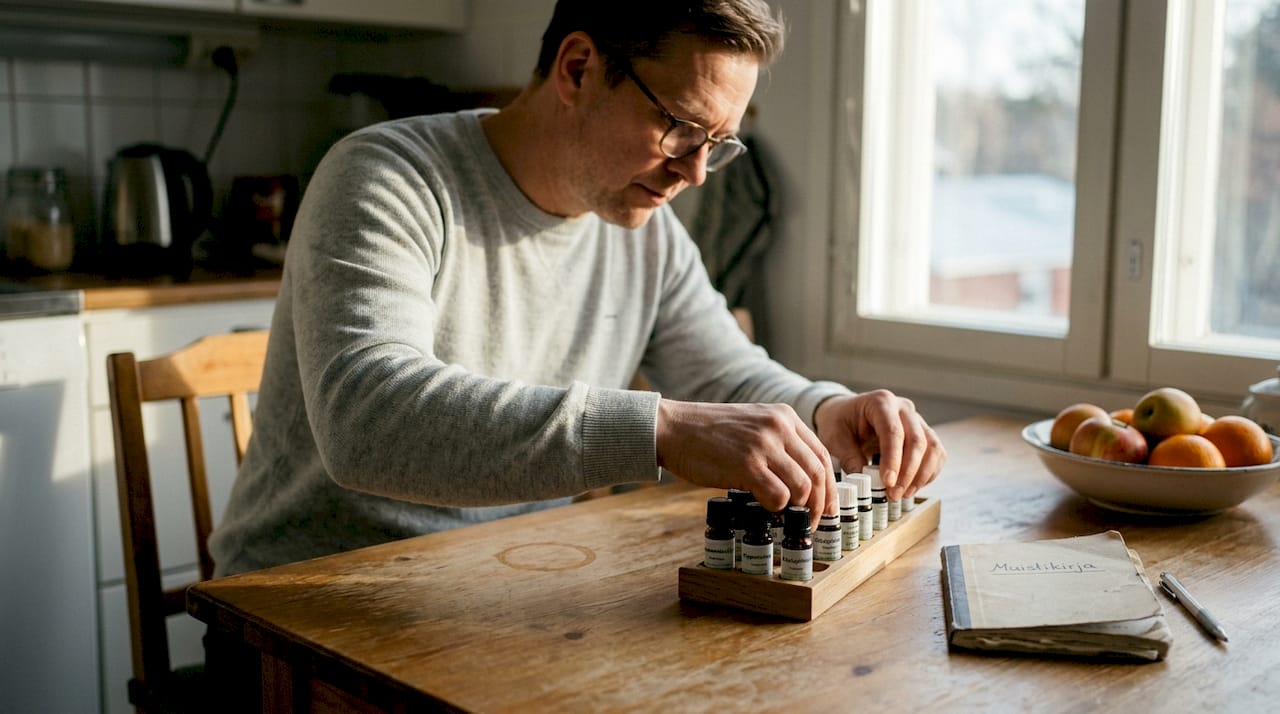
- Record your observations in a notebook. Compare different fragrances and look for recurring themes that you enjoy.
By layering fragrances of the same family, you can discover a truly unique scent profile that is specifically yours. For example, a woody base note combined with a floral heart note can create something truly special.
Professional tip: Keep a perfume testing diary. Record the date of each test, the weather, your skin type, and your observations at each stage. After a few months, you'll clearly see which scent profile suits you best.
The benefits of fragrance-free skincare are highlighted during the testing phase: a fragrance-free basic moisturizer won't interfere with the development of the tested scent on your skin. This ensures the purest possible result. Read more about selecting a fragrance sample before you embark on your own scent journey.
Find the Perfect Perfume Samples – Try Before You Buy
Now that you know how fragrance notes work, it's time to put that knowledge into practice. The only way to truly understand how a perfume develops on your skin is to actually test it. A quick sniff in a store only tells you the top note, not the whole story.
Befrsh.com offers a wide selection of extensive perfume samples from the most popular and interesting niche fragrances. You can order several samples at once and test the entire lifespan of each scent at home at your leisure. This way, you'll find the right fragrance without risk, without regret, and without unnecessary spending. Each sample is high-quality and authentic, so you get exactly the same experience as from a full bottle. Start your scent journey today and let the notes tell their story.
Frequently Asked Questions About Fragrance Notes
What is a top note and how long does it last?
A top note is the initial phase of a fragrance, typically lingering on the skin for 5–15 minutes. It creates the first impression but does not represent the overall character of the scent.
Can a single fragrance contain multiple heart notes?
Yes, the heart phase can be composed of several different scents and their combinations, making the perfume multi-layered and rich.
How does skin type affect fragrance longevity?
On dry skin, a fragrance evaporates faster than on oily skin, because fat binds fragrance molecules more effectively.
What is the best way to test fragrance notes?
Test fragrances on your own skin and allow the scent to develop throughout the day before making a purchase, as fragrance development is individual.
Leave a comment