

The Right Way to Apply Perfume – A Guide to the Perfect Scent Experience

Have you ever noticed that your perfume fades too quickly or feels overpowering? The problem is often not the scent itself, but the application. Many people spray perfume in the wrong places, at the wrong distance, or in the wrong amount, which significantly diminishes the fragrance experience. The correct application depends on the type of perfume, its concentration, and your skin's characteristics. In this guide, you will learn scientifically-backed, practical steps to get the best possible results from your perfume and significantly extend its longevity.
Table of Contents
- Key Learnings
- Prepare Properly: What You Need to Know Before Application
- Perfect Application: How to Spray Perfume Correctly
- Common Mistakes and How to Avoid Them in Application
- Ensuring Fragrance Longevity and Personal Adjustments
- Explore Our Quality Perfume Selection
- Frequently Asked Questions
Key Takeaways
| Point | Information |
|---|---|
| Perfume Type Application | Different perfume types such as eau de cologne, EDT, EDP, and parfum require different application methods, and their longevity varies. |
| Utilizing Pulse Points | Spraying on pulse points activates the fragrance with body heat, effectively spreading it into the surrounding space. |
| Avoiding Rubbing Wrists | Do not rub wrists after spraying, as this breaks down fragrance molecules and alters the structure of the top notes. |
| Spray Distance on Skin | Keep the spray 10-15 centimeters away from the skin to ensure even distribution and prevent concentration in one spot. |
Key Learnings
| Key Learning | Why It's Important |
|---|---|
| Perfume types require different spray amounts | Eau de Cologne lasts 2-3 hours, Parfum up to 24 hours |
| Spraying on pulse points maximizes fragrance | Body heat activates perfume notes more effectively |
| Rubbing skin weakens the scent | Fragrance molecules break down from mechanical friction |
| Skin is better than clothes | Clothes alter the scent and can stain |
| Concentration determines the number of sprays | EDC needs 4-6 sprays, Parfum only 1-3 |
Prepare Properly: What You Need to Know Before Application
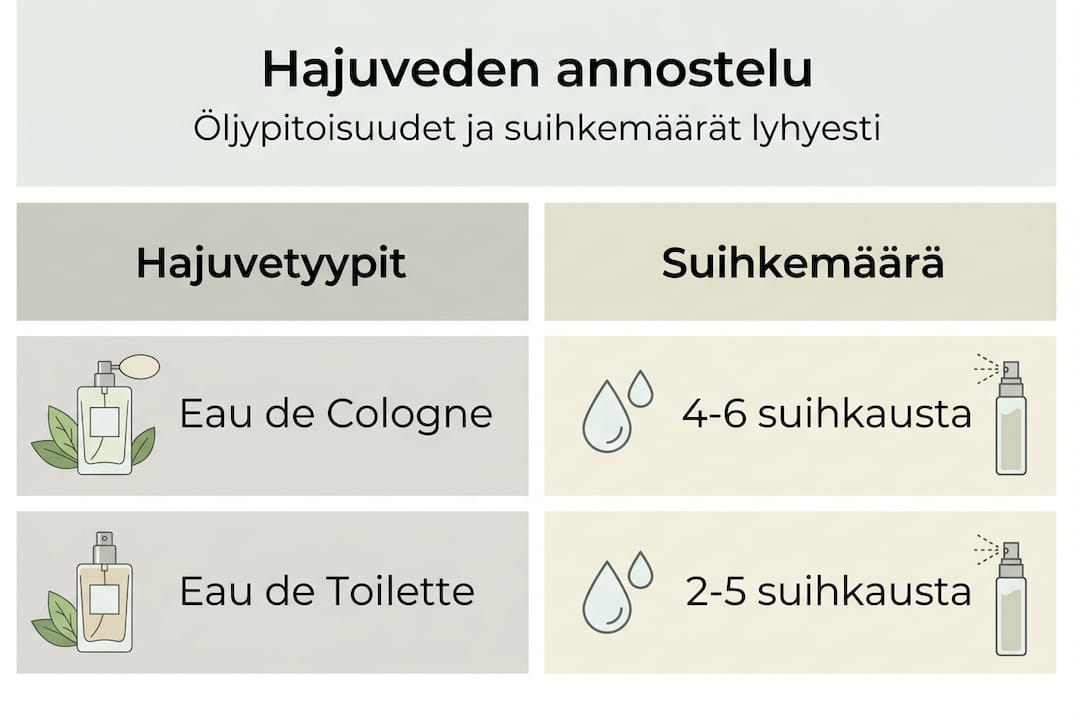
Before you spray perfume, you need to understand that not all perfumes are created equal. Perfume types differ significantly in oil concentration and longevity, which directly affects how many sprays you need. Eau de Cologne contains only 2-5% fragrance oil and lasts the shortest amount of time, typically 2-3 hours. Eau de Toilette, with a concentration of 5-15%, lasts about 3-5 hours, while Eau de Parfum, with 15-20% concentration, stays on the skin for 5-8 hours. Parfum, containing 20-40% fragrance oil, is the strongest and can last up to 24 hours.
Correct application depends on the perfume's concentration: EDC needs 4-6 sprays, EDT 3-6, EDP 2-5, and Parfum only 1-3 sprays for an optimal fragrance experience. These amounts are not arbitrary but are based on the evaporation of fragrance oil and the skin's ability to retain the scent. The higher the concentration, the less you need, as the fragrance molecules are more concentrated and long-lasting.
Pro tip: Always start with the lowest recommended number of sprays, especially with a new perfume. You can always add more, but an excessive scent is difficult to remove. Wait 15-20 minutes after the first spray to see how the scent develops on your skin before deciding to add more.
Familiarize yourself with perfume terminology and types to understand what the label on the bottle means. Terms like "top notes," "heart notes," and "base notes" describe the evolution of the scent over time. Top notes are the initial scents you smell, and they evaporate in 15-30 minutes. Heart notes form the core of the fragrance and last 2-4 hours. Base notes are the deepest, richest scents that linger the longest, up to 6-24 hours depending on the concentration.
| Perfume Type | Oil Concentration | Duration | Recommended Sprays |
|---|---|---|---|
| Eau de Cologne | 2-5% | 2-3 h | 4-6 sprays |
| Eau de Toilette | 5-15% | 3-5 h | 3-6 sprays |
| Eau de Parfum | 15-20% | 5-8 h | 2-5 sprays |
| Parfum | 20-40% | 8-24 h | 1-3 sprays |
Once you know the type of your perfume, you can fine-tune your application. This knowledge helps you avoid over-application, which can be overwhelming for those around you, or under-application, which leaves you without a scent after a few hours.
Perfect Application: How to Spray Perfume Correctly
The correct spraying technique begins with the right distance. Hold the perfume bottle 10-15 centimeters away from your skin. This distance ensures that the spray distributes evenly without creating an overly concentrated spot, which can cause stains or an overpowering scent in one area. Spraying too close concentrates the perfume in too small an area, hindering its ability to develop naturally.
Spray onto pulse points, where the skin is warm and blood vessels are close to the surface. These areas activate the fragrance more effectively because heat accelerates the evaporation and diffusion of fragrance molecules into the air. Key pulse points include:
- Behind the ears: A warm area that subtly diffuses the scent as you move.
- On the sides of the neck: A central area where the scent naturally rises upwards.
- On the wrists: A frequently moved area that spreads the scent with hand movements.
- Inside the elbows: A lesser-known but effective warm spot.
- Behind the knees: Excellent in summer when legs are exposed.
Never rub your wrists together after spraying. This common mistake breaks down fragrance molecules and alters the scent's structure, especially the top notes, which disappear prematurely. Allow the perfume to air dry on your skin naturally for 30-60 seconds. The fragrance develops best when it can evaporate at its own pace without mechanical interference.
Pro tip: If your skin is particularly dry, apply an unscented moisturizer to your pulse points before spraying perfume. More hydrated skin holds the scent better because fragrance molecules adhere more effectively to the skin's surface. This simple step can extend the scent's longevity by 30-40%.
Skin type significantly affects how many sprays you need. Dry skin absorbs perfume more quickly and requires 1-2 extra sprays compared to recommendations. Oily skin retains fragrance longer due to natural oils, so you can use the lower end of the recommendations. Normal skin performs best with standard recommendations.

You can lightly spray perfume into your hair, but be careful. First, spray into the air and walk through the mist, or spray onto a brush and comb through your hair. Direct spraying into hair can dry it out due to alcohol. Spraying on clothes should be avoided entirely, as it can cause stains and alter the scent, because fabrics do not activate the perfume in the same way as warm skin.
Explore perfume usage tips for more detailed advice on different situations, such as post-sport application or preparing for special occasions.
Common Mistakes and How to Avoid Them in Application
One of the most common mistakes is shaking the bottle before use. This might feel natural, but it can disrupt the delicate composition of the perfume. Perfumes are carefully balanced mixtures of alcohol, oils, and water combined precisely. Shaking can cause air bubbles to form, which oxidizes the fragrance oils and changes the scent over time.
Rubbing the skin significantly hinders the development of the fragrance. When you rub your wrists together, the heat and friction break down delicate top note molecules before they have a chance to evaporate naturally. This causes the fragrance to jump directly to the heart note phase, making the perfume flatter and less multi-dimensional. The scent should develop in stages, and rubbing disrupts this process.
Spraying too close significantly increases the risk of stains. When you hold the bottle less than 10 centimeters away, the spray doesn't have time to spread evenly, instead forming a wet spot on the skin. This can leave an oily mark on clothes if they come into contact with wet skin before the perfume has dried. Darker perfumes, which contain more oil, are particularly prone to staining.
“Spraying perfume on clothes can significantly alter the scent, as fabrics do not activate fragrance oils in the same way as skin. Additionally, many perfumes contain oils that can leave permanent stains on delicate fabrics.”
Spraying on clothes causes stains and changes the scent because fabrics absorb perfume differently than skin. Clothes do not generate the heat necessary to activate and develop the fragrance. As a result, the perfume remains flat and one-dimensional, and its notes do not fully unfold. Silk, wool, and other delicate fabrics are particularly susceptible to permanent oil stains.
Avoid these common mistakes:
- Do not spray perfume immediately after showering when your skin is still wet. Wait until your skin is completely dry for the perfume to adhere properly.
- Do not store perfume in the bathroom. Humidity and temperature fluctuations break down fragrance oils more quickly.
- Do not mix too many perfumes at once. Use a maximum of one perfume at a time, unless it's a deliberate layering technique.
- Do not spray perfume directly on jewelry. Alcohol can damage certain metals and stones.
With the right techniques, your fragrance will last longer, appear cleaner, and leave a positive impression. Learn about common perfume usage mistakes to avoid costly errors and maximize the value of your perfume investment.
Ensuring Fragrance Longevity and Personal Adjustments
Skin type is a critical factor in how long a perfume lasts on your skin. Dry skin requires more sprays because it absorbs fragrance oils faster and doesn't retain them on the surface as effectively as oily skin. If your skin is dry, you might notice your scent fading in 2-3 hours, even if you're using Eau de Parfum. In this case, add 1-2 sprays to the standard recommendation and moisturize your skin regularly.
Oily skin is an advantage for perfume wearers, as natural oils act as a carrier, keeping fragrance molecules on the skin's surface for longer. If your skin is oily, you can use the lower end of the recommendations without the scent fading too quickly. This also means you can choose lighter perfume types, like Eau de Toilette, and still achieve good longevity.
Warm conditions significantly enhance the opening of fragrances. In summer or warm climates, you need fewer sprays because heat activates the perfume more effectively. In winter or cold conditions, the scent doesn't diffuse as easily, so you might need 1-2 extra sprays. Also, note that cold air dries out the skin, affecting fragrance longevity.
| Skin Type | Challenge | Recommendation | Extra Sprays |
|---|---|---|---|
| Dry | Absorbs perfume quickly | Moisturize first, use an oil base | +1-2 |
| Oily | Can be too strong | Use lighter types | -1-2 |
| Normal | Balanced | Follow standard recommendations | 0 |
| Sensitive | Risk of irritation | Test first, avoid alcohol-based | 0 or -1 |
Your activity level also affects application. If you move a lot or exercise, your scent will fade faster due to sweat and increased blood circulation. In this case, consider a lighter perfume that you can reapply during the day, instead of using a strong Parfum in the morning. A travel-sized bottle in your pocket or bag allows for quick reapplication if needed.
Also, consider your environment. In an office setting, it's best to use a more restrained application, 2-3 sprays of Eau de Parfum or 3-4 sprays of Eau de Toilette. For dinner or a special occasion, you can use the full recommended amount. Elevators, small rooms, and other enclosed spaces intensify the scent, so be careful not to over-apply.
Explore the benefits of perfume samples to find the perfect scent that suits your skin type and lifestyle. Samples allow you to test how the perfume develops on your skin over several hours before committing to a full-sized bottle.
Explore Our Quality Perfume Selection
Now that you've mastered the art of correct perfume application, it's time to find the perfect fragrance for you. Be Frsh's perfume selection offers a wide range of high-quality scents from all leading brands, both classics and the latest releases. In our selection, you'll find women's, men's, and unisex fragrances, clearly organized by category to make your choice easier.
Our perfume samples allow you to test fragrances on your own skin before purchasing a full-sized bottle. This way, you can apply the application techniques you've learned and see how the scent develops on your skin over several hours. We also offer travel-sized bottles, perfect for on-the-go application. Explore our scent sets, which include several samples by theme, and gift cards, which make an excellent present for fragrance enthusiasts. Our fast delivery and customer-centric service make shopping effortless.
Frequently Asked Questions
How many times should perfume be sprayed for different types?
Eau de Cologne needs 4-6 sprays, as its oil concentration is only 2-5 percent and lasts 2-3 hours. Eau de Toilette requires 3-6 sprays with a 5-15 percent concentration and lasts 3-5 hours. Eau de Parfum needs 2-5 sprays with a 15-20 percent concentration and lasts 5-8 hours. Parfum, the strongest type with a 20-40 percent concentration, only requires 1-3 sprays and lasts 8-24 hours. Always start with the lower end of the recommendations and add more if needed.
Why do I spray perfume on pulse points?
At pulse points, blood vessels are close to the skin's surface, making these areas warmer. The heat activates the fragrance oils and accelerates their evaporation, which diffuses the scent more effectively into the environment. Spraying behind the ears, on the sides of the neck, on the wrists, and inside the elbows maximizes the development of the fragrance. If you spray in the wrong places, such as your stomach or back, the scent will not develop optimally because these areas do not generate as much heat.
Can I spray perfume on clothes?
Spraying perfume on clothes is not recommended, as it can cause permanent oil stains, especially on delicate fabrics like silk and wool. Clothes do not generate the heat necessary to activate the perfume, so the scent remains constant and does not develop in a multi-dimensional way. Additionally, fabrics can alter the scent as they absorb certain notes differently than skin. Spraying on skin ensures authenticity, better longevity, and the proper development of the fragrance.
How does skin type affect perfume longevity?
Dry skin absorbs fragrance oils more quickly and doesn't hold them on the surface as long as oily skin, meaning you'll need 1-2 extra sprays. Oily skin contains natural oils that act as a carrier, keeping fragrance molecules on the skin's surface longer, so you can use fewer sprays. Normal skin works best according to standard recommendations. Moisturize dry skin before applying perfume to extend the scent's longevity by up to 30-40 percent.
Leave a comment