

How to Choose a Perfume Sample in 2026

Choosing the right perfume can feel overwhelming, with thousands of options and high prices. Many have bought a full-sized bottle only to realize the scent doesn't work on their skin or suit their style. Perfume samples effectively solve this problem. They allow you to test scents in real-life conditions before making a large investment. This guide will teach you how to professionally select and evaluate perfume samples to find the perfect scent for men, women, and unisex options.
Table of Contents
- Key Learnings
- Why Perfume Samples Are a Crucial Part of Scent Selection
- Preparation: What You Need Before Selecting a Perfume Sample
- How to Select and Evaluate Perfume Samples Step-by-Step
- Verification: Common Mistakes and How to Avoid Them
- Find Quality Perfume Samples at Be Frsh
- FAQ
Key Learnings
| Point | Details |
|---|---|
| Samples prevent costly mistakes | Testing on the skin reveals the true aroma and suitability before purchase |
| Match the scent to your style | Perfume should complement your dressing style for the best outcome |
| Test in different conditions | Scent development varies with temperature, humidity, and skin pH |
| Use diverse samples | Explore different fragrance families and notes to find your favorite |
| Ensure authenticity and size | Choose reliable brands and sufficiently sized samples for proper testing |
Why Perfume Samples Are a Crucial Part of Scent Selection
Buying perfume without testing it is a financial risk. A full-sized bottle can easily cost from 50 to over 200 euros, and if the scent isn't pleasing, the money is wasted. Many buy perfume based on brand name or recommendations, but everyone's skin reacts to scents differently. Chemical compounds mix with the skin's natural oils and pH, completely altering the aroma. Samples allow for true testing in your own environment, not in a rushed store.
The popularity of fragrances has grown immensely in recent years, making samples more accessible. Perfumes have been very popular for some time, and there are more options on the market than ever before. This means you don't have to settle for the first scent. Samples give you the freedom to explore different fragrance families, notes, and intensities without financial pressure.
Matching the scent to your personal style significantly improves satisfaction. A classic dresser benefits from different scents than a sporty or bohemian style. Fragrance is an invisible accessory that completes the overall look. When testing samples, consider what kind of clothes you wear most often. A fresh citrus scent suits a relaxed everyday style, while a deep woody scent complements formal wear.
Knowing different fragrance families helps in selection:
- Floral scents suit romantic and feminine styles
- Citrus and green notes work for active daily life
- Oriental and woody scents create a warm, sophisticated impression
- Aromatic scents suit modern and minimalist styles
Seasons also affect scent choice. Light scents for spring and summer feel refreshing, while deeper, warmer notes for autumn and winter create comfort. Samples allow you to try seasonal options before committing. Evaluating perfumes correctly requires patience and a systematic approach, starting with an understanding of why samples are essential.
Choosing a fragrance is a personal journey. Don't rush the process; give yourself time to find a scent that truly resonates with you and supports your identity.
Preparation: What You Need Before Selecting a Perfume Sample
Before you start testing perfume samples, proper preparation ensures reliable results. Gather a diverse selection of samples that represent different fragrance families. Don't limit yourself to just one style or brand. Test floral, woody, citrus, and oriental options to get a comprehensive understanding of what works best. This diversity helps identify your preferences and narrow down options effectively.
The testing environment should be neutral and odorless. Strong food smells, cigarette smoke, or other odors interfere with evaluation. Choose a quiet moment when you can concentrate on observing the fragrance without haste. Morning is often the best time, as the sense of smell is sharpest after rest. Avoid testing immediately after a shower if you've used strongly scented products.

What you wear affects testing more than you might think. Wear neutral, unscented clothing during testing. Scents from detergents and fabric softeners can mix with perfume and distort results. A cotton shirt without a strong inherent smell is an ideal choice. Matching scents to your style improves choices, so keep your usual dressing style in mind when choosing samples to test.
You will also need practical tools:
- Scent strips or blotter paper for initial fragrance assessment
- Clean skin areas on wrists and inner elbows
- Note-taking materials to record observations
- Coffee or coffee beans to reset your sense of smell between tests
Be patient and give yourself time. The true nature of a fragrance is revealed only 30 minutes to several hours after application. Top notes, heart notes, and base notes develop at different stages. If you evaluate a scent too quickly, you might overlook its true character. This is the most common mistake beginners make. The perfume sample user guide helps you better understand the stages of fragrance development.
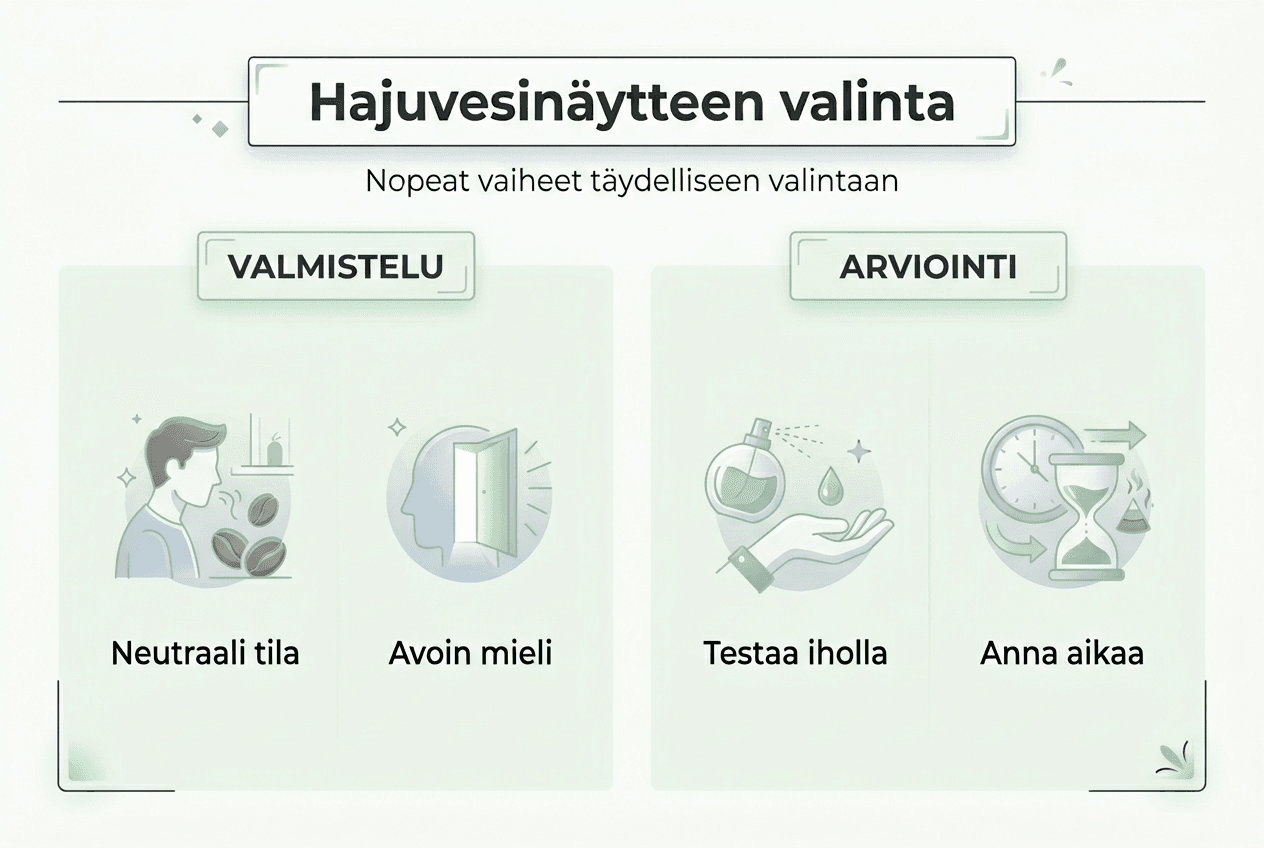
Pro tip: Test a maximum of three perfumes per day. Olfactory fatigue is a real phenomenon where the nose loses the ability to distinguish scents after too many aromas. Give your sense of smell a break between tests by sniffing coffee beans or breathing fresh air. This simple trick resets receptors and significantly improves evaluation accuracy.
You must have an open mind. Don't decide beforehand what scent suits you. Surprises are common in the world of perfumes. A scent that sounds repulsive on paper might be perfect on your skin. Conversely, a popular scent might not work due to your body chemistry. Give every sample a fair chance to prove its worth.
How to Select and Evaluate Perfume Samples Step-by-Step
A systematic approach guarantees the best results when testing perfume samples. Follow these steps for an accurate evaluation of each fragrance:
-
Start with a scent strip. Spray the sample onto a paper strip and smell it a few times. This gives an initial impression of the top notes without skin contact. If the scent isn't pleasing at this stage, it's unlikely to improve on the skin.
-
Spray the sample onto a clean skin area. The wrist or inner elbow are the best spots. Use one spray per test area. Too much will distort the intensity and longevity of the scent.
-
Wait 10 minutes before the first evaluation. The top notes are now most noticeable. These are the first scents you perceive, often fresh and strong notes like citrus or lavender.
-
Re-evaluate after 30 minutes. The heart notes will now begin to dominate. This is the true core of the fragrance, lasting several hours. Notice how the scent has changed from its initial application.
-
Check the fragrance after 4 hours. The base notes are now present. These deep, lasting scents like musk, vanilla, or sandalwood reveal what the perfume smells like at the end of the day.
-
Document your observations at each stage. Write down what notes you detect, how strong the scent is, and how it makes you feel. Compare the fragrance to your style and usual situations.
Perfume recommendations vary according to six different dressing styles, so consider during testing how the scent fits into your daily life. Will you use it for work, leisure, or special occasions? The scent should feel like a natural part of your identity.
Pro tip: Test the same perfume on at least two different days before making a final decision. Weather, hormonal fluctuations, and even diet can affect how a fragrance develops on your skin. A second test confirms the initial impression or reveals that the scent isn't as consistent as you thought.
Use a table to systematically compare different samples:
| Scent | Top Notes | Heart Notes | Base Notes | Longevity | Style Suitability |
|---|---|---|---|---|---|
| Sample 1 | Citrus, Bergamot | Jasmine, Rose | Musk, Cedarwood | 6 hours | Classic, Formal |
| Sample 2 | Green Apple, Mint | Lavender, Geranium | Sandalwood, Amber | 4 hours | Casual, Everyday |
| Sample 3 | Pepper, Ginger | Leather, Tobacco | Vanilla, Tonka | 8 hours | Bold, Evening |
This table helps you clearly see the differences and make an informed choice. Note that longevity and intensity are just as important as the notes themselves. A short-lived fragrance requires reapplication, which can be impractical in a busy daily life.
When evaluating a fragrance, ask yourself:
- Does the scent feel authentic and natural on my skin?
- Do I want to smell this all day?
- Is the scent suitable for the situations in which I'll wear it?
- Do I receive positive feedback from others about the scent?
- Does the scent stand out positively, or does it feel too generic?
The perfume selection guide offers more in-depth information on choosing fragrances and evaluation criteria that help make wise decisions.
Verification: Common Mistakes and How to Avoid Them
Even experienced fragrance enthusiasts make mistakes in evaluation. Avoiding these pitfalls will significantly improve the quality of your choices.
The most common mistake is testing too many samples at once. The sense of smell quickly fatigues, and after three scents, the ability to distinguish subtle differences diminishes. This leads to confusing observations and poor decisions. Limit testing to a maximum of three perfumes per day. If you test more, the results will be unreliable. Give your nose time to recover between tests by sniffing coffee or going outside for fresh air.
Another serious mistake is evaluating a fragrance immediately after spraying. Alcohol evaporation takes time, and top notes dominate for the first few minutes. The true scent is revealed only after 15 minutes. Many reject a perfect perfume because the initial impression was too strong or incorrect. Patience is key to successful selection.
Mixing several perfumes on the same skin area is a catastrophic error. The scents react with each other, creating a muddled aroma that doesn't represent either of the original perfumes. Test only one scent per skin area. If you want to test more, use different wrists and inner elbows. Never apply two perfumes to the same spot consecutively without thoroughly washing the skin.
The store environment often misleads:
- Strong air conditioning changes the development of the scent
- Rush and hustle interfere with concentration
- Sales pressure can lead to impulse decisions
- Other customers' perfumes mix with your testing
Always test samples at home in your own conditions. This gives a realistic picture of what the scent truly feels like in your everyday life.
Matching the scent to your style improves satisfaction and prevents poor choices. Don't choose a perfume based solely on trends or popularity. Even if all your friends love a certain scent, it doesn't mean it's right for you. Personal style and skin chemistry are unique. Trust your own observations more than others' opinions.
Also avoid these common pitfalls:
- Choosing a fragrance based solely on bottle design
- Relying only on online reviews without personal testing
- Using the same scent for every occasion
- Storing samples in poor conditions, which alters the scent
- Testing immediately after strong food or tobacco
The best perfume is the one that feels like you. It doesn't scream for attention but subtly complements your personality. Don't force yourself to like a scent that doesn't feel right, no matter how popular it is.
The perfume set selection guide helps you understand how different scents work together and how to build a versatile collection for different occasions. Learning from mistakes is part of the journey to the perfect fragrance.
Find Quality Perfume Samples at Be Frsh
Once you've learned how to properly select and evaluate perfume samples, the next step is to find a reliable source for quality samples. Be Frsh offers a wide selection of authentic perfume samples for men, women, and unisex options. The range covers both classic favorites and the latest trends, so you're sure to find something to test for every style and occasion.
High-quality samples allow you to explore fragrances without a large financial risk. You can try several different fragrance families and brands to find your signature scent. Be Frsh's selection includes popular options like Jean Paul Gaultier Scandal Le Parfum, which offers a bold and feminine fragrance experience. Among niche fragrances, you'll find Parfums de Marly Palatine, representing luxury and sophistication. For lovers of fresh, summery options, Maison Margiela Replica Beach Walk evokes the feeling of a sunny beach day.
FAQ
How long should I smell a perfume sample before deciding?
At least 4 hours to follow the full development of the fragrance. Top notes evaporate in 15 minutes, heart notes dominate for 2 hours, and base notes are only revealed after 4 hours. Ideally, test the same scent on two different days to ensure consistency.