

How to Compare Fragrance Samples: Find the Best One

You’ve visited the fragrance department, sprayed three different scents on your wrist, and gone home excited. But the next morning, you can’t remember which one was the right one. Or even worse: you order a full-sized bottle, and at home, the scent smells completely different from how it did in the store. This is a familiar situation for many fragrance enthusiasts. Systematically comparing fragrance samples solves precisely this problem: once you know how to test correctly, you’ll find a scent that suits you, not just the atmosphere of the store.
Table of Contents
- What You Need for Comparing Fragrance Samples
- Tips for Testing Fragrance Samples in Practice
- How to Systematically Compare Fragrance Samples
- Common Mistakes in Comparing Fragrance Samples and How to Avoid Them
- How to Utilize Evaluation Results in Your Purchase Decision
- Order Fragrance Samples Easily from Be Frsh
- Frequently Asked Questions About Comparing Fragrance Samples
Key Takeaways
| Point | Details |
|---|---|
| Test at your leisure | Compare at most 3–4 scents at a time and allow the fragrance to develop on your skin for several hours. |
| Document observations | Jot down your initial impression, heart notes, and base notes to help remember the differences. |
| Utilize blind testing | Label samples with numbers and evaluate objectively without brand or name influence. |
| Avoid common mistakes | Test on skin and don't rush the decision – environment, time, and your own body affect the outcome. |
| Make purchase decisions based on observations | Review your notes and choose a fragrance based on genuine test results, not marketing claims. |
What You Need for Comparing Fragrance Samples
A successful fragrance test doesn't require a professional laboratory, but a few basic tools will make the comparison significantly more reliable. By preparing in advance, you'll save time and get clearer results.
The most important tools are:
- Fragrance samples of at least two to three different options
- Blotter strips for initial screening tests before applying to skin
- A notebook or app for recording observations immediately during testing
- Unscented soap and water for cleaning the skin between tests
- Coffee beans or fresh air to reset your sense of smell
- Good lighting and a quiet space where you can concentrate without distractions
Clean skin is an absolute prerequisite. Do not use strongly scented lotions or deodorants on testing day, as they will mix with the sample and distort the result. Testing under different conditions yields more reliable results, so set aside time for multiple testing days.
Pro tip: Always include the date, time, weather, and your mood in your notes. These factors influence how you perceive a fragrance and will help you understand later why the same sample felt different on different days.
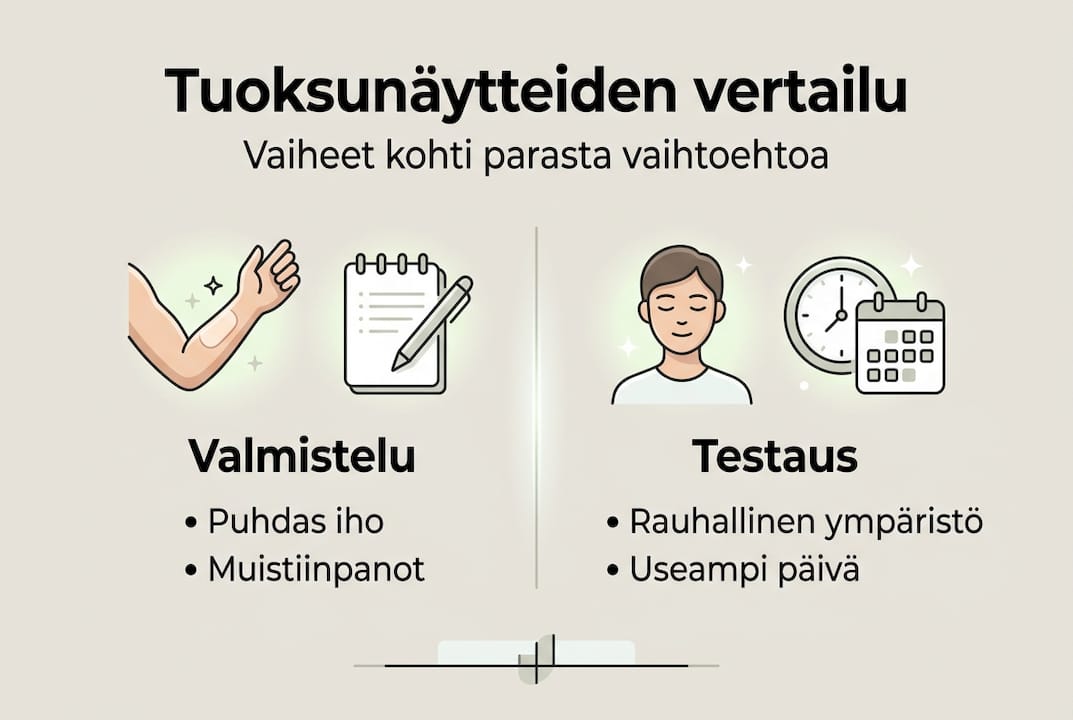
You can find more practical advice in the fragrance sample user guide, which covers the entire process from beginning to end.
| Tool | Purpose | Importance |
|---|---|---|
| Blotter strips | Quick pre-screening test | High |
| Notebook | Documenting observations | High |
| Coffee beans | Resetting sense of smell | Medium |
| Unscented soap | Skin cleansing | High |
| Clean skin | Authentic skin chemistry test | Essential |
Tips for Testing Fragrance Samples in Practice
Once you have your tools ready, it's time to move on to the actual testing. At this stage, systematic approach separates random experimentation from genuine comparison.
- Start with blotters. Spray each sample on its own strip and sniff them quickly. This helps to weed out any scents that aren't interesting at all before you apply anything to your skin.
- Select a maximum of three or four favorites for skin testing. More than four scents at once will overwhelm your sense of smell, and a reliable comparison will no longer be possible.
- Apply different fragrances to different areas of the skin. Use your wrists, inner elbows, or sides of the neck. Note in your observations which scent is on which spot.
- Record your initial impression immediately. What do you notice within the first few minutes? This is the so-called top note.
- Wait 15 minutes and smell again. Now the heart note begins, which reveals the true character of the fragrance.
- Revisit the fragrance after 4 hours. The base note is what remains on your skin after a long time, and often it's what determines whether you love the scent or not.
It's worth monitoring the fragrance development in stages: top notes last between 0 and 15 minutes, heart notes from 15 minutes to two hours, and base notes four hours or more. Document each stage in your notes or a table.
“A fragrance is not just what you smell from the bottle. It's a living experience that changes on your skin over hours.”
Test the same sample on several days under different conditions, as skin chemistry and environmental factors significantly affect the outcome. On a rainy day, a fragrance might feel stronger, while in hot weather, it might be more intense.
Pro tip: Neutralize your sense of smell between tests by sniffing your own skin on the inside of your wrist where there is no fragrance. This often works better than coffee beans because a familiar scent quickly resets your senses.
Read more about why trying fragrance samples saves money and disappointment, and how you can evaluate perfumes step-by-step systematically.
How to Systematically Compare Fragrance Samples
After individual tests, it's time to consolidate observations and compare results fairly. At this stage, objectivity is key.
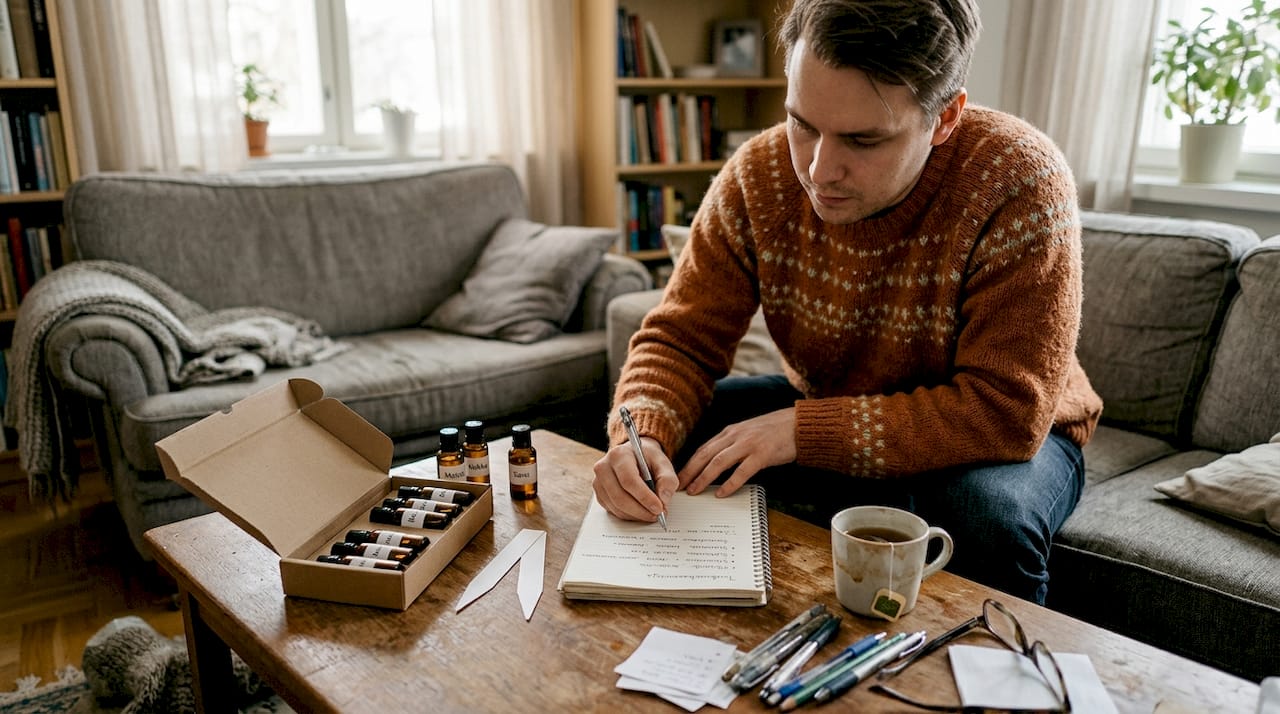
Blind testing reduces bias: label samples with numbers without names, so that brand reputation or packaging appearance doesn't influence your evaluation. This is the same method professionals use.
Steps for comparison:
- Number the samples and write down the names on a separate paper, which you only turn over after the comparison.
- Evaluate each fragrance using the same criteria: longevity, intensity, suitability for different occasions, and overall impression.
- Score the characteristics on a scale of 1 to 5 for each sample individually.
- Fill in a comparison table with the results for all samples.
- Involve your close circle. Ask a friend or partner to smell the fragrances without any prior information. An external perspective can be surprising.
Panel tests show that subjective scoring works effectively when evaluation criteria are clear and all samples are tested under the same conditions.
| Feature | Sample 1 | Sample 2 | Sample 3 |
|---|---|---|---|
| Longevity (1 to 5) | |||
| Intensity (1 to 5) | |||
| Suitability for daily use (1 to 5) | |||
| Suitability for special occasions (1 to 5) | |||
| Overall impression (1 to 5) | |||
| Total Score |
Use this table as a basis for your own comparison. Once the scores are tallied, the winner isn't always the one that felt best on the first sniff. Learn more about what the benefits of comparing samples mean in practice before making a big purchase decision.
Common Mistakes in Comparing Fragrance Samples and How to Avoid Them
Systematic comparison is a good start, but certain pitfalls can still obscure the results. By recognizing these errors beforehand, you can avoid frustration.
- Too many scents at once. The sense of smell quickly becomes fatigued, and after just five scents, the differences start to blur. Keep it to a maximum of four.
- Too short a waiting time. Many people make decisions based solely on the top note. Fragrance changes with skin chemistry, so test on your own skin for at least 4 to 6 hours before making a final assessment.
- Comparing under different conditions without documentation. If you test one scent on Monday and another on Friday in different weather and moods, the comparison isn't fair.
- Bottle test only. A fragrance in the bottle is completely different from a fragrance on your skin. Alcohol evaporates and the scent changes as it reacts with your skin.
- Neglecting to reset your sense of smell. Without neutralization, the previous scent will mix with the next, and you'll be evaluating a combination, not an individual sample.
Pro tip: If you notice your sense of smell becoming fatigued, take a 20-minute break outdoors in fresh air. It's the most effective way to restore your senses and doesn't require any special equipment.
Also remember that considering fragrance development is an essential part of comparison. Don't make a decision until you've experienced the full arc from top note to base note.
How to Utilize Evaluation Results in Your Purchase Decision
Once errors have been avoided and observations meticulously collected, it's time to make a decision. At this stage, your notes are invaluable.
- Review your notes calmly. Don't make a decision immediately after testing; give yourself a night or two to think.
- Organize fragrances according to your own criteria. What's most important to you: longevity, suitability for a particular occasion, or the feeling the fragrance evokes?
- Consider observations made in different situations. Does the fragrance work both in the office and in the evening? Or is it clearly suitable for only one situation?
- Ask for opinions from your close circle. Especially for gift purchases, another person's reaction is important information.
- Choose based on the sample, not marketing or packaging. A beautiful bottle doesn't smell on your skin, but the right fragrance does.
Remember that choosing based on samples is the only way to ensure that a full-sized bottle meets your expectations. Marketing can promise a lot, but only your own skin tells the truth.
If you're buying a fragrance as a gift, try to get information about the recipient's skin chemistry and preferences. Ask if they prefer floral or woody, fresh or warm scents. Samples are also an excellent gift in themselves, as they give the recipient the opportunity to find their own favorite without pressure.
Order Fragrance Samples Easily from Be Frsh
Once you know how to compare fragrances systematically and expertly, the next step is to acquire high-quality samples to test at home. A calm home environment is the best place to conduct this comparison, as there are no store smells, no rush, and no sales assistant influence.
From Be Frsh's fragrance sample selection, you'll find a wide collection of popular and niche fragrances for women, men, and unisex use. You can order several samples at once and conduct the comparison described in this article at home at your own pace. Each sample is carefully packaged and delivered quickly. Read more about why trying samples before buying a full-sized bottle is beneficial, and start your own fragrance journey today.
Frequently Asked Questions About Comparing Fragrance Samples
How many fragrances should be tested at once?
Test a maximum of 3 to 4 fragrances at a time so that your sense of smell doesn't become fatigued and you can clearly compare differences without confusion.
Why does a fragrance change on my skin throughout the day?
Skin chemistry, humidity, and temperature affect the development of a fragrance, which is why the same scent can feel fresh in the morning and warmer in the evening.
Do the names of fragrance samples need to be hidden during comparison?
Yes, blind testing reduces bias and helps to compare objectively without the influence of brand or packaging.
Should I test both on skin and with a blotter?
Blotters allow you to quickly pre-screen options, but testing on skin gives a more accurate picture of how the fragrance interacts with your specific skin chemistry.
How long should I wait before forming a final opinion?
Allow each fragrance at least 4 to 6 hours to develop on your skin before making a final assessment, so that the base notes have time to emerge.
Recommendation
Transparency: this article was written with AI assistance and reviewed before publishing. Illustrations may be AI-generated.
Leave a comment