

Safe Scents for Allergy Sufferers: A Guide to Reaction-Free Living

Many assume that all fragrances are safe and harmless, but in reality, fragrance allergies and sensitivities affect a significant portion of adults in Finland. Up to 32% of Finns suffer from fragrance hypersensitivity, and symptoms can range from mild rashes to more severe reactions. This guide explains the differences between fragrance allergy and sensitivity, the risks, and ways to choose safe, high-quality fragrances without allergic reactions. You will learn to identify allergens, avoid symptoms, and enjoy fragrances safely.
Table of Contents
- Key Learnings
- How Fragrance Allergy Differs from Fragrance Sensitivity
- How to Identify and Avoid Fragrance Allergy Triggers
- Safe Fragrances and Options for Fragrance Allergy Sufferers
- Treatment and Prevention of Fragrance Allergy and Sensitivity
- Find Safe and High-Quality Fragrances at Be Frsh
- Frequently Asked Questions
Key Takeaways
| Aspect | Information |
|---|---|
| Fragrance allergy vs. sensitivity | Fragrance allergy is a delayed immune response contact dermatitis, with symptoms appearing 24-72 hours after exposure. |
| EU labeling of allergens | EU cosmetics regulation requires labeling of over 80 fragrance allergens when concentrations exceed limits. |
| Common allergens | Limonene, linalool, geraniol, citral, coumarin, and farnesol are the most common allergens in both synthetic and natural oils. |
| Avoiding allergens | Always read the product ingredient list and avoid products labeled "parfum" or "fragrance" without specific breakdown. |
Key Learnings
| Topic | Key Information |
|---|---|
| Fragrance Allergy | Delayed skin reaction, diagnosable with patch testing |
| Fragrance Sensitivity | Immediate symptoms without immune reaction, such as headache or runny nose |
| Avoiding Allergens | Check ingredient lists and avoid listed allergens |
| Safe Alternatives | Hypoallergenic and fragrance-free products with an Allergy Label |
| EU Regulations | Over 80 common fragrance allergens require labeling in cosmetics |
| Testing | Always test new products on a small skin area before wider use |
How Fragrance Allergy Differs from Fragrance Sensitivity
Fragrance allergy and fragrance sensitivity are often confused, but they are medically distinct conditions. Understanding the difference can help you identify your symptoms and choose the right products.
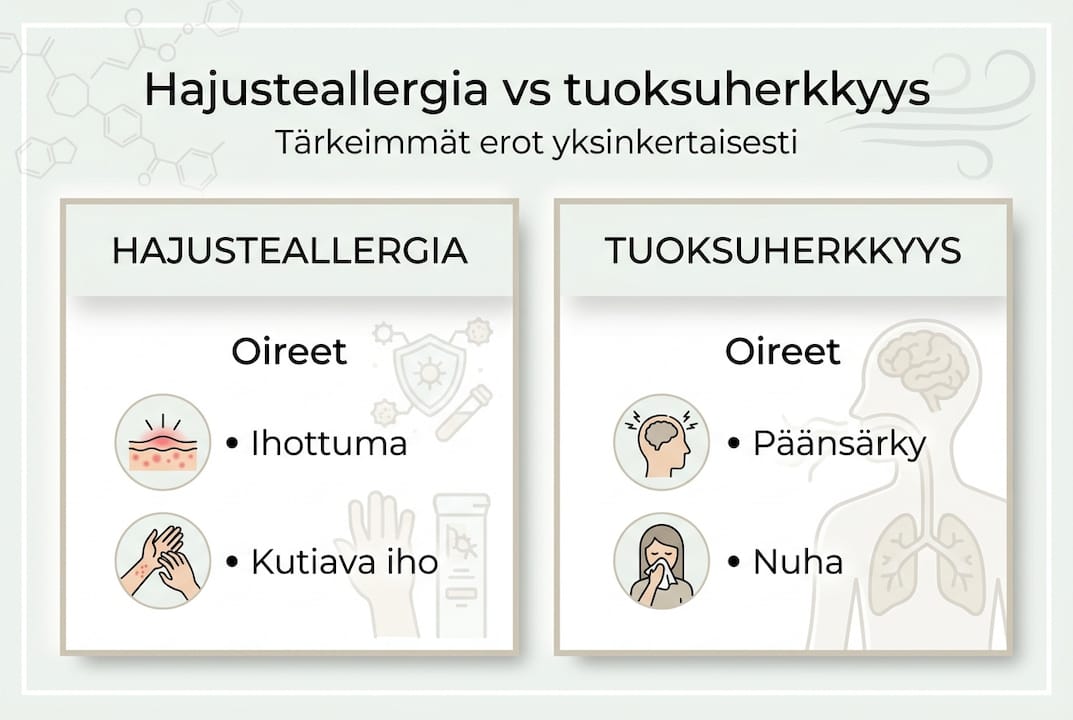
Fragrance allergy is a delayed type IV allergic contact dermatitis that develops when the skin is repeatedly exposed to certain fragrances. Symptoms typically appear 24-72 hours after exposure and include redness, itching, rash, and blisters, especially on the face, neck, and hands. Diagnosis is confirmed by a patch test, where allergens are tested on the skin for 48 hours. This immune-mediated reaction means your body recognizes the fragrance as a foreign substance and reacts with a defense mechanism.
Fragrance sensitivity is not an immunological allergy but an abnormal reaction to scents. Symptoms appear quickly, often within minutes, and include headaches, nausea, runny nose, eye irritation, and facial redness. Approximately 10-40% of adults experience fragrance sensitivity, and in Finland, the figure is as high as 32% according to studies. Since it is not an immune reaction, fragrance sensitivity cannot be diagnosed with allergy tests. Instead, symptom management is based on avoiding exposure and controlling environmental factors.
Differences in practice:
- Fragrance allergy requires activation of an immune response and develops over time due to repeated exposure.
- Fragrance sensitivity causes immediate symptoms without an immunological background and can occur even with the first exposure.
- Symptoms of fragrance allergy are generally confined to the skin, while fragrance sensitivity affects the respiratory tract, nervous system, and general well-being.
- Fragrance allergy is diagnosed with medical tests; fragrance sensitivity is identified based on symptoms and the connection to exposure.
Understanding this helps you choose the right products and avoid unnecessary symptoms. If you suspect a fragrance allergy, consult a dermatologist for testing. Living with fragrance sensitivity requires conscious selection of fragrances and suitable products and minimizing exposure in daily life.
How to Identify and Avoid Fragrance Allergy Triggers
Managing fragrance allergy begins with identifying allergens and avoiding them in everyday products. This requires precision and knowledge of ingredients.
The EU cosmetics regulation requires the labeling of over 80 common fragrance allergens if their concentrations exceed certain thresholds: 0.001% in leave-on products and 0.01% in rinse-off products. This legislation protects consumers and enables informed choices. The most common significant allergens include limonene, linalool, geraniol, citral, coumarin, and farnesol. These occur in both synthetic fragrances and natural essential oils.
Many allergies are caused by synthetic fragrances, which contain complex chemical compounds. Surprisingly, essential oils can also cause allergies, as they naturally contain many allergens such as limonene in citrus oils or linalool in lavender oil. Thus, natural does not automatically mean safe for allergy sufferers.
Practical ways to avoid allergens:
- Always read the product's ingredient list carefully before purchasing and focus on the allergens in the fragrance section.
- Avoid products that list the general term "parfum" or "fragrance" without further breakdown.
- Choose fragrance-free or hypoallergenic products that carry the Allergy Label or similar certification.
- Always test a new product on a small skin area, such as the inside of the wrist, for 48 hours before wider use.
- Keep a diary of the products you use and any symptoms to identify your personal triggers.
Professional tip: When examining fragrance concentrations, remember that a higher fragrance concentration also means greater allergen exposure. Eau de parfum contains 15-20% fragrance oils, while eau de toilette contains 5-15%. For allergy sufferers, a lower concentration may be safer, but it is always advisable to check the ingredients first.
Common fragrance allergens and their sources:
| Allergen | Typical Sources | Occurrence |
|---|---|---|
| Limonene | Citrus oils, mint | Shampoos, soaps, perfumes |
| Linalool | Lavender, coriander | Skincare products, deodorants |
| Geraniol | Rose, lemongrass | Perfumes, lotions |
| Citral | Lemongrass, verbena | Perfumes, detergents |
| Coumarin | Tonka beans, cinnamon | Scented candles, perfumes |
| Farnesol | Ylang-ylang, jasmine | Luxury perfumes, facial creams |
Once you identify your allergens, you can make informed choices and enjoy fragrances safely. Fragrance evaluation helps you find suitable products without risks. Remember to also check ingredients to avoid in cosmetics more broadly.
Safe Fragrances and Options for Fragrance Allergy Sufferers
Living with a fragrance allergy or sensitivity doesn't mean giving up on fragrances entirely. The right choices can allow you to enjoy scents without symptoms.
The best choice is completely fragrance-free products marked with an Allergy Label, which have been tested and certified suitable for allergy sufferers. These products contain no added fragrances or common allergens. The Allergy Label guarantees that the product has undergone strict tests and meets the safety criteria set for allergy sufferers. This is the safest way to avoid reactions, especially if you have a diagnosed fragrance allergy.

Natural, additive-free ingredients may be better suited for those with fragrance sensitivity than synthetic fragrances, but caution is still needed. Synthetic fragrances are more likely to cause allergies than essential oils used in small doses, but essential oils are not risk-free. A small amount of essential oils has a lower allergy risk, but repeated exposure should be avoided. If you choose products containing essential oils, ensure allergens are clearly marked and test the product first.
Criteria for choosing safe products:
- Look for labels such as "fragrance-free," "hypoallergenic," or "Allergy Label"
- Prefer products with a short and understandable ingredient list
- Avoid products with the general label "parfum" without allergen breakdown
- Choose mildly scented products if you want some fragrance but want to minimize risk
- Contact the manufacturer if you doubt a product's suitability
Professional tip: Winter fragrances can be particularly challenging for allergy sufferers, as they often contain strong spices and balms. If you want to enjoy winter scents, try sample bottles first and test them on a small skin area. This way, you can find suitable fragrances without significant financial risk or allergic reactions.
Comparison: hypoallergenic vs. fragrance-free products:
| Feature | Hypoallergenic | Fragrance-Free |
|---|---|---|
| Fragrance | Mildly scented, tested allergens | No added fragrances |
| Allergy Risk | Low, but not zero | Very low |
| Suitability | Mild sensitivity | Diagnosed allergy |
| Selection | Wider range | More limited range |
| User Experience | Pleasant scent | Neutral, ingredients may have a scent |
| Certification | Varies | Allergy Label recommended |
When evaluating fragrances, use fragrance assessment methods that help you identify suitable products. Test the product first in the air, then on your wrist, and monitor for any symptoms for 48 hours. Never apply a new product broadly until you are sure of its suitability.
For those sensitive to fragrances, mildly scented products with less volatile fragrance are also recommended. These products do not diffuse scent as strongly into the environment, which reduces respiratory irritation. Always testing on your skin before use is essential, as every skin and immune system reacts individually.
Treatment and Prevention of Fragrance Allergy and Sensitivity
Correct diagnosis and proactive measures are key in managing fragrance allergy and sensitivity. This way, you can minimize symptoms and improve your quality of life.
Fragrance allergy is diagnosed with patch tests followed by a 48-hour observation period, where patches containing allergens are applied to the back. These tests reveal sensitivity to specific substances and help create a personalized avoidance plan. A dermatologist will interpret the results and provide precise instructions on which ingredients you should avoid. For severe symptoms, such as widespread rash or breathing difficulties, a doctor's consultation is important to receive the correct treatment.
Treatment for fragrance sensitivity is based on reducing exposure, as it cannot be immunologically diagnosed and there is no medicinal cure. Managing symptoms requires modifying your environment and making conscious choices in daily life. Avoid fragrances, air fresheners, and exposing environments such as perfume sections or strongly scented areas. Inform your family, colleagues, and friends about your sensitivity so they can take it into account.
Practical guidelines for treatment and prevention:
- Identify your triggers: Keep a symptom diary where you record exposures and symptoms. This helps identify patterns and avoid certain products or environments.
- Choose products marked with the Allergy Label: These are tested and certified as suitable for allergy sufferers, significantly reducing the risk.
- Always read ingredient lists: Pay special attention to the fragrance section and avoid known allergens. Do not rely solely on marketing claims like "natural" or "sensitive skin."
- Test new products: Apply a small amount of the product to the inside of your wrist and observe for 48 hours. If there are no symptoms, the product is likely safe.
- Reduce exposure at home: Use fragrance-free detergents, do not burn scented candles, and ventilate regularly. Choose fragrance-free cleaning products.
- Be careful with hair dye and skincare products: These can contain hidden allergens, such as PPD in hair dyes or preservatives in creams.
Professional tip: If you work in an environment where you are exposed to fragrances, discuss with your employer the possibility of a fragrance-free workplace. Many workplaces have implemented fragrance-free policies to protect sensitive employees. You can also use a respirator temporarily in strongly scented areas.
Prevention is most effective when you understand your body's reactions and make informed choices. Fragrance selection and sensitivity go hand in hand, and the right tools will help you enjoy fragrances safely. Remember that everyone is an individual, and what works for one person may not work for you. Listen to your body and seek professional help if needed.
Find Safe and High-Quality Fragrances at Be Frsh
Now that you understand fragrance allergy and sensitivity, the next step is to find products that are right for you. Be Frsh offers a wide selection of hypoallergenic and fragrance-free products designed to meet the needs of allergy sufferers. In our online store, you'll find guidance on choosing fragrances and safe alternatives that allow you to enjoy scents without symptoms.
Explore Be Frsh's online store, where you can try various perfume samples before making a larger purchase. This reduces risk and helps you find the perfect scent that won't cause allergic reactions. We also offer detailed scent evaluation instructions to help you make informed choices and safely enjoy quality fragrances. Our customer-centric service and fast delivery make trying out scents effortless.
Frequently Asked Questions
How to recognize the symptoms of perfume allergy?
Fragrance allergy manifests as redness, itching, and rash on the face, neck, or hands, typically 24-72 hours after exposure. Symptoms may also include blisters and swelling at the points of contact. Diagnosis is confirmed by epicutaneous patch tests at a dermatologist's office, where allergens are tested on the skin for 48 hours. If you suspect a fragrance allergy, seek a doctor's evaluation and avoid using suspected products until then.
How does fragrance sensitivity differ from allergy?
Fragrance sensitivity causes rapid symptoms such as headache, runny nose, nausea, and eye irritation without immunological allergy. Symptoms appear within minutes of exposure and subside when exposure ends. Fragrance allergy, on the other hand, is a delayed immune reaction on the skin that develops over hours or days and requires an immunological response. Fragrance sensitivity cannot be diagnosed with allergy tests, and treatment is based on avoiding exposure.
How to choose safe fragrances for sensitive skin?
Choose fragrance-free or hypoallergenic products that carry the Allergy Label or a similar certification. Always check the ingredient list and avoid known allergens such as limonene, linalool, and geraniol. Test new products on a small skin area, such as the inside of the wrist, for 48 hours before wider use. Choosing safe fragrances requires conscious decisions and careful product evaluation.
What are the most common ingredients containing fragrance allergens?
Common allergens include limonene, linalool, geraniol, citral, coumarin, and farnesol, which are often found in cosmetics, perfumes, and skincare products. Over 80 fragrance allergens require labeling under EU regulations if their concentrations exceed certain thresholds. These allergens are present in both synthetic fragrances and natural essential oils, such as citrus oils, lavender, and rose. Always read the product's ingredient list and avoid listed allergens if you have a diagnosed fragrance allergy or known sensitivity to certain substances.
Leave a comment