

How to make your fragrance last longer on your skin: top tips

TL;DR:
- Skin type, pH, and hormonal fluctuations affect a fragrance's longevity.
- Layering and proper application techniques extend a fragrance's wear.
- Test fragrances on your skin and during different seasons for the best results.
Many people think that a fragrance's longevity depends solely on the quality or price of the perfume. The reality is more complex. The same perfume might disappear from one person's skin in an hour and last all day on another, and it's not about who has the more expensive bottle. Skin type, skin pH, hormone levels, and even what you ate for breakfast all influence how a fragrance develops and lasts on your skin. In this article, we'll go through all the essential factors, concrete application techniques, and testing methods to help you get the most out of your fragrance.
Table of Contents
- What factors affect fragrance longevity on the skin?
- Fragrance types and their longevity on different skin types
- Secrets to longer-lasting fragrance: testing methods and application techniques
- Fragrance longevity testing and seasonal tips
- What experts don't always tell you about fragrance longevity
- Easily discover your new favorite fragrance by experimenting
- Frequently asked questions
Key Takeaways
| Point | Details |
|---|---|
| Skin type affects longevity | Oily skin retains fragrance better than dry skin. |
| Moisturizing improves longevity | Use an unscented lotion or oil before applying fragrance for maximum longevity. |
| Concentration determines longevity | Eau de Parfum typically lasts longer on the skin than Eau de Toilette. |
| Test on your own skin | Experience a fragrance's true longevity by testing it on your skin, not on paper. |
What factors affect fragrance longevity on the skin?
Once you know that a fragrance doesn't behave the same way on everyone, it's important to understand what factors influence it. Longevity isn't a coincidence; it's the sum of several variables.
Skin type is one of the most important factors. Oily skin retains fragrance longer than dry skin, as sebum effectively traps fragrance molecules. On dry skin, fragrance molecules evaporate more quickly because there aren't enough lipids in the surface structure to hold them. On combination skin, the effect varies between different areas of the face and body.
Skin pH is another crucial factor. A more acidic pH (4.5–6.5) can make a fragrance smell more aggressive and sharper, while a more neutral pH (6–7) reproduces the fragrance more faithfully to its original form. In practice, this means the same perfume can smell very different on two different people. Skin pH varies due to diet, soap use, and even stress levels, among other things.
Hormonal fluctuations also have a significant impact. During different phases of the menstrual cycle, skin chemistry changes, which directly reflects how the fragrance develops. Stress raises cortisol levels, which can make fragrances sharper or significantly shorten their longevity. Diet also plays a role: heavily spiced foods, alcohol, and caffeine can alter skin odor and thus affect how a perfume blends with the skin.
Seasonal factors are often an underestimated element. In summer, heat intensifies fragrance evaporation, making the scent more potent but also potentially causing it to dissipate more quickly. In winter, cold air slows down evaporation and emphasizes the base notes of the fragrance. Humidity also plays a part: humid air carries fragrance molecules more effectively, which is why a scent might feel stronger on a rainy day.
| Factor | Effect on longevity | Note |
|---|---|---|
| Oily skin | Longer longevity | Sebum traps molecules |
| Dry skin | Shorter longevity | Moisturizing helps |
| Low pH | Alters fragrance | Can make fragrance sharp |
| High temperature | Accelerates evaporation | Use a lighter fragrance |
| Stress | Shortens longevity | Cortisol changes skin chemistry |
| High humidity | Carries fragrance better | Fragrance diffuses more widely |
When choosing the best perfume for yourself, it's important to consider your skin type and life situation, not just how the fragrance sounds in its description.
Fragrance is a personal experience. The same perfume can be a long-lasting classic for one person and a fleeting wisp for another, and neither is wrong.
Fragrance types and their longevity on different skin types
Knowing what factors affect a fragrance's longevity, it's useful to understand the significance of fragrance type and your own skin. The concentration of perfumes is one of the clearest factors influencing longevity, and it's worth understanding before making a purchase decision.
Fragrance longevity on the skin primarily depends on the perfume's concentration: Eau de Toilette (EDT) typically lasts 3–5 hours, Eau de Parfum (EDP) 6–8 hours, and Parfum over 8 hours. However, these are averages, and skin type can significantly alter these figures in either direction.
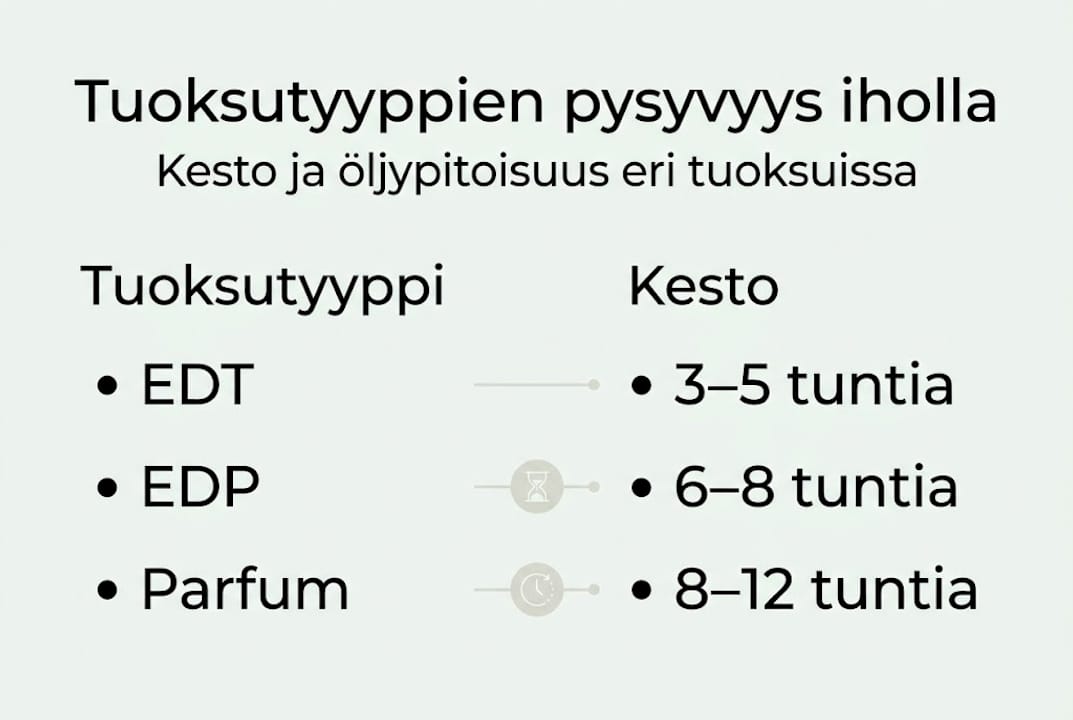
EDT (Eau de Toilette) generally contains 5–15% fragrance oils. It's a light and fresh option, especially suitable for summer use and daytime occasions. On oily skin, EDT can last up to 5–6 hours, whereas on dry skin, it might evaporate in as little as two hours.
EDP (Eau de Parfum) contains 15–20% fragrance oils and is significantly longer-lasting. It's a versatile choice suitable for both day and evening wear. Even on dry skin, EDP usually lasts 4–6 hours, and on oily skin, it can last considerably longer.
Parfum, or pure perfume, contains 20–40% fragrance oils and is the longest-lasting option of all. Even a small amount provides a long-lasting result, and it's especially suitable for very dry skin, which tends to consume fragrances more quickly.
| Fragrance Type | Oil Concentration | Oily Skin | Dry Skin | Combination Skin |
|---|---|---|---|---|
| EDT | 5–15 % | 4–6 h | 2–3 h | 3–4 h |
| EDP | 15–20 % | 7–9 h | 4–6 h | 5–7 h |
| Parfum | 20–40 % | 10+ h | 7–9 h | 8–10 h |
Before investing in a full bottle, it's definitely worth testing the fragrance on your own skin. Using fragrance samples, you can try different concentrations and find the one that works best for your skin.
Choosing the right fragrance strength for your skin:
- Identify your skin type: oily, dry, or combination?
- First, test an EDT if you want a light and fresh everyday scent.
- Move to an EDP if you desire longer longevity or a deeper scent.
- Consider Parfum if your skin is very dry or you want to minimize reapplication.
- Remember that fragrance changes on the skin over time, so allow it to develop before making a final judgment.
Professional tip: If you're used to wearing EDT but the fragrance doesn't last, try the EDP version of the same fragrance family before switching to an entirely new scent. Often, simply increasing the concentration solves the problem.
Secrets to longer-lasting fragrance: testing methods and application techniques
Once you know how to choose and test a suitable fragrance, the next step is to maximize its longevity with the right methods. Application technique significantly affects a fragrance's staying power more than most people realize.
Moisturizing before application is one of the most effective ways. An unscented lotion or oil creates a lipid base that traps fragrance molecules on the skin for longer. Layering, i.e., using a shower gel, lotion, and perfume from the same fragrance family together, significantly improves longevity. This is an especially helpful tip for dry skin, where fragrance otherwise evaporates quickly.
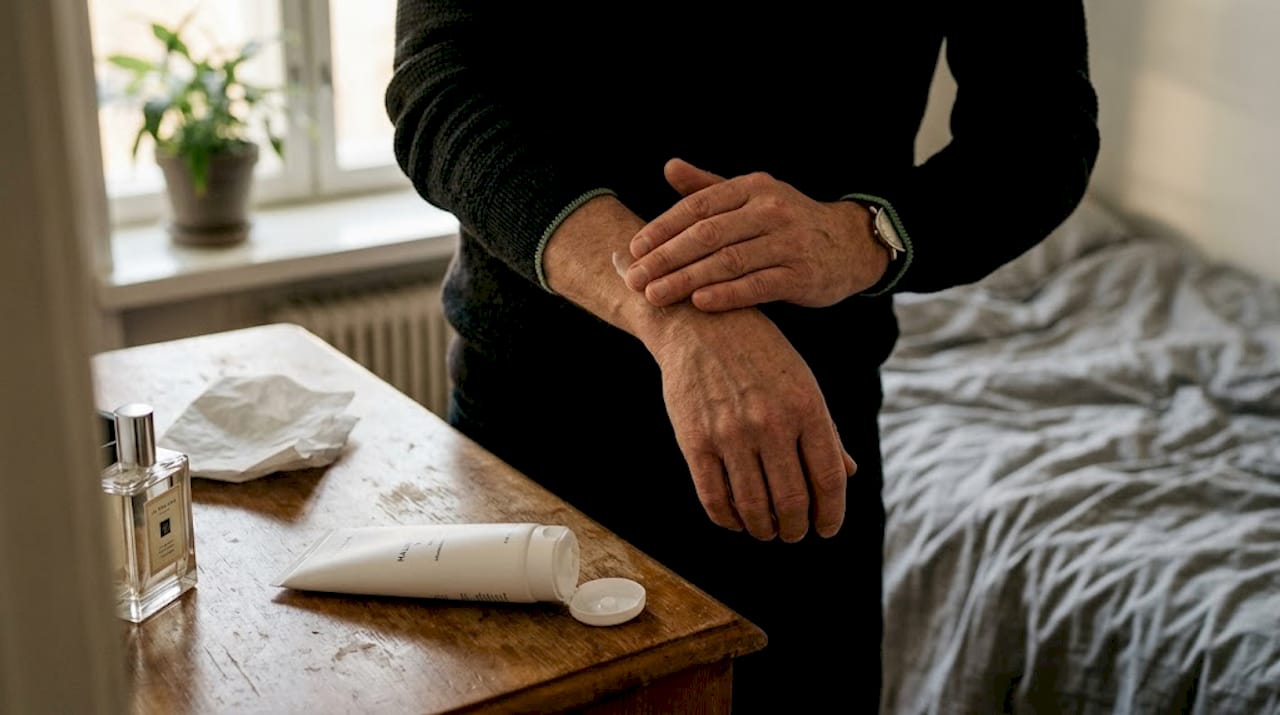
Pulse points are key. Applying to pulse points, such as wrists, neck, and behind the ears, leverages body heat and circulation. These areas are warmer than other skin, which continuously activates fragrance molecules throughout the day. The sternum, inner elbows, and behind the knees are also good spots.
One of the most common mistakes is rubbing wrists together after application. This breaks down the top notes of the fragrance and can adversely alter the scent's development. Spray or apply the fragrance and let it dry naturally.
Other common mistakes and their solutions:
- Too much at once: A few sprays are enough. More doesn't extend longevity; it just overpowers.
- Applying to clothes first: Start with the skin, as body heat activates the fragrance best.
- Dry skin without moisturizing: Always moisturize first, especially in winter.
- Applying immediately after a shower: Wait a few minutes for the skin to stabilize.
Professional tip: Lightly spray perfume into your hair or at the roots. Hair retains fragrance for a long time, and as you move, the scent will naturally diffuse around you. However, be cautious with alcohol-based fragrances if your hair is dry or color-treated.
If you want to test a fragrance correctly before a larger purchase, these application techniques will help you assess its true longevity on your skin.
Fragrance longevity testing and seasonal tips
You'll get the most out of fragrances when you test them on your own skin and consider the seasons. Testing is a skill that can be developed, and with the right method, you'll save both money and disappointment.
Always test on skin for at least 30 minutes, preferably for several hours. An overnight test is the best way to assess a fragrance's true longevity and development: apply the fragrance in the evening and evaluate how it behaves in the morning. A test strip gives an initial impression, but it doesn't reflect how the fragrance works on your skin, as it lacks the skin's warmth, pH, and chemistry.
Here's how to conduct proper testing step-by-step:
- Apply the fragrance to clean, unmoisturized skin at pulse points.
- Wait 15–20 minutes for the alcohol to evaporate and the heart notes to begin developing.
- Smell the fragrance again after 30 minutes, 2 hours, and 4 hours.
- Assess how the fragrance changes and when it begins to fade.
- Do an overnight test: apply in the evening and check in the morning if the scent is still detectable.
Seasonality significantly affects a fragrance. Heat intensifies evaporation and makes the scent stronger, while cold emphasizes base notes and slows down development. This means that in summer, lighter and fresh fragrances are preferable, while in winter, deep and warm-based scents work best.
Clothing choice also matters. Natural fibers like wool and cotton retain fragrance well, while synthetic fabrics can adversely alter the fragrance's development. If you want a long-lasting fragrance experience, also apply perfume to a wool scarf or cotton shirt.
Professional tip: Try the overnight test especially when considering a new fragrance purchase. Apply a sample in the evening and evaluate in the morning if the scent still feels right for you. This method reveals the base notes, which are often the factor that determines whether you love a fragrance or not.
What experts don't always tell you about fragrance longevity
Once the basics are mastered, a rarely discussed but crucial phenomenon emerges: individuality. Most fragrance guides provide general advice that works well for the average user. But in reality, your skin's history, life situation, and body chemistry are constantly changing.
Hormones, stress, diet, age, and illnesses alter skin chemistry and thus the development of a fragrance. Pregnancy can make a scent unbearable, even if it has been a favorite perfume for years. Certain medications change skin pH so much that a familiar fragrance smells completely different. A lifestyle change, such as altering your diet or starting to exercise, can also have an impact.
This means you shouldn't give up on a fragrance if it's not working right now. Re-test it in a different life situation. And if you want to choose a personalized fragrance just for you, give yourself permission to bravely experiment with several options without the pressure of finding "the one" immediately.
The best advice is simple: test a lot, test often, and remember that evaluating a fragrance is best done when you are rested, stress-free, and have eaten normally.
Easily discover your new favorite fragrance by experimenting
Now that you know how skin type, pH, season, and application technique affect a fragrance's longevity, it's time to put that knowledge into practice.
At Befrsh.com, you can try fragrances and find your favorites risk-free. A wide selection of high-quality samples means you can test dozens of scents on your skin before deciding to purchase a full-sized bottle. You can compare different concentrations, try fragrances for various seasons, and utilize all the tips you've learned in this article directly in practice. Discovering fragrances is at its best when it happens on your own terms, at your own pace, and without pressure.
Frequently asked questions
Why doesn't a fragrance last as long on my skin as it does on my friend's?
Skin type, pH, hormones, and application methods individually affect a fragrance's longevity. Oily skin retains fragrance longer than dry skin because sebum traps fragrance molecules more effectively.
Should fragrance be applied to clothes or just skin?
Wool and cotton retain fragrance for a long time, but the fragrance develops more individually on the skin. Avoid synthetic fabrics, as they can adversely alter the fragrance's development.
How can fragrance longevity be easily extended?
Moisturize your skin with an unscented lotion before application and favor layering. An unscented lotion or oil creates a lipid base that significantly traps molecules on the skin for longer.
How should a fragrance be tested before purchasing?
For best results, test the fragrance on your own skin for at least 30 minutes or overnight. Always test on skin, as a test strip doesn't reflect how the fragrance works specifically on your skin.
Leave a comment