

How to properly test fragrances: the best methods

Choosing fragrances is one of the most enjoyable, yet also challenging, purchasing decisions. A perfume might seem perfect in the store, but at home, it turns out to be quite different. This is because the development of a fragrance on the skin is always a personal experience, influenced by skin chemistry, temperature, and even diet. The right testing method is not a minor detail; it is a crucial factor in whether you find your favorite or make an expensive mistake. In this guide, we will go through the best testing methods, their differences, and how to get the most out of each testing session.
Table of Contents
- Why is testing fragrances worthwhile?
- Paper strips versus skin testing: two main methods
- Basic guidelines for testing fragrances
- Panels and group testing: the power of community
- Best situations and recommendations: how to choose the right testing method for you
- Test at home easily: order samples and find your favorite
- Frequently Asked Questions about fragrance testing
Key Takeaways
| Point | Details |
|---|---|
| Test in multiple ways | First try fragrances on a paper strip, then confirm with a skin test. |
| Test in your own environment | At home, the nuances of the fragrance come out best without distractions. |
| Consider the time | All the nuances of a fragrance only appear over several hours – monitor its development. |
| Test only a few fragrances at a time | Avoid olfactory overload by keeping the number of tests moderate and pausing between trials. |
Why is testing fragrances worthwhile?
Before we introduce specific testing methods, let's explain why consideration and testing are essential for every fragrance enthusiast. Perfume is not like clothing that can be easily returned if it doesn't fit. A full-sized bottle often costs tens or even hundreds of euros, so the purchasing decision should be made carefully.
The development of a fragrance is a personal journey. The same perfume can smell completely different on two different people because skin chemistry individually alters the scent. This means that your friend's favorite might not work for you at all. Therefore, a skin test before purchase is always essential.
Mini and discovery sets allow for home testing without significant financial risk, and they are particularly recommended for enthusiasts who want to try several trendy products at once. Niche fragrances are a special case here: they often surprise positively, but also negatively, so testing is especially important.
Benefits at a glance:
- Save money by avoiding bad purchases
- Discover fragrances you wouldn't have tried otherwise
- Learn how your own skin reacts to different fragrances
- You can try before buying in peace at home
- Develop your sense of smell and understanding of the fragrance world
Professional tip: Try the fragrance at home in peace, as your sense of smell quickly becomes accustomed to other scents, air conditioning, and the environment in a store. At home, you get a much more honest picture of how the fragrance works in your everyday life.
Paper strips versus skin testing: two main methods
Now that the basics are known, let's compare the differences and uses of the two most popular testing methods. Both methods are useful, but in different situations and for different purposes.
Paper strip testing vs. skin testing is a classic comparison that divides fragrance enthusiasts into two camps. The truth is that both are needed, but at different stages.
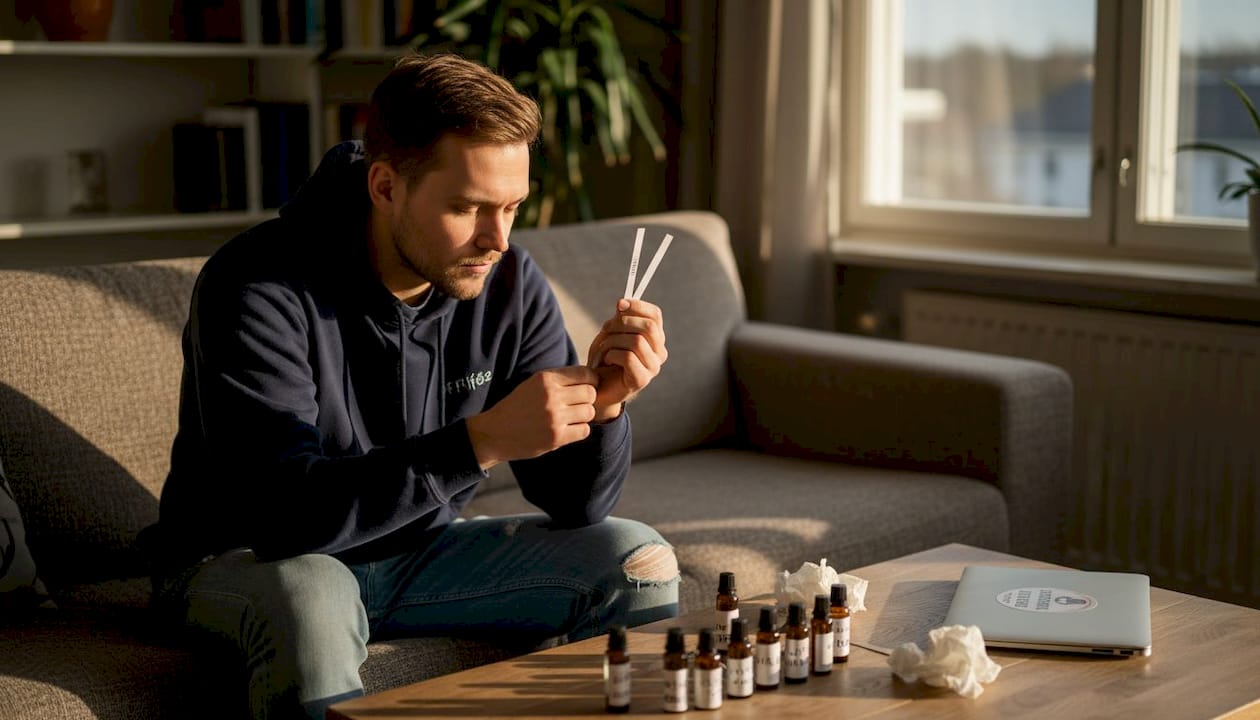
| Feature | Paper Strip | Skin Test |
|---|---|---|
| Speed | Quick initial assessment | Requires time (several hours) |
| Accuracy | Gives an overall picture | Shows the actual result |
| Skin Chemistry | No effect | Significant effect |
| Suitable for | Comparison in store | Final selection at home |
| Development Stages | Sees top notes | Sees all stages |
For testing fragrances, paper strips are recommended for initial assessment and skin for the final test, where the fragrance's development through top, heart, and base notes is monitored over several hours. This two-stage approach is the most effective way to find the right fragrance.
A paper strip tells you the first impression and general character of the fragrance. It's a good tool when you want to quickly rule out fragrances that don't interest you at all. But it doesn't tell you how the fragrance will develop on your skin or how long it will last.
Skin testing is the crucial step. Test on pulse points like wrists or neck, let the fragrance develop for 15 to 20 minutes for heart notes, 1 to 2 hours for base notes, and check longevity after 6 hours. This process gives you a complete picture of the fragrance.
Some important considerations during skin testing:
- Spray the fragrance directly onto the skin, not clothing
- Test one fragrance per area to prevent them from mixing
- Note down your observations at each development stage
- Use a consistent testing process
Professional tip: Do not rub your wrists together during testing. It may feel natural, but it alters the fragrance by breaking down molecules and gives you a distorted impression of the fragrance's true character.
Basic guidelines for testing fragrances
At the user level, a good testing routine is paramount. Try these guidelines for your next fragrance round, and you'll notice how much clearer a picture you'll form of each fragrance.
Prepare in a neutral environment: clean skin without competing fragrances, limit to 3 or 4 fragrances per session, and cleanse your nose with coffee or chocolate between scents. This is the professional standard, which also works at home.
- Cleanse your skin thoroughly before testing. Avoid scented soaps, lotions, or deodorants that may interfere with the fragrance being tested.
- Limit the number of fragrances to be tested to three or four per session. More than four fragrances at a time will cause your sense of smell to become fatigued, and your assessment will no longer be reliable.
- Cleanse your sense of smell between fragrances by sniffing coffee or chocolate. These neutral aromas effectively reset your olfactory senses.
- Test each fragrance on its own area of the skin. For example, use your left and right wrists and inner elbow for different fragrances.
- Monitor the development stages systematically. Assess the top notes immediately after spraying, the heart notes after 15 minutes, and the base notes after 1 or 2 hours.
“Do not rub your wrists together during testing, as it breaks down molecules and significantly alters the fragrance.”
It's worth keeping the testing guidelines in mind, especially when testing new niche fragrances or more expensive options. The more systematic you are, the better you'll remember which fragrance felt best after a week.
Professional tip: Keep a fragrance diary. Note down the name of each fragrance you test, the date, and your observations at different development stages. This will help you compare fragrances later and make a better purchasing decision.
Panels and group testing: the power of community
Not all fragrances feel the same on an individual level. How does the comparison change when several people are involved in the assessment? Group testing brings a dimension that is not achievable when testing alone.
Panel tests work by having several people smell fragrances on paper strips and score them according to an agreed scale. The results are summed up, and the winner is determined by the averages. For example, in Ilta-Sanomat's panel tests, Korres Black Pepper has emerged as the winner with 4.7 out of five points, indicating how unanimous a group can be about certain fragrances.
Clear advantages of group testing:
- You get multiple perspectives on the same fragrance
- The group identifies nuances that one might not notice alone
- Objectivity increases when personal preference doesn't dominate
- The social experience makes testing more fun
- You discover new favorites through others' recommendations
“Group testing reveals the universal appeal of fragrances: if multiple people like the same fragrance, it's a sign of a quality and versatile scent.”
You can easily organize your own panel at home. Invite a few friends, order a few discovery sets keeping fragrance testing criteria in mind, and let everyone evaluate the fragrances anonymously before revealing the names. The result often surprises.
| Testing Method | Participants | Objectivity | Time |
|---|---|---|---|
| Individual testing | 1 | Low | Short |
| Pair testing | 2 | Moderate | Moderate |
| Panel testing | 3 or more | High | Longer |
Best situations and recommendations: how to choose the right testing method for you
Different situations and goals require different testing methods. Here's how to easily find the right approach for yourself, depending on where you are and what you're looking for.
Testing in peace at home is the best option when you want to make a well-considered purchasing decision. Order a discovery set online, reserve a calm moment for yourself, and systematically test the fragrances. Situation-specific testing methods vary depending on whether it's a quick store visit or a long home test.
When shopping, a paper strip is the best tool. It's quick, clean, and gives you enough information to decide if you want to order a sample for home testing. Don't make a final purchasing decision based solely on a paper strip test.
Key situation-specific recommendations:
- In store: Paper strip for initial assessment, maximum 4 fragrances at a time
- At home: Skin testing with a discovery set, monitor development for several hours
- In a group: Panel testing with paper strips, scoring system
- Traveling: Travel bottles and samples that fit in hand luggage
Hunger, fatigue, or stress weaken the sense of smell, so always test when you are most alert. The morning is often the best time, before the day's stresses begin to affect your senses.
Skin moisturization is one of the most underestimated tips. Layering extends longevity: apply an unscented cream or oil to your skin before spraying the fragrance. This significantly extends the fragrance's longevity and gives you a more realistic idea of how long the fragrance truly lasts in daily use.
Professional tip: Test fragrances in different seasons. The same fragrance can smell completely different in the summer heat and winter frost, because temperature directly affects how the fragrance evaporates from the skin.
Test at home easily: order samples and find your favorite
Once you know the best testing methods, the next step is to try new fragrances in your own peace. Online shopping makes this easier than ever.
Order fragrance samples to your home from the BeFrsh online store and enjoy testing in your own environment without rush or store noise. BeFrsh offers a wide selection of samples and discovery sets for women, men, and unisex fragrances, including popular niche brands not found in regular department stores. You can compare several trendy fragrances at once without financial risk, and fast delivery means you can start testing new favorites within a few days of ordering. Find your next favorite fragrance comfortably from your couch.
Frequently Asked Questions about fragrance testing
How many fragrances can you test at once without your sense of smell becoming fatigued?
Limit to 3 or 4 fragrances per session and cleanse your nose with coffee or chocolate between scents. This keeps your sense of smell sharp throughout the testing process.
Why does a fragrance smell different on my skin than on a paper strip?
Skin chemistry individually alters the fragrance, so the final choice should always be made based on a skin test, not just a paper strip.
Can you rub your wrists together when testing a fragrance?
It is not recommended, as rubbing alters the fragrance by breaking down molecules and gives an unrealistic impression of the fragrance's true character.
Where can I find mini and discovery sets for trying out?
Many online stores, such as BeFrsh, offer extensive sample sets delivered to your home, and mini-sets allow for home testing without significant financial risk.
Leave a comment