

How to Evaluate Perfumes and Find Your Favorite

Choosing a new perfume can feel challenging when you want to find a scent that perfectly suits you without rushing. A quality evaluation begins by allowing the fragrance to develop peacefully on neutral, clean skin in a calm environment. This way, you can enjoy the true nuances of the scent and recognize its uniqueness at all stages without distractions. This guide will teach you how to professionally evaluate a perfume sample and get the most authentic scent experience possible.
Table of Contents
- Step 1: Prepare the Evaluation Environment and Cleanse Your Skin
- Step 2: Apply the Perfume Sample Correctly and Carefully
- Step 3: Observe the Different Stages and Notes of the Scent
- Step 4: Evaluate the Scent's Longevity and Development on Your Skin
- Step 5: Check the Scent's Suitability for Your Style
Quick Summary
| Key Point | Explanation |
|---|---|
| 1. Choose a calm evaluation environment | Ensure you evaluate the scent in a place free of distractions and other odors. |
| 2. Cleanse your skin thoroughly | Use a neutral soap to ensure there are no previous scents on your skin. |
| 3. Apply the perfume sample correctly | Spray the perfume on pulse points from a distance of about 10-15 cm without rubbing. |
| 4. Observe the different stages of the scent | Identify the top notes, heart notes, and base notes, and follow their development. |
| 5. Evaluate the scent's suitability | Consider how your chosen scent complements your style and personality. |
Step 1: Prepare the Evaluation Environment and Cleanse Your Skin
Evaluating a perfume requires careful preparation. In this step, you create a neutral base for scent observation by cleansing your skin and choosing a suitable evaluation environment.
Start by choosing a calm evaluation environment free of distracting odors. A good place might be:
- A quiet room with good air circulation
- A space away from food or strong household scents
- A neutral area without any previous fragrances
Cleansing your skin is a critical step in evaluating a scent. Wash your skin with a neutral soap or cleansing water to ensure there are no previous scents or odors on your skin. Focus especially on:
- Wrists
- Beneath the neck
- Inner elbows
Clean skin allows you to evaluate the true scent notes of the perfume without distracting background factors.
Avoid other fragrances before starting the evaluation. Do not use deodorants, hand creams, or other scented products that might affect the identification of the perfume.
The table below compares the impact of the evaluation environment on perfume assessment:
| Environment | Positive impact | Negative impact |
|---|---|---|
| Quiet room | Authentic scent experience | No distractions |
| Kitchen or dining area | Disturbs scent accuracy | Mixing of other odors |
| Outdoor space | Improves air circulation | Fluctuating temperature |
Pro tip: Use a neutral, unscented soap to wash your skin and allow it to dry completely before applying the fragrance.
Step 2: Apply the Perfume Sample Correctly and Carefully
Applying a perfume sample correctly is important so that you can experience the full multidimensionality of the scent. In this step, we focus on optimally applying the fragrance to your skin.
Proper perfume application requires precise technique. Focus on these pulse points:
- Wrists
- Sides of the neck
- Inner elbows
- Collarbone area
Do not rub the perfume into your skin. This practice is incorrect because:
- The perfume mixes with the skin's natural oils
- Scent molecules break down
- The original scent composition changes
The correct application technique preserves the perfume's original aroma and gives you a complete scent experience.
Use a moderate amount of perfume. Excessive use can lead to olfactory fatigue, where you can no longer distinguish the finer nuances of the scent.
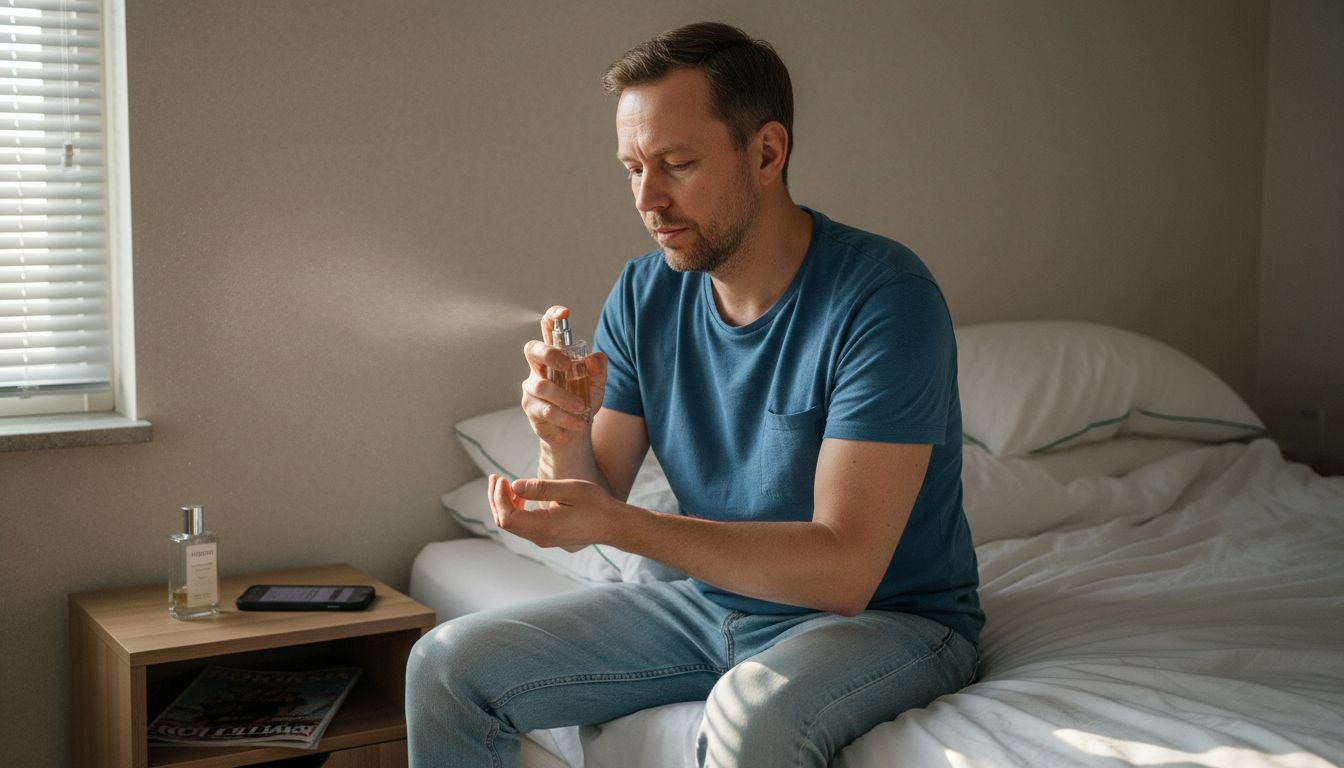
Pro tip: Spray the perfume from a distance of about 10-15 cm onto the skin and let it dry naturally without rubbing.
Step 3: Observe the Different Stages and Notes of the Scent
Evaluating a scent is like listening to a piece of music – each stage has its own significance. In this step, you will learn to identify the multifaceted notes of a perfume and understand their development.
A perfume's olfactive pyramid consists of three main layers:
- Top notes (initial impression)
- Heart notes (the core of the fragrance)
- Base notes (long-lasting character)
Each layer develops differently on the skin:
The following table summarizes the layers of a perfume's scent pyramid and their characteristics:
| Layer | Duration on skin | Typical scents | Effect begins |
|---|---|---|---|
| Top notes | 0-15 minutes | Fresh, citrus | After spraying |
| Heart notes | 15-120 minutes | Floral, fruity | After top notes |
| Base notes | 2-24 hours | Woody, musky, vanilla | As the scent evaporates |
-
Top notes (0-15 minutes)
- Fresh and light
- Volatile impression
-
Heart notes (15-120 minutes)
- Floral or fruity
- The actual character of the scent
-
Base notes (2-24 hours)
- Deep and warm
- Woody or musky undertone
A complete evaluation of a scent requires patience and careful observation at all stages of its development.
Follow the development of the scent calmly. Do not make quick observations but allow the scent to transform on your skin.
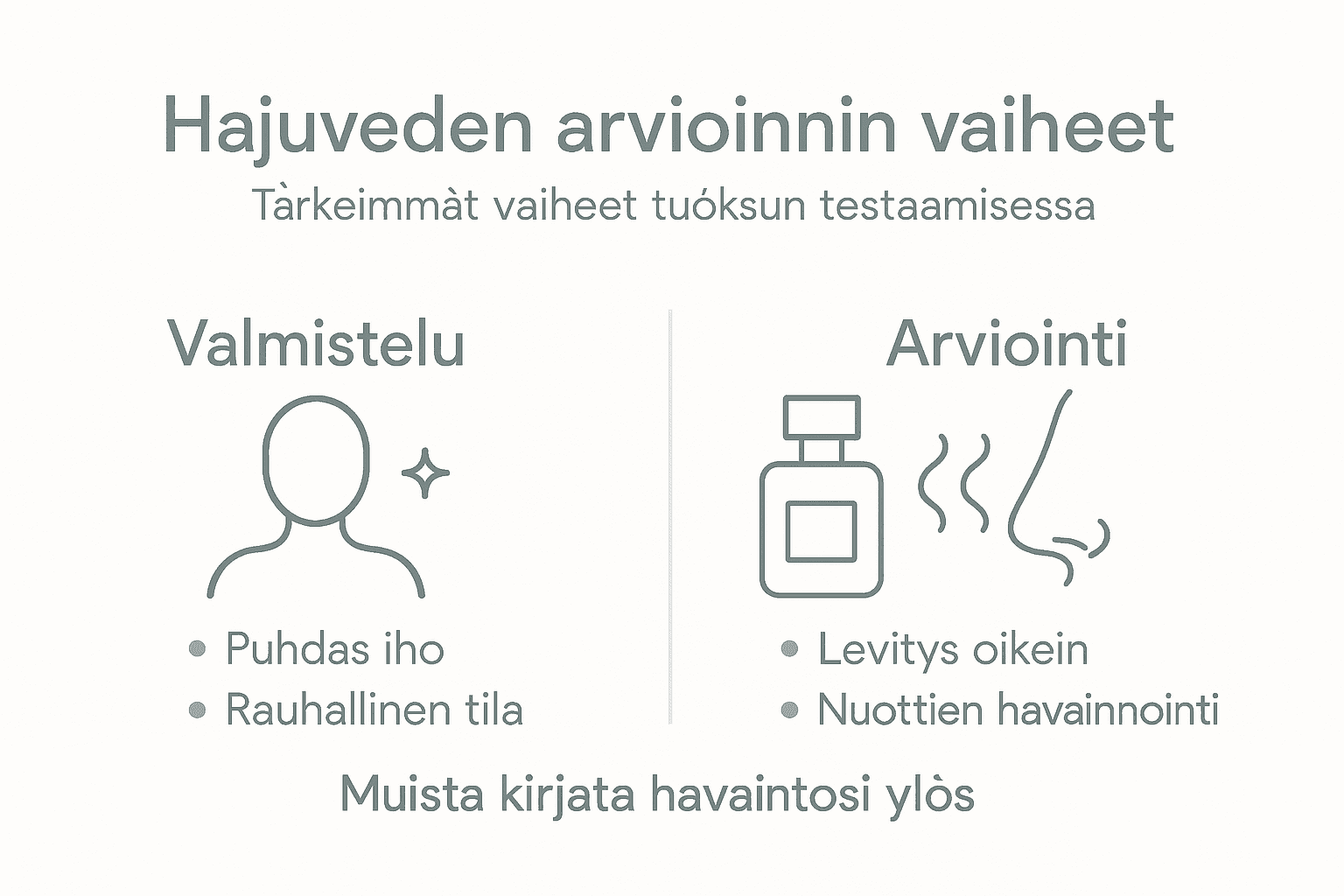
Pro tip: Jot down the changes in the scent at different intervals so you can compare and remember the details of the fragrance later.
Step 4: Evaluate the Scent's Longevity and Development on Your Skin
Every scent is like its own story, developing uniquely on your skin. In this step, you will learn to measure the true longevity of a perfume and understand how it transforms over time.
The individual development of a perfume depends on several factors:
- Your skin chemistry
- Temperature
- Humidity
- Activity level
Evaluate the scent's longevity systematically:
-
First hour
- Record the initial impression
- Observe the intensity of the scent
-
Four hours later
- Check for changes in the scent
- Evaluate the development of the base notes
-
Eight hours later
- Measure the remaining intensity of the scent
- Compare to the original intensity
The true nature of a scent is revealed only with long-term wear.
Do not make hasty conclusions about the longevity of the scent. Allow the perfume to develop peacefully.
Pro tip: Wear the same scent at different times of the day and in various weather conditions to get a comprehensive understanding of its behavior.
Step 5: Check the Scent's Suitability for Your Style
Choosing a scent is like finding your own personal soundtrack. In this step, you assess how your chosen perfume resonates with your personality and lifestyle.
You can evaluate a scent's compatibility on several levels:
- Expressing your personality
- Daily use context
- The emotional state the scent evokes
- Social situations
Pay attention to these aspects:
-
Professional level
- Is it suitable for the work environment
- Is the scent too strong or discreet
-
Personal style
- Do the scent notes match your dressing style
- Does the scent reflect your values
-
Interaction situations
- How does the scent perform near others
- Does it evoke positive or negative reactions
A scent is more than just an odor - it's part of your story.
Do not choose a scent solely based on appearance or reputation. Listen to your own intuition.
Pro tip: Wear the perfume in different situations and ask trusted friends for honest feedback on its suitability.
Find Your Perfect Scent Easily and Safely
In the article "How to evaluate perfumes and find your favorite scent," it was emphasized how important it is to prepare your skin and environment carefully and to patiently follow the different notes of a fragrance. Often, the challenge is identifying the perfect scent for you without unnecessary waste or disappointment. This is where sampling a wide range of perfumes comes in, enabling expert evaluation and helping you find an aroma that perfectly suits your style and life stage.
Befrsh.com offers a comprehensive selection of high-quality perfume samples for women, men, and lovers of unisex fragrances. The service is designed to facilitate this evaluation process, for example, by offering small or travel-sized bottles that allow you to apply and observe the different developmental stages of scents on your skin at your leisure and without haste. This enables the precision described in the article, where you can follow from top notes to base notes and evaluate the longevity of the scent in a genuine environment.
Ordering perfume samples helps you avoid the risks of buying large bottles and enables you to build a personal fragrance collection that perfectly matches your lifestyle and personality. Take advantage of this opportunity and start your scent journey today at Befrsh.com.
Frequently Asked Questions
How do I prepare my skin for perfume evaluation?
Cleansing your skin is an important step before evaluating a perfume. Wash your skin with a neutral soap or cleansing water, especially on your wrists, beneath your neck, and inner elbows.
What is the best way to apply a perfume sample?
Apply the perfume sample to pulse points, such as wrists and sides of the neck, from a distance of about 10-15 cm from the skin. Let the perfume dry naturally without rubbing to preserve its original aroma.
How can I identify the different notes of a perfume?
When evaluating a perfume, focus on its three main layers: top notes, heart notes, and base notes. Record the changes in the scent at different intervals to observe how the notes develop on your skin.
How do I evaluate a perfume's longevity?
Evaluate the scent's longevity at the first hour, four hours, and eight hours. Measure the intensity of the scent and the development of the base notes to get a comprehensive understanding of its staying power.
What role does scent play in expressing one's personal style?
A scent can reflect your personality and be suitable for various social situations. Evaluate how your chosen scent resonates with your dressing style and life, and ask friends for feedback on its suitability.
Why is it important to avoid other fragrances before evaluating a perfume?
Other fragrances can interfere with perfume evaluation and mask the true notes of the perfume. Keep your skin clean and avoid perfumes, deodorants, or other scented products during evaluation.
Recommendation
Transparency: this article was written with AI assistance and reviewed before publishing. Illustrations may be AI-generated.
Leave a comment