
Perfume terminology decoded: Notes, accords & families

TL;DR:
- Understanding fragrance notes and layering helps you choose scents that suit your preferences.
- Fragrance families and accords categorize scents, making it easier to find your signature style.
- Sampling and personal exploration ensure you select perfumes that truly resonate with you.
Picking a new perfume should feel exciting, but the moment you read phrases like “fougère accord,” “dry-down base notes,” or “chypre family,” the excitement can turn into pure confusion. Most shoppers end up guessing, relying on bottle design or a celebrity name instead of actual scent knowledge. That’s a costly gamble when a full bottle runs $100 or more. Learning the language of fragrance changes everything. Once you understand how notes layer, how families are classified, and what accords actually mean, you stop guessing and start choosing scents you genuinely love.
Table of Contents
- Fragrance pyramid: Understanding notes and layers
- Fragrance families: Classification and popular subfamilies
- Accords: The art of blending signature scents
- Common perfume terms and practical tips for buyers
- The real secret to choosing a scent: Go beyond the label
- Explore more and discover your signature scent
- Frequently asked questions
Key Takeaways
| Point | Details |
|---|---|
| Layers shape scent experience | Perfume unfolds in top, heart, and base notes, changing over hours for a dynamic fragrance journey. |
| Families guide your choices | Fragrance families like Fresh, Floral, Woody, and Amber help match perfumes to your taste. |
| Accords create signature blends | Accords blend notes to produce unique scents and are key to perfume artistry. |
| Know the jargon for smart buying | Understanding common terms empowers you to select perfumes that fit your preferences and avoid common mistakes. |
Fragrance pyramid: Understanding notes and layers
Every perfume you’ve ever worn tells a story in three acts. That story is built on the fragrance pyramid explained, a structure that organizes scent into top, heart, and base notes, each unfolding at a different pace on your skin.
Top notes are what you smell the moment you spray. They’re bright, sharp, and intentionally attention-grabbing. Citrus, bergamot, light herbs, and green tea are classic examples. The catch? They last only 5 to 30 minutes before fading. This is why sniffing a tester cap in a store gives you a completely misleading impression of a perfume.
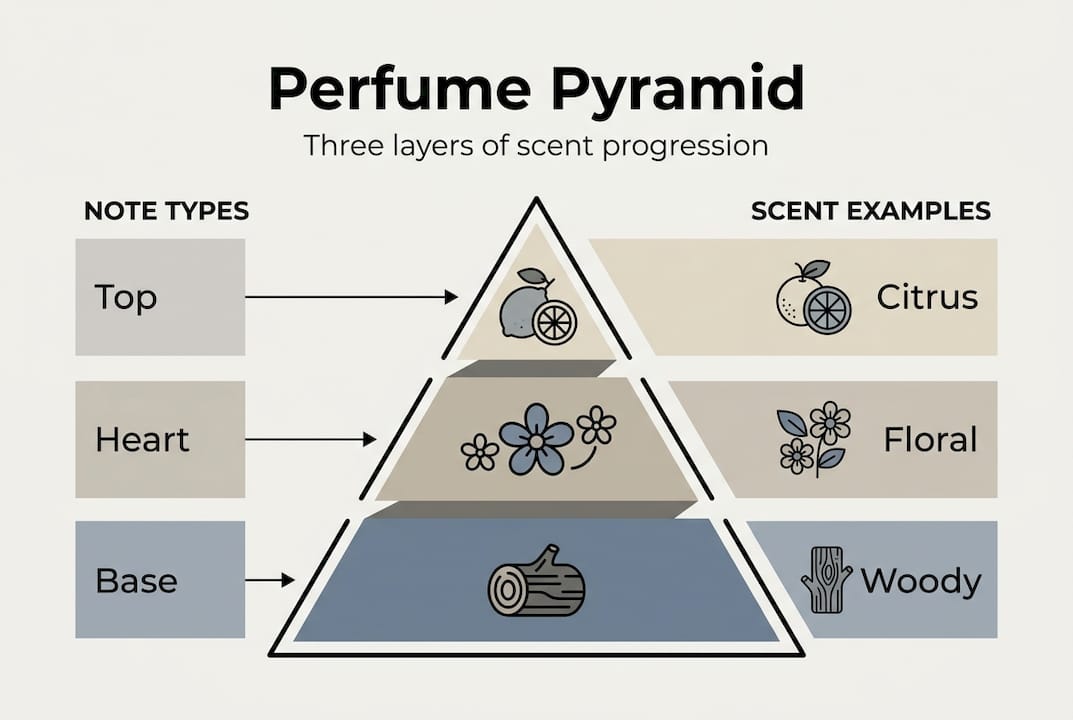
Heart notes (also called middle notes) emerge once the top notes fade. These form the true character of the fragrance, the part that defines it as floral, spicy, or aromatic. Jasmine, rose, cinnamon, and geranium are common heart notes. They typically last 1 to 4 hours and represent the emotional core of a scent.
Base notes are the foundation. Rich, heavy materials like sandalwood, vetiver, musk, and amber anchor the entire composition and can linger on skin and fabric for 4 hours or longer. Base notes also influence how heart notes smell, which is why the same perfume can smell different on two people.
Understanding perfume layer basics helps you evaluate a fragrance properly instead of making snap decisions. Here’s a quick breakdown of what to expect from each layer:
- Top notes: First impression, volatile, fade quickly (citrus, aldehydes, light herbs)
- Heart notes: Core identity, balanced and expressive (florals, spices, fruity notes)
- Base notes: Lasting signature, deep and warm (woods, musks, resins, vanilla)
Pro Tip: When testing a new fragrance, spray it on your wrist and wait at least 20 minutes before deciding. What you smell at the 30-minute mark, when the heart notes emerge, is far more representative of what you’ll actually wear all day.
When exploring perfume notes before committing to a full bottle, sampling is your best tool. It lets the entire pyramid unfold naturally on your skin so you experience all three acts.
Fragrance families: Classification and popular subfamilies
With a grasp of perfume structures, we’ll move to an equally important layer: fragrance families and how they’re classified.
Fragrance families are the broadest way to categorize a scent. Think of them as genres in music. Just as you might gravitate toward jazz over heavy metal, you likely have a preference for fresh scents over heavy orientals, even if you’ve never had the words to describe it.
The most widely used system comes from perfume expert Michael Edwards, whose fragrance family classifications organize perfumes into four main groups with 14 subfamilies. Here’s a comparison of the main families:
| Family | Typical notes | Mood/feel |
|---|---|---|
| Fresh | Citrus, green, aquatic | Clean, energetic, light |
| Floral | Rose, jasmine, peony | Romantic, soft, feminine |
| Woody | Sandalwood, cedar, vetiver | Earthy, warm, grounded |
| Amber/Oriental | Vanilla, spices, resins | Sensual, rich, bold |
Beyond these four pillars, subfamilies get more specific. A few worth knowing:
- Fougère: Built on lavender, oakmoss, and coumarin. Classic masculine barbershop energy.
- Chypre: Bergamot, patchouli, and oakmoss create a sophisticated, mossy depth.
- Gourmand: Edible, dessert-like notes such as caramel, chocolate, and tonka bean.
- Aquatic/Marine: Fresh, ozonic notes that evoke ocean air and clean water.
Knowing which family appeals to you is a shortcut to narrowing down hundreds of options. If you’ve always loved the smell of a forest after rain, you’re likely drawn to woody or chypre subfamilies. If you reach for vanilla body lotion every day, gourmand or amber fragrances will feel immediately familiar.
Understanding fragrance composition also helps you read marketing descriptions critically. When a brand says a perfume is “a vibrant floral with earthy depth,” you now know that means floral heart notes sitting on a woody base, which is a very specific and predictable experience.
Accords: The art of blending signature scents
Beyond notes and families lie the accents that give perfumes their personality. These are known as accords.

An accord is not a single ingredient. It’s a deliberate blend of multiple notes that, when combined, create a completely new and unified scent impression. Think of it like a chord in music: three separate notes played together produce something that sounds entirely different from any note alone.
Accords are blended combinations that create distinct, signature scents used throughout the fragrance pyramid to build harmony and complexity. A classic example is the Fougère accord, built from lavender, coumarin, and oakmoss. None of those three smells like a fern forest on their own, but together they evoke exactly that.
Here are some of the most recognized accords and their typical ingredients:
- Fougère accord: Lavender, coumarin, oakmoss. Earthy, aromatic, and classically masculine.
- Gourmand accord: Vanilla, caramel, tonka bean. Sweet, edible, comforting.
- Chypre accord: Bergamot, labdanum, oakmoss. Sophisticated, mossy, timeless.
- Leather accord: Birch tar, castoreum, suede. Bold, smoky, and distinctive.
- Aquatic accord: Calone, sea salt, ozonic notes. Fresh, airy, and modern.
Accords give perfumers a kind of shorthand. Instead of layering 15 individual notes, a perfumer can use an established accord as a building block and then modify it with other elements. This is why two perfumes can both claim “woody” notes but smell completely different from each other.
Pro Tip: When you read a perfume description and see a term like “fougère” or “chypre,” that’s referring to the dominant accord, not a single ingredient. Recognizing accords helps you predict how a fragrance will feel before you ever smell it.
For a deeper look at how specific perfume note combinations work together, exploring individual note profiles is a great next step.
Common perfume terms and practical tips for buyers
Once you can decipher the complex lingo and blending practices, you’ll face a flurry of everyday terms and practical buying challenges.
Understanding key perfume terms directly impacts your experience with longevity, intensity, and personal preference. Here are the most important ones to know:
- EDP (Eau de Parfum): Contains 15 to 20% fragrance concentration. Stronger, longer-lasting, and typically more expensive.
- EDT (Eau de Toilette): Contains 5 to 15% concentration. Lighter and better suited for daytime or warmer weather.
- EDC (Eau de Cologne): Around 2 to 4% concentration. Very light and often used as a refreshing splash.
- Sillage: Pronounced “see-yazh,” this French term describes how far a fragrance projects from your body. High sillage means people notice your scent from across the room.
- Longevity: How long a fragrance lasts on your skin. Affected by concentration, skin type, and base note composition.
- Dry-down: The final stage of a fragrance after all the top and heart notes have evaporated. What remains is the true base character.
- Batch code: A production code stamped on the bottle or box that lets you verify the manufacturing date and authenticity of your perfume.
Practical perfume buying tips make a real difference. Never buy a fragrance based solely on the dry blotter strip at a counter. Skin chemistry changes how a scent smells, and a fragrance that seems sharp on paper can become warm and inviting on your wrist.
Pro Tip: Check the batch code of any perfume you buy online using a free verification tool. Older stock can mean degraded top notes and a noticeably different smell from what’s described.
Also pay attention to concentration when comparing prices. An EDP at $90 often outlasts an EDT at $70, making the pricier option the better value over time.
The real secret to choosing a scent: Go beyond the label
Here’s the uncomfortable truth about perfume terminology: knowing all of it still won’t guarantee you’ll love a fragrance. Labels and descriptions are useful maps, but they are not the territory.
We’ve seen countless fragrance enthusiasts memorize note pyramids and family classifications, then still end up disappointed by a blind buy. Why? Because scent is deeply personal and rooted in memory, emotion, and body chemistry. A gourmand accord that smells heavenly on one person can feel cloying and overwhelming on another.
Terminology is a compass, not a destination. Use it to narrow your options, not to make final decisions. The real work happens when you explore scents personally by actually wearing samples over multiple hours in real-life conditions.
The most confident fragrance buyers we know combine knowledge with curiosity. They use families and accords to shortlist candidates, then let their nose and gut make the final call. That balance of research and intuition is what separates a satisfying fragrance wardrobe from a shelf full of expensive mistakes.
Explore more and discover your signature scent
Now that you’ve got the vocabulary to navigate the fragrance world, the next step is putting it into practice with real scents on real skin.

At Befrsh.com, you can explore a wide range of fragrance samples across every family and accord type we’ve covered here. Instead of committing to a full bottle based on a description, you get to wear the scent, experience the full pyramid, and decide with confidence. From fresh citrus to deep amber, from fougère classics to modern gourmands, sampling first is the smartest way to build a fragrance collection you’ll actually love. Browse the full selection and let your nose lead the way.
Frequently asked questions
What do ‘top, heart, and base notes’ in perfume mean?
These are layers of scent that unfold over time, starting with the initial burst (top), followed by the core aroma (heart), and finishing with the lingering foundation (base). Each layer has a different lifespan, with top notes lasting 5 to 30 minutes and base notes persisting for 4 hours or more.
How do fragrance families help in perfume selection?
Fragrance families categorize perfumes by core scent types, helping you quickly identify aromas you’ll likely enjoy. The four main families are Fresh, Floral, Woody, and Amber/Oriental, each with distinct subfamilies that get even more specific.
What is an ‘accord’ in perfume?
An accord is a blend of several notes forming a unique, signature scent, much like a chord in music. Accords create distinct scents that are greater than the sum of their individual ingredients, giving perfumes their recognizable personality.
What does ‘sillage’ mean when talking about perfumes?
Sillage describes how strongly a fragrance projects from your skin and how far it travels in the air around you. High sillage means others notice your scent easily, while low sillage is more intimate and close to the skin. Perfume terminology like this directly impacts how you experience and choose a scent.
How can I use perfume terminology to make better purchases?
Understanding notes, families, and concentration terms helps you match perfumes to your preferences and avoid disappointing blind buys. Terminology shapes longevity, intensity, and personal fit, so pairing that knowledge with hands-on sampling gives you the most reliable path to a scent you’ll love.